
Refuse names both what is cast out and the act of resistance. Waste, garbage, remainder, what is left behind and meant to disappear. But also: to resist, to withhold consent, to say no with the full weight of one’s body. That the two meanings share a spelling is not an accident. Language remembers what power would prefer to split apart.
Nothing becomes waste on its own. Something is named waste — marked for removal, declared excessive, dangerous, unclean, finished. Garbage is not an objective quality so much as a social verdict. What is true of matter is also true of people. Every society sorts: the pure from the impure, the valuable from the disposable. These distinctions may arrive dressed as common sense, but they are never innocent. Someone draws the boundary. Someone profits from it. Someone else is made to carry what must not be seen.
Under caste, impurity is not metaphor but method — the management of filth inseparable from the management of human beings. Hierarchy is never satisfied with exclusion alone. It wants the excluded to participate in the staging of their own exclusion. The Empire arrived and found the language immediately useful. An 1899 advertisement for Pears Soap declared that “the first step towards lightening the White Man’s Burden is through teaching the virtues of cleanliness.” One map of contamination settled over another. Those at the bottom of one order were pressed down by two.
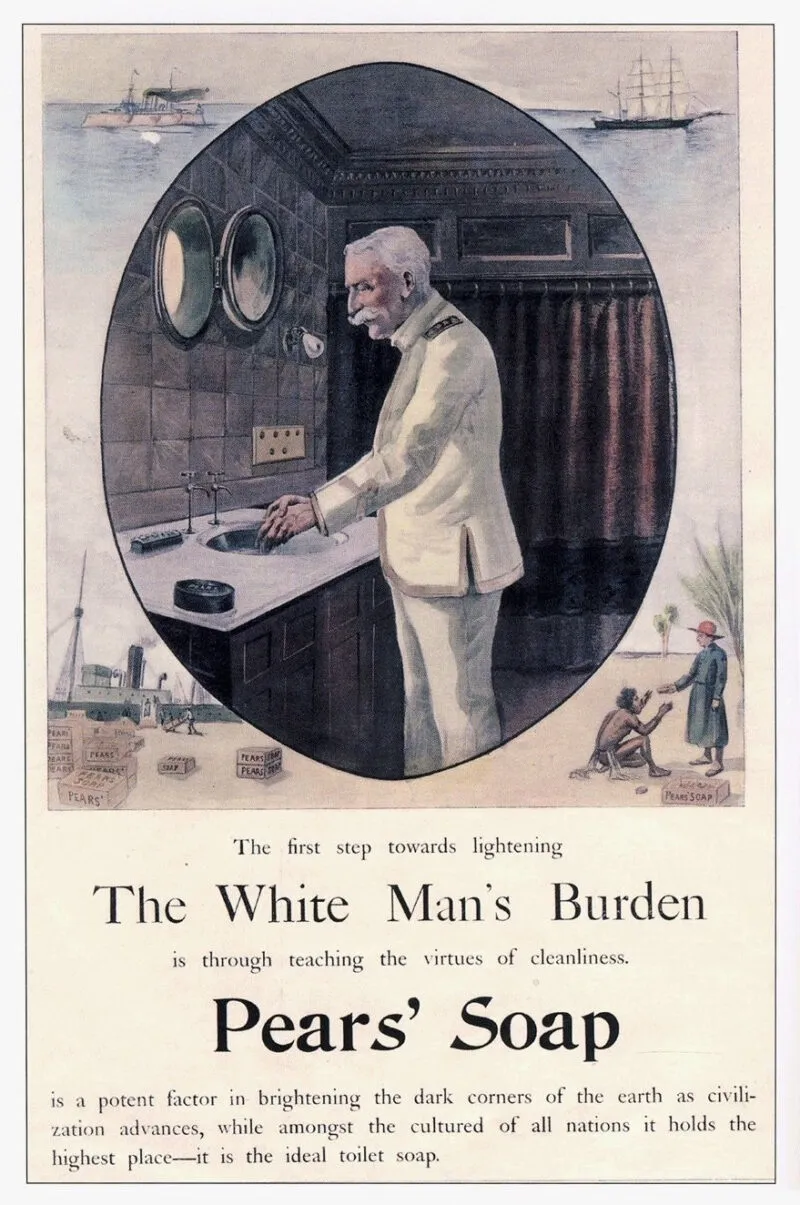
1899 Pears Soap advertisement — “the first step towards lightening the White Man’s Burden is through teaching the virtues of cleanliness.”
The woman’s body has long borne these overlapping regimes — impure by menstruation, sexuality, widowhood in one order; purified into symbol, honour, nation in another. Too polluted to enter, or too sacred to belong to herself. Capitalism does not interrupt this logic. It perfects it — the worker valued only while the body can be mined, the refugee redesignated as excess life. Wasted life. The verdict travels faster than thought.
What is done to the body is done to the earth. The Dalit basti is downstream. The indigenous forest is the sacrifice zone. Ecological and caste catastrophe proceed through the same logic of expendability, at different scales and speeds. Refuse does not vanish. It accumulates, ferments, returns — as heat, flood, the long afterlife of convenience.
Literature has always begun at this threshold: where the world declares something unworthy and a writer bends down and picks it up. Baby Kamble, Bama, Urmila Pawar, Om Prakash Valmiki, Meena Kandasamy took what intersecting orders had marked as expendable and made from it a literature of witness, fury, and consequence. The line between the discarded and the defiant is thinner than power wants us to believe. Literature is often also born from a compost heap of writings and ideas.
Usawa Literary Review invites poetry, fiction, nonfiction, interviews, book reviews, and translations — through caste and gender, ecology and the body, disgust and endurance. Work that asks what a society throws away to call itself clean, and what continues to speak from the heap, the grave, the wound.
Send us your writings. Refuse.
We encourage you to peruse our previous issues and subscribe to our monthly newsletter to gain insight into our editorial preferences.
Thank you for adhering to our submission guidelines. We eagerly anticipate reviewing your work.
Ready to submit to Issue 15?
Submit via Google FormFor any queries write to editor@usawa.in