
The Usawa Bookshelf: Matchbox, Feb 2025
These works confront systemic power and historical trauma, articulating decolonial and Global South perspectives that challenge established narratives and envision alternative realities.
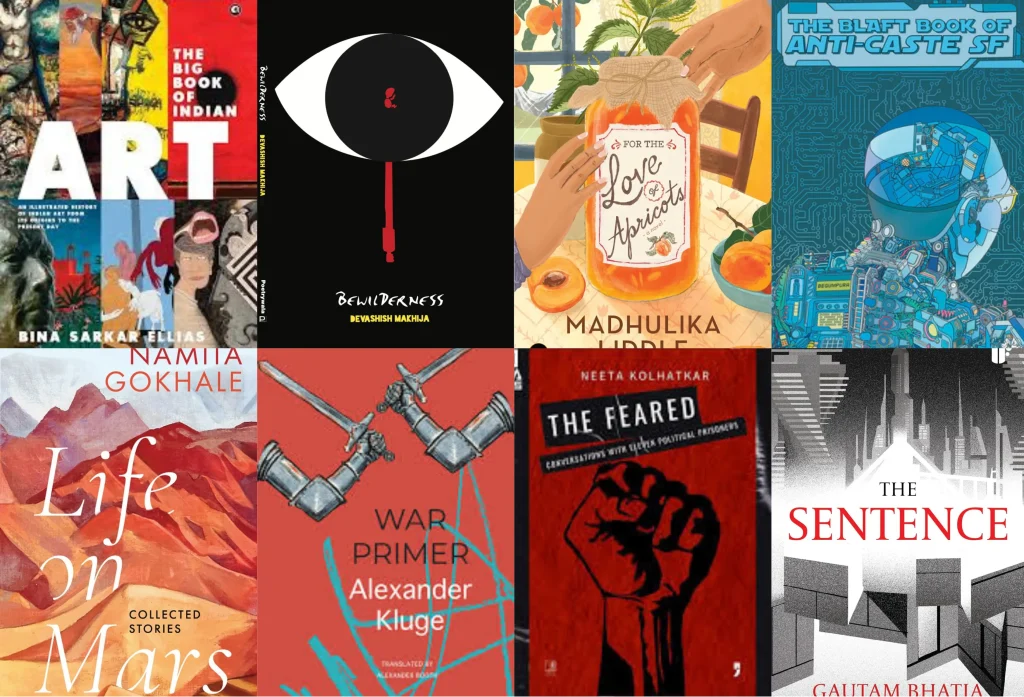
The Big Book of Indian Art: An Illustrated History of Indian Art from Its Origins to the Present Day
A comprehensive book yet published on modern Indian art. It traces the history of Indian art from its origins to the present day, and features the work of more than 300 Indian artists—painters, sculptors, illustrators, printmakers, multi-media artists, lithographers, and muralists.
Bewilderness
A collection of poems by poet, author, graphic artist, screenwriter and filmmaker, Devashish Makhija. Read some of the poems here.
For the Love of Apricots
Played out against the backdrop of the Kumaon Hills, across wooded mountains and apricot orchards, For the Love of Apricots is a quietly romantic, humorous story about a seemingly headstrong yet vulnerable heroine and a lonely man who realize, before it’s too late, that love deserves a second chance. Read an excerpt here.
The Blaft Book of Anti-Caste SF
An anthology of weird, fantastic, supernatural, Dalit futurist, & magical realist fiction by writers from South Asia and the diaspora.
Life on Mars
Namita Gokhale produces fiction that follows no easy rules, unafraid to look life in the eye and speak with equal honesty about its seductions and sorrows, its grace and absurdity. These fifteen stories are arranged in two sections—’Love and Other Derangements’ and ‘The Mirror of the Mahabharata’—about women and men who swim or sink in the ceaseless river of life.
War Primer
‘War is back again.’ So begins Alexander Kluge’s latest book, prompted by a war of aggression that, though being waged in Europe, is of global importance. Blending simple stories with multimedia and reflecting on human responses and hope, the author does not aim to take sides nor make an appeal. Rather, he is concerned with what he calls ‘mole war’, the tenacious and often subterranean survival of war—what war makes of people and what life of its own it is capable of.
The Feared
The Feared brings together interviews conducted by Kolhatkar with eleven political prisoners, and in some cases, their loved ones, in which she highlights the interviewees’ everyday lives within the walls of multiple prisons across India.
The Sentence
An impoverished young man, Jagat, is found guilty of murder. For his crime, he is sentenced to the highest form of punishment—the sleep of death for a century, with the promise of revival should his innocence ever be proven.But his act sparks violence in the great city of Peruma, with the Commune, an anarchist collective of workers, revolting against the Council, which has ruled Peruma for four hundred years.
