
From ULR
Issue 12 – Gender & its Discontents
Visual Narrative: Freedom as an Unwording – Capturing Unnameable Rebellions
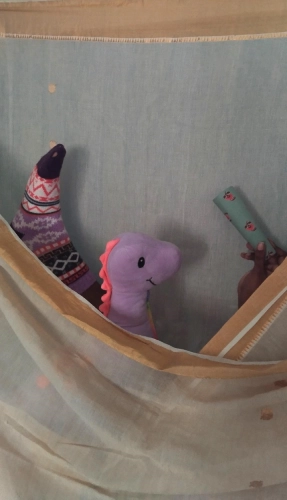
A gender bridge stretches between a playground and grave. Names, heartbreak, medicine—familiar burdens line its path. A sari whispers stories of tradition.
1 / 5
Swipe to navigate
Visual Narrative · Usawa Literary Review
Gender is the bridge between a playground and a funeral. Strewn along its length are many perplexing things in no particular order: assigned names, binders, illness, emotional labour, identification documents, drugs, AMAB, heartbreak, AFAB, HRT, marriage, innocence, dysphoria, loneliness. An obsolete yet all powerful concept, the gender bridge continues to stand, and all of us cross it for as long as we remain.
↗ Click any image to enlarge
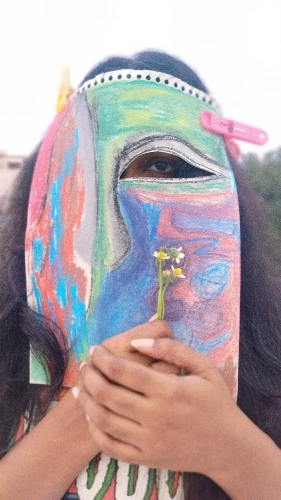
As a child, I remember my mother addressing me as ‘mone’ instead of ‘mole’, and feeling strangely liberated by it. Did she know or was that just casual instinct? What could be my mother’s gender?
The gap between how I am constructed within language — the discursive identity of me as someone perceived woman because of my body, because of how I present — and who I truly am is the distance I’m cursed to walk on the gender bridge. Like Sisyphus, I too scale my assigned distances, even in my sleep.
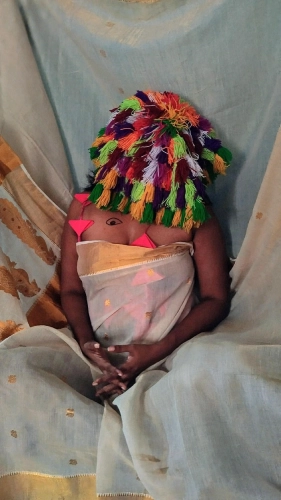
If gender is a bridge, then perception is a prison built from the collaboration of language and patriarchy. In it, I am mandated to do my time wearing clothes that make my assigned gender. Look at the kasavu sari for example. It evolved from Mundum-Neriyethum (also called set-mundu), a two piece attire that traces back to the Buddhist era in Kerala (from 3rd century BC) and is one of the oldest such documented references of any Indian weaving traditions. Yet, in Kerala, where I hail from, it has come to represent a cisheteronormative, upper caste-class feminine aesthetic.
I am woman when its pleats are tucked into my waist. So I think of everything else I can become while still wearing it — perhaps a mantis shrimp, a girlie octopus, or even a nonbinary god self?
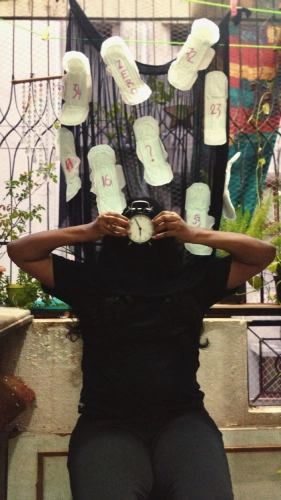
The Gender Bridge also carries clocks of all kinds: Gregorian, biological, patriarchal, societal, neuronormative. The dysphoria that my body carries is a protest to the dictatorship of its time. I seek to live as nature does: nonlinear; collaborative; embodied; unambitious; responsive; and for most parts, unlabeled.
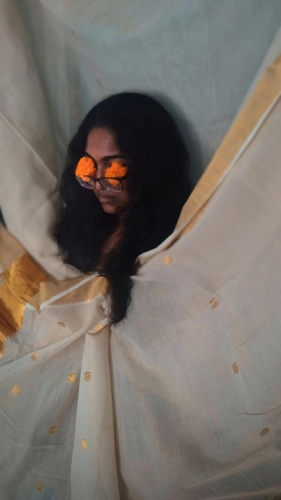
My gender is a disagreement. It doesn’t always carry pronouns. Nor does it want to disclose when required. My gender is a moving intersection. In many ways, it is something similar to what dear Koko, the speaking gorilla, said in one of her last video clips shared online:
“I am flowers, I am nature.”
— Koko, the speaking gorillaThis disagreement with gender centres me in my aliveness and defiance, and through these frames, I’m attempting to channel that aliveness and externalise my internal experience of being myself. I’m trying to look at how strangely beautiful, mysterious, and fascinating it would be for each of us to see ourselves as we experience ourselves internally; how deeply liberating, mysterious, confusing, and creative it would be to perceive each other as we really are, and not always through the barriers and rungs of language — native or imposed.
Let me conclude by acknowledging both the paradox and pain of having to use language to convey all of this. There’s heaviness in aligning with a language that is alien to me; a language that has been forced upon me; one that renders me anxious as to whether I’m presenting it right; a language that is not native to my confusions. For all these reasons and more, let me assert that my discontents remain an incomplete rebellion, a living refusal to render everything clear in the language that has a history of colonising my land and my subjectivity.

Meherin Roshanara
Meherin is an artist, writer, therapist, and comedian based in Hyderabad, India.Their work as a poet and photographer has been published in Antiserious, Bhashaposhini, City Journal, Muse India etc and has been part of various print anthologies.Please feel welcome to reach out to them at meherinroshanara@gmail.com