
Review: Dangerous Games
Political manipulation of history and memory's malleability perpetuates intractable conflicts, profoundly shaping…
Read more →Global organ commodification constitutes a colonial extension, where the Global North's longevity demands entail bio-surveillance, sanitizing Global South bodies and domesticity.
American anthropologist Nancy Scheper‐Hughes describes the global trade in human organs as a morbid transaction between the Global South and the Global North. Much like the labour of the Global South is exploited for income from the Global North, organs from the former are commodified in return for financial compensation from the latter. A market that exploits labour, human effort, and reproductive capability also creates conditions in which human organs are treated as surplus capital to be auctioned to the highest bidder. Significantly, these transactions disproportionately target the economically marginalised, who often belong to and make up the Global South.
The organ trade and the asymmetrical power balance it maintains lead to human rights violations in the Global South and to an artificial scarcity of organs for the Global North. While the former resorts to selling its organs in an unusual market to earn, the latter purchases organs with the intention of “extending life indefinitely with the organs” of the former (Scheper‐Hughes, 2000, p. 198). The attempt to seek immortality often comes at the cost of commercialising the organs of the’other’, placing them at medical vulnerability. Apart from that, a hierarchy of health forms wherein healthier donors are relatively more valued, creating a politics of contamination. These power relations defined by the organ trade are stark in Manjula Padmanabhan’s Harvest.
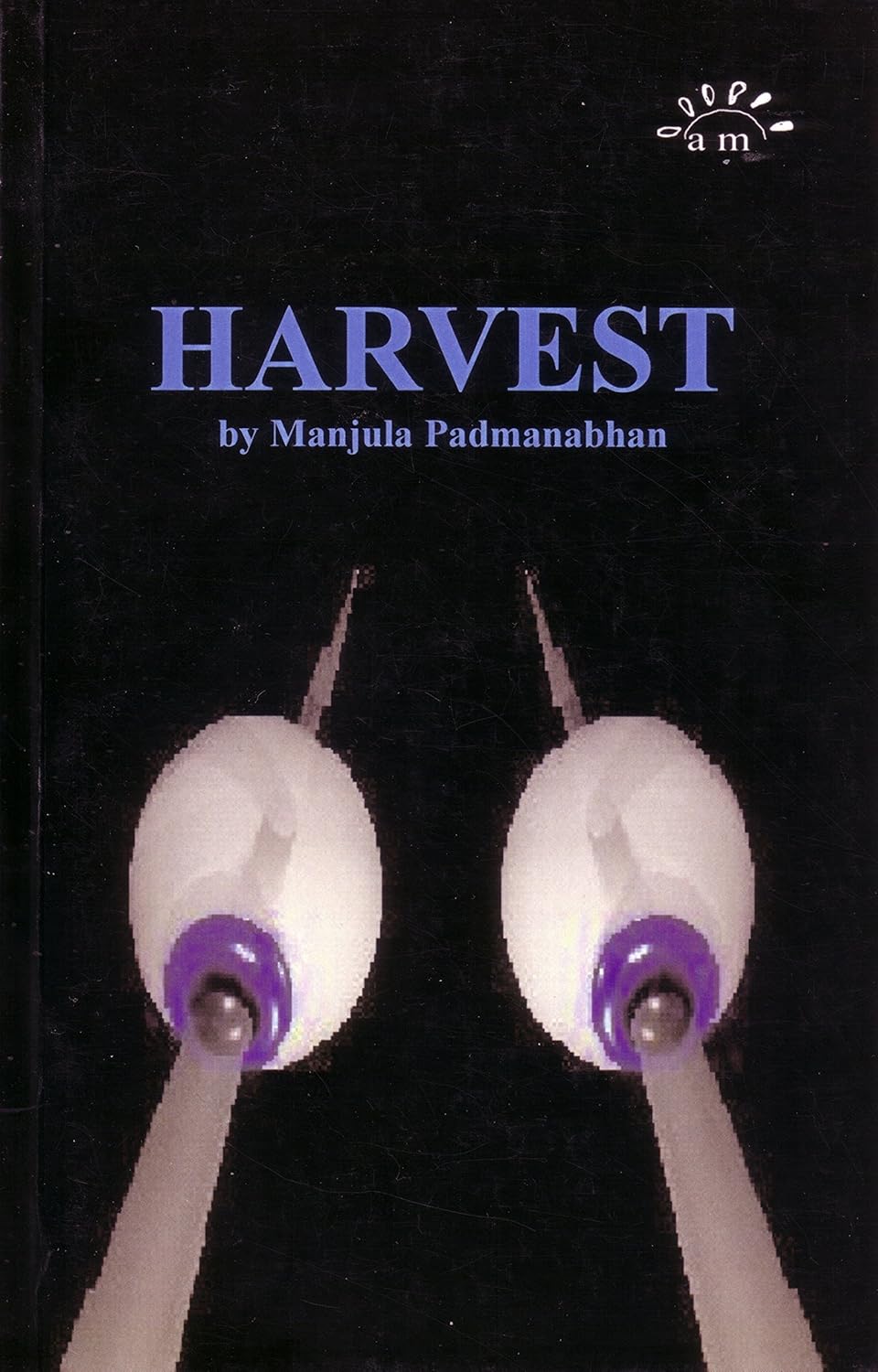
Harvest is a dystopian play written by Manjula Padmanabhan that revolves around Om, an unemployed man from a working-class background who registers to donate his organ to support his erratic family. The recipient is identified as Virginia, alias Ginni, a white American woman who sponsors the exorbitant expenses of Om’s family for his organ that she requires for unknown reasons. InterPlanta Services, a biomedical corporation, is an intermediary that facilitates communication between the donor and recipient and oversees all the technical aspects of organ transplantation. Gradually, Ginni and InterPlanta Services assume control of Om and his family, disciplining their habits and biological processes, seeking to discipline their organ recipient into a hygienic and obedient brown body.
While most works surrounding organ donation focus on the often-tragic after-effects of the transaction, Harvest focuses on the bio-surveillance and dehumanisation of the organ recipients right from the selection stage of recipients till the transplantation itself. Instead of merely focusing on how the brown body becomes a site of refuse or biomaterial that the Global North renders useless, Harvest showcases the utilitarian view of the white recipient. Ginni, in a patronising way, pesters the family to eat on time, smile often, and facilitates the construction of a toilet in Om’s cramped single-room house. Om is marked for biovalue refuse as soon as his organ donation process is successful.
Moreover, the Global North, despite requiring the organs and labour of the Global South, harbours deep paranoia about the latter’s surroundings and people. Om, to register himself as a donor, had to undergo a selection process wherein he was made to stand in a long queue, resembling a mechanical assembly line, with 6000 other men. The biological conditions of the men in this queue were monitored; they were made to strip themselves naked, their bodies were sanitised through scented water, and unknown chemicals were injected into their arms. More importantly, none of these men was adequately informed about the entire screening process. These processes to select a healthy organ donor for white Americans reek of paranoia, chillingly reminding one of the sanitisation of laboured bodies during the SARS-CoV pandemic.
After Om is selected as a donor, the guards of InterPlanta Services unceremoniously intrude into his modest “single-room accommodation in a tenement building” (Padmanabhan, 2017, p. 9) and deliver a spiel welcoming him to the program and instructing him on the starter kit he received earlier. Simultaneously, another guard dumps all the kitchen items into a carton box, cleans the kitchen top area, and replaces the previous kitchenware with a “cooking device and bottles full of multi-coloured pellets” (Padmanabhan, p. 19). The food that Om’s family used to consume is replaced with ‘fuel’ or pellets that InterPlanta Services and the white recipient force Om’s family to consume.
As such, paranoia about contamination disrupts the dietary norms of Om’s family, adding another factor in how the Global South is controlled through biosurveillance. Food, which elicits pleasure, holds cultural value, and brings communities together, is depreciated into a pellet that provides nutrition for biological maintenance. Furthermore, the frantic cleaning by the guards of InterPlanta is indicative of the hyper-capitalist aesthetic of neat minimalism, wherein all traces of the Global South’s essence and material culture are discarded.
The kitchen, a site of domestic autonomy and cultural expression through food, is transformed into a sterile, regulated space that seeks to erase any traces of the Global South’s material realities. This is diabolical in the way Om’s household ceases to function as a home for him and his family, instead becoming an extension of the sterile biomedical infrastructure of the Global North. Guided by paranoia of contamination of all essence of the Global South, the Global North colonises the everyday life, manipulating every single routine into biologically optimising its people for organ transplantation. Through this, the Global North colonialism extends far beyond spaces and material resources.
Besides this, when the white recipient peers at Om’s house through a surveillance system, they express visible disgust at its cramped conditions and the lack of a toilet within the house. This disgust, paired with Om’s eagerness to impress the white recipient, generated a sense of embarrassment within the family. As a result, they increasingly come to view themselves through the gaze of the Global North, internalising its concerns regarding contamination and hygiene.
In the midst of it all, Jaya, Om’s wife, stands as a dissenter against all of InterPlanta Services and Ginni. Jaya visibly scoffs at the Global North’s concerns about the purported ‘dangers’ of contamination from the Global South. When her reproductivity was demanded by the white recipient and InterPlanta Services, she threatenes suicide to ward off these advances, and challenged the white recipient to risk their skin and visit India. Unlike Om and the rest of the family, who eventually succumb to the sway of the Global North, Jaya actively resists, exposing the absurdity of the Global North’s exploitation of the bodies of the Global South while simultaneously portraying them as sites of pollution and disease.
Throughout the play, Padmanabhan illustrates how the Global North assigns and determines the significance of different aspects of the Global South, particularly through organ donation as a biovalue. Besides, the latter is pliable in material and cultural colonialisation by the former, as its bodies, domestic spaces, and everyday practices become subject to external regulation and control. Through InterPlanta Services’ intrusion into Om’s household, the play demonstrates that exploitation extends beyond organ extraction to encompass the restructuring and sanitisation of their spaces and routines to meet the demands of the white recipient in the Global North.
References
Datta, A. (2020). Cadavers, Transactions and Birth of Knowledge: Scanning Disposable Bodies in Padmanabhan’s Harvest and the Visible Human Project. PostScriptum: An Interdisciplinary Journal of Literary Studies. https://doi.org/10.5281/zenodo.3712884
Foucault, M. (2003). The Birth of the Clinic: An Archaeology of Medical Perception. Taylor & Francis. (Original work published 1973)
Gilbert, H. (2006). Manjula Padmanabhan’s Harvest: Global Technoscapes and the International Trade in Human Body Organs. Contemporary Theatre Review, 16(1), 123–130. https://doi.org/10.1080/10486800500451070
Padmanabhan, Manjula. Harvest: Revised and Expanded Edition. Hachette India, 2017.
Scheper‐Hughes, N. (2000). The Global Traffic in Human Organs. Current Anthropology, 41(2), 191–224. https://doi.org/10.1086/300123
~
Purchase the book here.

Mahalakshmi Gururaj is an aspiring academician of Media Studies and Humanities. Their academic interests lie in surveillance, fandom studies, soft power, and cybernetic spaces. Interdisciplinarity is how they believe solutions to any problem can be conceived, and thinking through such an approach is how they thrive. Moreover, they love to dip their toes in various pursuits and art forms, ranging from photography to playing the Cajon.