
✨ LATEST ISSUE •
From ULR
Issue 15 – REFUSE
When Grief Strikes: Finding my Mother; losing my Mother
The essay navigates orphanhood at fifty-one through the disorienting arithmetic of parental loss, where grief becomes less an emotion than a persistent bodily shock—a low-intensity current exposing the sudden absence of any buffer against mortality.
For the first time, on the road north of Tampico,
Explore the Usawa Bookshelf
Discover the books that shape our times
I felt the life sliding out of me,
a drum in the desert, harder and harder to hear.
I was seven, I lay in the car
watching palm trees swirl a sickening pattern past the glass.
My stomach was a melon split wide inside my skin.
“How do you know if you are going to die?”
I begged my mother.
We had been traveling for days.
With strange confidence she answered,
“When you can no longer make a fist.”
Years later I smile to think of that journey,
the borders we must cross separately,
stamped with our unanswerable woes.
I who did not die, who am still living,
still lying in the backseat behind all my questions,
clenching and opening one small hand.
—Naomi Shihab Nye, “Making a Fist” from Grape Leaves: A Century of Arab American Poetry, 1988.
I lost my mother on 14 September 2025. Four days after my 51st birthday. A freshly-minted orphan, is what I said to so many people in the first few months of the aftermath, and also wrote, in response to innumerable condolence messages. I suppose I did so in a rather feeble effort to introduce levity to a bone-crushingly sad moment. But, to tell you the truth, I never thought I would be an orphan at 51. That I would have neither parent alive at 51. The knowledge induces a mild sense of shock in my body on a daily basis, like a low-intensity electric current which spreads from my gut to behind my eyes. Why shock though? I have seen others in the same situation, friends, cousins. I just never thought it would be my story.
Is it old enough though, 51, to not have a single parent alive? To not have anyone standing between yourself and your own inevitable, impending mortality?
Is it old enough though, 51, to not have a single parent alive? To not have anyone standing between yourself and your own inevitable, impending mortality? No one to shield you anymore from inching ever closer to the hardest phase of adulting?
John Berger, that most erudite of thinkers, and most eclectic of writers, describes what grieving feels like in his book A Seventh Man. He imagines one’s present life and psyche as a circle, with another broken concentric circle inside it which represents one’s past, immutable, unchangeable, manifested in one’s memories. In the centre of the circle are the dispersed particles of one’s future, still out of reach, still to take shape. Berger writes that when grief strikes, and one finds oneself in the throes of unrecoverable melancholia, which becomes something of a malady, the inner circle of one’s past, i.e., the memories of the bereaved in remembering the deceased, becomes a stubborn barrier and stands in the way of one’s present engaging with one’s future. In other words, it forms a barrier to letting one move on. One becomes hopeless, and has nothing left to live for. I realise this is what happened to my mother after my father died. She lived for eight years after him, yes, tried her hardest, but her heart was not in it. She longed to be gone.
Is nothingness a place? When we say about the deceased person, she is in a better place now, knowing full well that she is now in that realm which can only be understood as nothingness, what do we mean? And yet, some might argue, she is now part of something larger. Even scientifically speaking. I was reading recently that the atoms of the human body are more than 4.5 billion years old, older than the lifespan of Earth, because they are made up of the same matter as stars that might have long gone extinct. So, when our selves cease to exist, does that mean they no longer exist in themselves but have returned to being one with earth, nature, trees, sunlight, rain, the dust on the shelves in my house and my parents’?
But how do we ease into nothingness. Is it a process that begins before we draw our last breath? Do losses of loved ones help in the process? For instance, did losing my father eight years ago help my mother’s slippage into nothingness. I can say with certainty that over those plodding eight years without him, she lost some of her will to live. When you have spent close to 50 years loving one person and at some point, made the mistake of turning a life with him as its centre into your only project, losing that person means the centre might not hold any more. Well, I must add that her children were her projects too. But children are perilous projects; they grow up and move on.
During her last hospitalisation, I could see my mother getting muddled about details and facts. She even started imagining the Vasant Kunj hospital as a building in her childhood locality of Lodhi Colony. And yet, after a five-day horror in the ICU during that same hospitalisation, when she returned to her room, she asked for a newspaper, and then railed to my partner about the evils of a Trump administration. I found myself desperately looking for these signs of my mother from another time in the withered frame of the old person she had become. The mother who ate, drank and slept politics. The woman who had an opinion about everything. The woman who did not prioritise being nice over being efficient and productive. Oddly enough, these things about her had hurt me as a child, off and on. I felt then that often, she looked over my head at other things even as I spoke to her. But as she lay in the hospital bed, asleep, her calm old face resting on the pillow, the mouth collapsed somewhat with age, white hair at the temple, and skin mottled with post-menopausal dark spots but still as smooth as soft linen, I wondered about the intense loneliness she had felt over the last eight years since my father died. The accompanying pain of not allowing herself to talk about it freely. What does that do to our hearts, our minds, I wonder? It must be such a debilitating feeling of being trapped, trapped to live. As I thought of this, I yearned for that old, younger person-distractedness in her, distracted by the world and how she felt about it. Moments when she would not be focused on her failing body, her failing health, and feel sorry for herself. When she would insist on taking chock-a-block DTC buses from her office to home reposing her faith in public transport over the luxury of a private vehicle. When she would go for a brisk walk every evening and if one of us accompanied her, we would struggle to keep up.
Perhaps the mind mutates before death. The neurons in the brain misfire deliberately so as to allow meaning-making of a different kind, something inscrutable to us who are far from drawing our last breath, but entirely helpful to those inching closer to their last moment in the self, taking them closer to older memories, making early memories more real, more recent, to complete some sort of cycle, perhaps. In doing so, preparing us for what comes after, when our past, present and future fuse into one, as if they are rooms side by side. Like in Denis Villeneuve’s Arrival.
Arrival was the film I ended up watching the night before my father died on 17 April 2017, not knowing he would be gone the next morning and I would never see him with his eyes open again. Afterwards, I remember thinking the universe meant for me to watch it. Watching that film gave me a way of thinking of my time with my father even though he was gone and I was bent over breathless and mewling at the pain of his loss. That all our moments together were still happening. Babai and I, and I am telling him about my wonderful work trip to Taipei. And somewhere else, we are still posing together for a photo being taken by my mother, I am six, in his lap, giggling and safe. And somewhere else entirely, I am in the car with him getting a ride to Uni even as he lectures me about making an effort to get up on time to catch the USpecial, and in another place, there he is with little Amu, my daughter, on his belly fast asleep, even as he watches a football match on TV. All these moments are still happening side by side somewhere, right now, and will always continue to happen. Nothing is lost even though everything is over.
How did I start writing about my mother, gone just a few months ago, and end up writing about my father whom I haven’t seen in nine years? My fingers, as they type this, seem to have plans of their own. They want to dig deeper, wander into forbidden territory, tumble over scabs not quite healed.
When my father died, I had mistakenly believed I could look after my Mum like he had. Step in to be her companion. What foolish ideas! She soon let me know she needed me to stop trying so hard to perform a task which was well-nigh impossible. Coming face to face with that situation, blinded as I was by my own grief and worry for her, was unbearable for me. I took it as a personal failure, and felt furious with myself, and even as I raged at myself, loathing myself for being so inept, I turned quiet and sullen with my mother. My mother could see the change my father’s death had wrought in me. How it brought me closer to her even as it took her further away from me. Growing up, he was my favourite parent and my brother was my mother’s favourite child. But with my father gone, and my brother in another city, my mother and I had to see each other anew. That sort of realignment is an uncomfortable affair, after a lifetime of things settling and setting in a particular way.
Oddly enough, the pandemic brought us closer. My mother lost her beloved younger brother during that time, when so many lost their loved ones and could not even attend their last rites. My mother was not present for her brother’s funeral either, and it broke her even more. We drew closer then. I found it in me to be gentler with her, to respond to her need for my company, to also be able to tell her what might have irked me about our relationship over the years. The hard wax of ineffectual rage melted into some sort of understanding. We could hold hands again and sit in cafes chatting and go shopping and watch movies together.
It was during her last hospitalisation, however, that I learnt once more to say that I loved her. I can’t remember when I stopped saying that to her. In college? When I fell in love? When I had my children? But for three months before she died, I said to her every day, I love you, Mama. I like to think that before she died, I was able to show my mother that I saw her. It might have been late in coming, this seeing that she craved, but I like to think, it happened just in time.
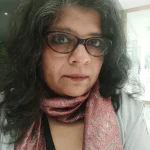
Arpita Das
Arpita Das is Founder-Publisher of the indie publishing house Yoda Press and Associate Professor of Writing at Ashoka University