
✨ LATEST ISSUE •
From
Matchbox – September’26
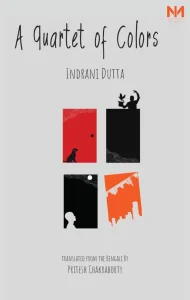
Excerpt : The Quartet of Colors
Original Language:
Two bombs went off at the crack of dawn. The explosion echoed from the street corner through the narrow lanes, bouncing off a wall here, ricocheting over a fence there, and still managed to violently rattle the window panes of the stacked-up apartments. Startled from their nightly slumber, people sat up, trying to rub off sleep from their eyes, and looked outside, bewildered. The lights came up one by one, water splashed on their faces, and on their way back from the washroom, they scanned their phones with Sandman still busy in their eyes. The way the five or six floors of the buildings woke up one after another made it seem as if the bombs turned on the lamps with a remote control on a Diwali night. Not being able to understand the source or its real consequence, most of the residents then snuck back into their beds. Lights went off one by one; dogs barked and ran about.
The Nest co-operative housing stood between one—and two-storied moss-covered private residences. The next house in the row belonged to Mithu, who was now headed for the bathroom. No sooner was it early morning than she started to feel her stomach churn, and she felt as if she would throw up. Perhaps she is suffering from indigestion. She left her bed and turned on the bathroom light. Gulgule and Kunti, perturbed by the removal of the light blanket, stretched into wakefulness. Just then, the noise originating from the street corner struck their house. The tripedal table crowned by the water filter has been shaky for a while now. The shock from the blast toppled the glass from the table and it shattered. This made Mithu scream with all the air in her lungs, “Maa, an earthquake!!” She gulped in a long draught of air and burst out, “How many times have I warned you not to keep the glass here?” She made for the bathroom with her arms tightly wrapped around her stomach, catching a glimpse of a dishevelled Chhanda emerging out of the room on the right. For a moment, curiosity got the better of her, and she thought she would wait and see if Biplob too came out of the same room. The next moment, she realized how uncharacteristic it was of her, and she bolted the bathroom door from inside.
Chhanda switched on the balcony lights first and then the living room and peeped out of the window—the lane outside stood immersed in shadows, and a stench emanated from the gutter. A scourge of mosquitoes hung in the air in the absence of any wind. Lalu, Kalu, and Beauty howled at the top of their voices; observing Mina and Sudhin stepping out of their house, Chhanda cried, “Whatever is the matter, sister?” Mithu could hear the ambulance from the bathroom. Then the fire brigade. The dogs were constantly changing their posts on the streets. Hearing Chhanda’s voice Mithu realized that her mother had managed to go down the stairs and was going out. Then there was Biplob coughing. “Are you done yet? I need to go.” Biplob tapped on the bathroom door and asked timidly.
“Almost. Wait up. Don’t step over the shards of the glass. Be careful.” Mithu’s house was almost the last one in the lane. The two abandoned houses next to it had been handed over to the builders, perhaps to be turned into new apartment complexes. Chhanda, Mina, and Sudhin spoke at the street corner, and a muddled cacophony of shrieks, ambulance hooters, and fire brigade sirens slowly filled up the frosty morning air.
“What is the matter? Wasn’t that an earthquake? What are you doing outside? Come inside or you will catch a cold. Where is Kunti?”
“Shut inside the house. You stay put. Lock the doors. Mina says a gas cylinder burst. No damn earthquake . . . I’ll go check, and please clean that up, will you? Don’t let your uncle cut his damn feet on the glass and get his feet bloody.”
Mithu knew that now Maa would go on about Biplob’s diabetes while walking up to the other end of the street. Mina Aunty would listen to all this with a tight upper lip till she goes inside her house . . .
Mithu felt a surge of anger. Then she smirked—the woman hasn’t learned a single thing yet. Mithu stooped with all her weight to collect the shards scattered over the various corners of the room. She enjoyed reaching for them. It was fun to reach out to the difficult corners. As she picked up the last piece, a ray of sun, half a centimetre in length, had already crossed the threshold. She was hungry. Tea, bread, toasted crisp—butter softening on the golden skin—her mouth watered. Chhanda was hollering as she came up the stairs, “Oh, It’s late already; did you make tea? Terrible! A bomb blast! People aren’t allowed to go out to the street.”
“So where were you all this while?”
Chhanda plunged into the bathroom without an answer.
…
Mithu, Chhanda and Biplob stood on the balcony sipping tea. On a normal day like this Bapi and Manik would have set their roadside vegetable vending mats on the opposite curb, the stationary would start selling—bread, Mother Dairy milk pouches, Marie biscuits; children queue toward the school bus that waited for them at the corner. The rickshaw would arrive to ferry Mithu while Biplob and Chhanda would have waited to see Mithu off. She would put her goggles on, waving at them as she would settle on her rickshaw, pulling the hood up and the plastic curtain down on rainy days. After Balai would drop Mithu at the main road she would take a bus to her college. Today is Sunday. Hence, instead of going to her college, she had asked Balai to take her to the market to get a few items— cosmetics and stuff, replenishing her stock of nail polish and perfume; she thought she could finish this errand early and take a long nap after lunch.
“Can Balai make it today? There is ‘no entry’ at the main road.” Chhanda wondered.
Though Balai had provided his mobile number to Mithu long ago, he could not always pick up if he was pulling the rickshaw, but today he picked up instantly.
“Didi, I am stuck at the main road; the police are not allowing anyone to enter. What to do?”
“I know. Can’t you take the road running along the other side of the fairground via Sahebgali?”
“No, Didi. Doesn’t look like it. There is a lot of trouble here. Do you know Manik is dead?”
“What do you mean?”
“You don’t know Manik? He used to sell vegetables opposite your house. He is dead, blown up.”
Mithu began to shake. “How did you know?”
“Two people are dead. It’s all over the TV. Blood everywhere. They will remove the bodies soon and then lift the barricade. Should I come then?”
“No, let’s drop it for today. Maa, O maa . . . turn on the TV, will you? Please.”
…
Biplob sits vegetating in front of the TV, changing channels and watching the same news on the million channels, hoping that one of them would cancel Manik’s death as a hoax—a false report.
Chhanda sniffled for a while and said, “What about our daily vegetables? Who will bring in the groceries?”
Gulgule, with its tail up, rubbed its head on Biplob’s pajamas and then on Chhanda’s saree. Kunti was found as usual under her usual blanket cover. Mithu was caressing her head. She pulled her scarf from the clothes rack and said, “I will fetch the groceries.”
Indrani Datta
Indrani Datta was born and brought up in a Calcutta suburb. She is an expatriate writer who discovered writing after landing on a distant shore. On an incessant mission searching for the magic words to connect with the readers, Indrani has so far authored three collections of short stories and a novel.

Dr. Pritesh Chakraborty
Dr. Pritesh Chakraborty is an Assistant Professor of English at Maharaja Srischandra College, West Bengal, India. A former Fulbright FLTA scholar (Hindi) at New York University, 2018- 2019, he has earned his PhD from West Bengal State University, India. His research explores superhero comic books of Batman and Indian comics. He shares a keen interest in fiction writing. His work is available on Kindle. He has penned multiple graphic novel scripts. Pritesh has published several academic articles in national and international journals including Journal of Graphic Novels and Comics. He has also contributed book chapters and has attended a number of seminars and conferences both in India and abroad.