
Vauhini Vara in Conversation with Tanya Samal
The conversation scrutinizes how technology companies' products shape human understanding and communication,…
Read more →Vara interrogates the precariousness of human expression and selfhood when mediated by digital algorithms, probing the possibility of truthfulness amidst technological interference.
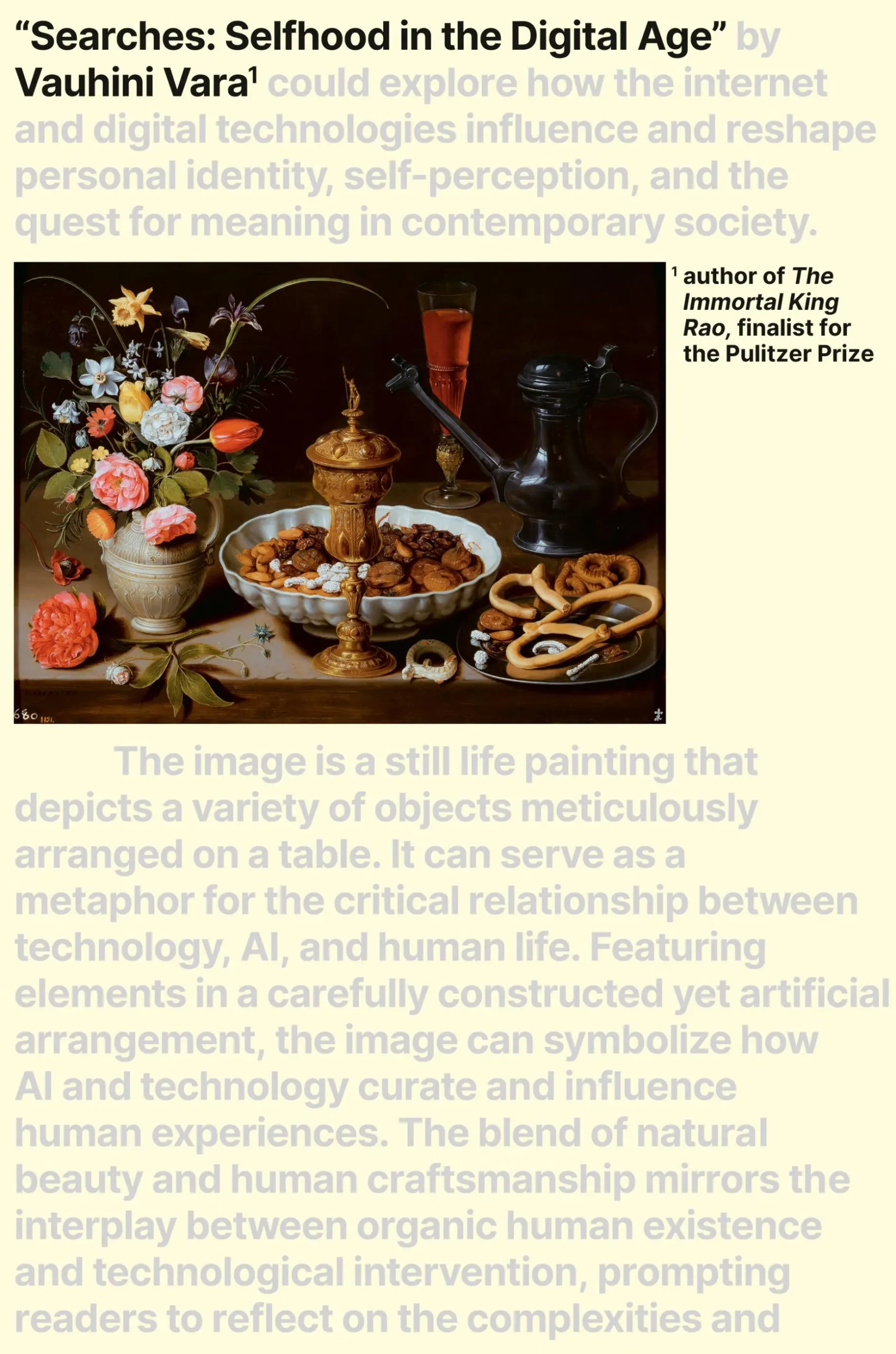
Searches: Selfhood in the Digital Age by Vauhini Vara is truly one of a kind; bridging technology and emotions in a rare and intimate fashion. She writes not just about machines but through them, testing the limits of human sentiments against the very texture of digital mediation. The book does not assert its originality overtly but rather, it presents itself delicately; with accuracy and malaise.
Vara, a journalist by trade, maintains meticulous control over prose that might otherwise crumble under its own self-reflexivity. Her phrases are cautious, skeptical, and emotionally charged. They draw the reader into the ambiguous space between reporting and confession. Even when she allows algorithms to intervene in the prose, by feeding her essays to AI, translating herself with Google, or creating stories from search results, the writing never becomes gimmicky. Each experiment feels like an extension of a well thought out idea, executed in a serene, controlled, and unconsciously haunted manner.
What emerges is a work that is less concerned with projecting the future of language than with tracing its gradual erosion. Vara’s work reflects that very erosion: simple but evocative, as if it were reduced down to what feels undeniably human and organic. Searches reads like a collection of bits found after a storm: lucid, brilliant, and most importantly– self aware.
At its core, Searches poses a question to its readers that is as philosophical as it is lexical: “how can one write in a truly honest manner when technology and its offshoots keeps finishing the sentence for you?” Vara’s response emerges through her essays that serve as a series of organized experiments, each of which examines the malleability of speech in the midst of digital disruption.
The essay “Ghosts,” in which Vara interacts with GPT-3, a fairly early language model to write about her late sister, serves as the book’s emotional crux. What should have been an exercise in digital imitation becomes a lesson in restraint. With AI delivering unnecessary details and sentimental narratives about her sister’s tragic passing, the prose notably oscillates between artifice and ache. In that tension, lies the book’s most memorable theme– it succeeds in affecting Vara.
Vara displays excellent command over rhythm and tempo in another essay based on her own Google search results. The fragmented pattern of search results resembles a kind of staccato beat, a collection of bits that feel disconnected but intimate, reflecting the restless pace of online cognition. Her style embodies the very anxiety it depicts. Her precise phrasing elevates what could have been a brilliant pastiche into a genuine representation of confusion.
Even when she gives up control by permitting errors in translation or crowdsourcing replies, the writing remains intact. Vara’s minimalism is misleading. Under its serene façade, there is a basic moral tension about authorship and ownership. Her phrases are tidy to the point of modesty, but emotion permeates the syntax. She recognizes the importance of what is left unsaid. However, not all of her experiments provide positive results for her book. feels blurry in terms of its theme and falls flat in comparison to her other essays. It distorts her aim rather than refining it, and the distinct tone of her voice is lost in the chaos of the responses.
What lingers after reading Searches is not its use of artificial intelligence, but its faith in the human ability to create meaning, no matter how imperfect the instruments may be. Vara’s prose thrives on the contrast between exactitude and vulnerability. She writes with the diligence of someone who is aware that language can fail and yet chooses to use it nonetheless. Ultimately, Searches is a work about both craft and consciousness. Vara views the essay form as a living structure that is adaptable, self-aware, and open to change. Each piece presents a subtle argument for truthfulness. Vara does not examine if AI can replace humans; rather, she argues that replication is besides the point.

This author contributes to our platform but hasn’t added a bio yet.