
From ULR
Issue 14 – WITNESS
Review: My Brilliant Friend
Ferrante challenges conventional truth-telling, asserting that friendship's resentful, mutual witnessing exposes brutal societal realities, often via childhood's distorted, fantastical lens.
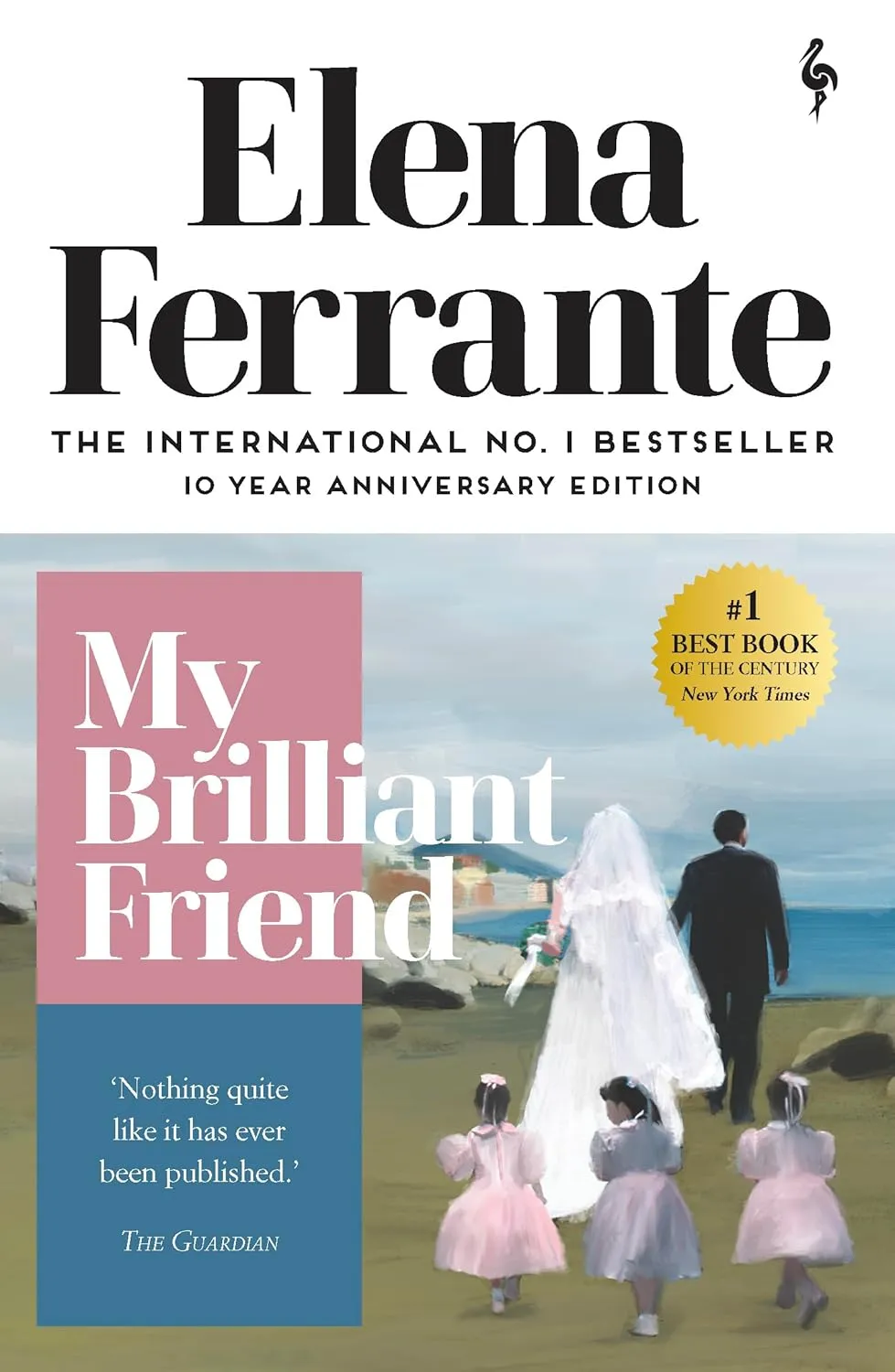
Oishika Roy revisits Elena Ferrante’s My Brilliant Friend, the first of the Neapolitan quartet novels, published in 2011 and currently experiencing an upsurge in readers many years after it was first deemed phenomenal. Roy tries to understand how Ferrante expertly interprets witnessing—observing, imagining, becoming—through her child- and adolescent- protagonists as they grapple with poverty stricken post-war Naples.
Elena Ferrante’s My Brilliant Friend reveals that friendship can be an ugly kind of bearing witness.
The Neapolitan novels by Elena Ferrante are venerated for being something else entirely. With reviews claiming it is “the best book of the century” (New York Times) and that, “nothing like it has ever been published” (The Guardian), My Brilliant Friend, the first book in the quartet, easily made a place for itself in 21st century’s literary canon. The relic-like grandness of the series, which documents two girls growing up dancing circles around each other in a Naples impoverished by the Second World War, isn’t hard to understand. In that the books span the whole lives of these two women and their friendship, the final story is bigger than the sum of its four parts, a type of evidence. It allows us to observe the intimate everyday of Lenu’s and Lila’s complete lives.
My Brilliant Friend starts with Elena Greco (Lenu) learning that her friend, Raffaella Cerullo (Lila) has disappeared. Lila spoke of her plan to disappear often. Now, she had not only managed it, but had also successfully removed any sign that she ever existed—clothes, letters, hairpin. At 66, Lenu sits down, bitterly angry, to write in painstaking detail the story of her friend Lila. It is not a sweet dedication that she hopes to write, but a comprehensive account of their intertwined lives, as a rejection of Lila’s act. “We’ll see who wins this time,” Lenu says at the very start of book one, insisting to Lila, through her writing, that you were there, because I saw you. In the prologue, titled Eliminating all the Traces, Ferrante makes clear one thing: that the process of documentation Lenu undertakes is a resentful, vengeful one—an act of defiance against her friend—immediately revealing something fundamental about the relationship we’re about to see. And thus begins Lenu’s final, to us primary, act of bearing witness to Lila’s life.
She starts with the first time they meet, at four-years-old, in their poor neighbourhood in Naples. Through the remaining 300 or so pages, Lenu recounts their adolescence. They discover each other’s geniuses—the seductive practice of analysis. They find that books and literacy are a source of excitement and beauty, but also a sure shot opportunity to escape their neighbourhood, make money, and gain capital.
While Lila’s genius scares Lenu, forcing her to aspire to her friend’s quick-wits to secure their friendship, it is Lila who isn’t permitted to continue schooling after elementary school. And while child Lenu is promised beauty as a young blonde with gentle features, it is a teenage Lila who attracts attention—gentle and crude—from their male peers. The two women expand and shrink in concert with one another, filling in the gaps the other leaves, trespassing on the other’s territories in insidious ways. But they also look to each other in moments of vulnerability, and build the skills to espouse, and at times provide, what the other needs. As academic Jill Richards says, “This divvying up of personality is a kind of balancing act, where the two girls exist at opposing poles. L&L are so perfectly matched, as though each girl were stepping into the negative left by the other.” Like Richards finds, their worlds were mediated through each other; the exacting, devotional act of observing each other causes the girls themselves to form. For instance, when a boy from Lenu’s neighbourhood asked to see her newly developing breasts for 10 lire, she evoked her now intuitive knowledge of what Lila would do and did the same: flash them, take the money, buy something for herself. After the incident, she realised that she learnt how to behave in and respond to the world from seeing Lila. Lenu writes, “I realised that Lila has acted…on me like a demanding ghost…I had mimicked Lila’s look and tone and behaviour in situations of brazen conflict, and I was pleased.” Their own act of becoming, then, is through the process of witnessing the other.
In fact, it is with the gaze of the other in mind that Ferrante writes Lila and Lenu, perennially puppeted by how to inculcate the other in herself. When Lenu goes to middle school, Lila takes a fascination with her family’s shoe business in response, drawing up absurd yet excellent footwear designs to carve out something distinct about herself. And when Lenu first becomes physically intimate with a boy from their neighbourhood, she does so keeping in mind her imagination of what Lila does with her fiancé. In their push and pull—so taut that there’s little room—Ferrante gets something unequivocally right about female friendships: that the act of witnessing is simultaneous and mutually produced. It is not a linear action with a doer and receiver, but one that is created and interpreted at the same time. While one watches—her gaze reflected outwards and inwards—the other creates, making herself to be met with a particular gaze. In that, the act of witnessing churns and churns, never ending. Readers of My Brilliant Friend will ask who the brilliant friend is. Ferrante responds: does it matter? Both girls start and end together, neither knowing who came first.
The only moment of fissure in this flux is at the end of the book during Lenu’s first moment of clarity. At Lila’s wedding to Stefano, the son of the neighbourhood loan shark, she remembers a moment with her elementary school teacher. Years earlier, Lenu’s teacher had asked her, “Do you know what the plebs are?” At 16, she finally realised what her teacher had meant. Lenu recounts, “The plebs were us…The plebs were my mother, who had drunk wine and was now leaning against my father’s shoulder, while he…laughed, his mouth gaping, at the sexual allusions of the metal dealer. They were all laughing, even Lila, with the expression of one who has a role and will play it to the utmost.”
It is in this moment, for the first time, that Lenu watches and Lila is watched; it is also the first time Lenu sees her context as an adult, now wrung free of the fog of childhood meaning making: In a cheap dress, and in a Naples rendered decrepit by war and fascism. While it is only in the last three pages of this book that Ferrante finally permits Lenu to clearly see the ugliness of her context, the preceding 300 pages, such Maestra Oliviera’s reference to plebs, set the political context.
While the end may seem more than a decade apart from the start of the book, they are tied closely together, almost wrapped, like a sphere closing in on itself. At the end Lila marries Stefano, when 12 years prior she walked up to his home to ask his father, Don Achile, the neighbourhood loan shark, for the dolls they had dropped into the pits of the city. They were certain he had taken their dolls from the neighbourhood’s murky underground and put them in “his black bag”. Lenu writes on the first page of the first chapter: “(Don Achile) was the ogre of fairy tales, I was absolutely forbidden to go near him, speak to him… Regarding him there was, in my house but not only mine, a fear and a hatred whose origin I didn’t know. The way my father talked about him, I imagined a huge man, covered with purple boils, violent in spite of the ‘don’…He was being created out of some unidentifiable material, iron, glass, nettles, but alive, alive, the hot breath streaming from his nose and mouth.”
What appears on the first page of the book is then revealed to Lenu clearly in the last, no longer obfuscated by her child-self’s interpretations of Neapolitan horrors and their collective histories. But what four-year-old Lila and Lenu observe of their situation, and how their little heads make sense of it, is in some ways, the opposite of obfuscation, crystal clear.
Soon after their first interaction with him, Don Achile was killed, and Alfredo Peluso, the neighbourhood carpenter, was convicted for the crime. However, Lila and Lenu spread a rumour among their friends that it was actually a creature—“half male and half female who hides in the sewers and comes out of the grates like the rats”—that had committed the murder. Both Lila and Lenu knew that it would be better for the neighbourhood if a grotesque creature had killed Don Achile, and not a man they knew. At 14, a bit older, they learn why they felt so and what made them imagine such disgusting fantasies. In a fit of anger, the murderer’s son reveals that “the (neighbourhood bar) had been a place for loan sharks from the Camorra, that it was the base for smuggling and for collecting votes for the monarchists…that Don Achile had been a spy for the Nazi Fascists”. Pasquale, a communist following in his father’s footsteps, says, “Papa was right to kill (Don Achile).” Neither Lenu or Lila knew what these terms meant or the histories they implied; still, they knew that the sharp images of monsters they dreamt up represented their realities well and acted as their first mediums to truly see the world they lived in. In some cases, they preferred the twisted horrors of their imagination to what they lived.
When they see Don Achile, they don’t see the garb of normalcy he wore—a receding hairline, face made of flesh—but the monster that he has been to the neighbourhood until a bitter animosity between him and the others had formed. Of course, Lenu’s description of Don Achile and his murder isn’t real; but parts of it suggest truths. While to the children, he seemed to be an ogre carrying around a black bag, the reality was hidden in plain sight: he was an ogre, carrying la borsa nera, literally meaning black bag, but colloquially known as the black market to English speakers. In their fantastical vivid pictures of Don Achile, the neighbourhood, Naples, and post-war Italy lay the real Don Achile, Naples, and post-war Italy.
Through Lila and Lenu’s childhood, Ferrante slowly unfurls the complicated world her characters were thrown into, allowing the deadly realities of the neighbourhood to creep up on the reader as well. As children and adolescents, they make unlikely connections that see—witness—the world for what it is, not what is being shown. Through images of monsters, of reality physically fracturing and giving way (something Lila often experiences), and the instinct to disappear entirely, Ferrante’s writing of her young characters captures a collective consciousness in image that the larger polity in the book rarely visualises, only feels.
Devoted to this vision, Ferrante is immediate in setting the pace for what the books will reveal: a destructive honesty that appears, at times, absurd but holds fundamental truth.
You can purchase the book here.

Oishika Roy
Oishika Roy is an editor and writer with a keen interest in understanding our relationships with food, and what they reveal about the world. She works as an editor at The Locavore, a digital platform committed to telling stories about the Indian food system.