
Review: The Bare Bones Book of Humour
Challenging literary hierarchies, the anthology reclaims humour as a rigorous mode of intellectual inquiry, essential for navigating contradiction and human experience.
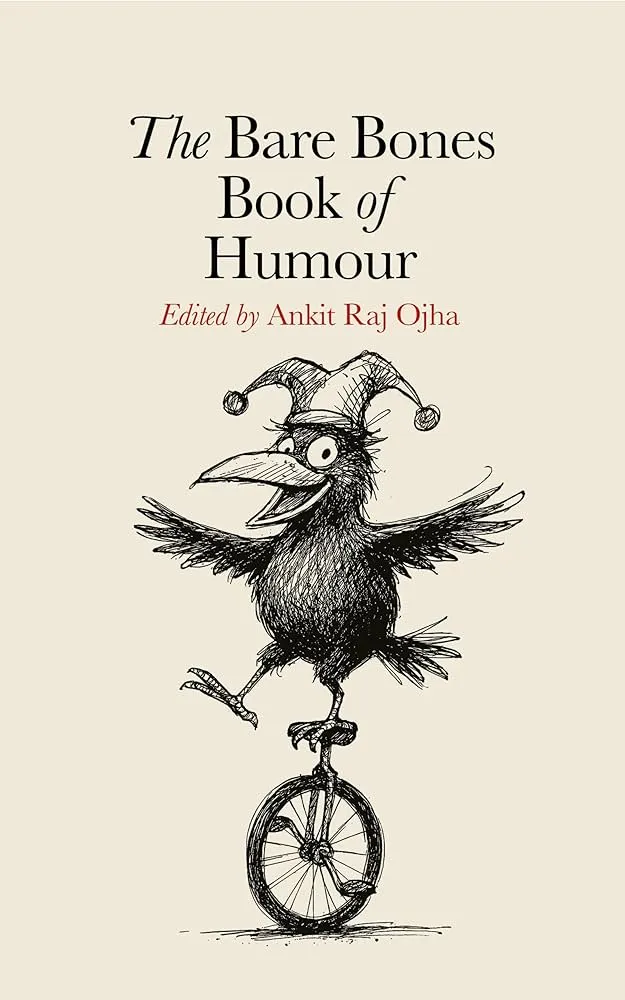
Humour in literature is often relegated to the margins, treated as an embellishment rather than a mode of intellectual inquiry. Yet The Bare Bones Book of Humour, edited by Ankit Raj Ojha, insists that humour belongs alongside the most serious aesthetic traditions. The anthology situates itself within a global lineage, from Aristophanes to Rabelais, from Cervantes to Dickens, from Mark Twain to Bulgakov, where laughter becomes a method of philosophical scrutiny. It reveals, with quiet rigour, that humour is not the opposite of seriousness but its partner, its pressure valve, and often its most incisive diagnostic tool.
Ojha’s introduction, ‘A Series of Un-serious Events,’ declares humour as a cultural inevitability: “I was born and raised in Bihar, where humour is obvious, inevitable—like life and death.” In invoking this regional instinct, and citing Tabish Khair’s lament that “Indian English in India” does not take humour seriously enough, Ojha calls attention to a long-standing hierarchy in literary thought: Tragedy has long been canonised, while comedy must perpetually defend its intellectual legitimacy. Like Kundera or Eco, he positions humour as a way of thinking—the capacity to destabilise received narratives through wit, irony, and the gentle violence of laughter. When he notes that the stories “span cultures and ‘senses’ of humour … laugh out loud … cheeky grin … all-knowing smile,” he is echoing Henri Bergson’s insight that laughter arises not from a single emotional register but from a series of cognitive negotiations between the mechanical, the human, and the unexpected.
This range becomes evident in Merlin Flower’s “Robes and Roles,” where a man’s disorientation on unexpectedly experiencing menstrual symptoms reads like a modern inversion of Aristophanic body-comedy: “Why was he having knives shoved into the stomach? … Why did it have a weird smell?” The humour is physical, immediate, and yet epistemologically charged. Like Virginia Woolf’s satirical essays or Swift’s scatological attacks, Flower uses bodily confusion to expose gaps in gendered understanding. When her protagonist anxiously wonders, “Would he have periods every month?”, it becomes a contemporary gloss on the long comic tradition of men misinterpreting the mechanisms of the world around them—an embarrassment that fuels insight.
Steve Akinkuolie’s “Because of Ram and Rice,” where a stolen (or mis-stolen) ram is dragged across a compound “with missionary zeal,” evokes not only R.K. Narayan’s light-footed village comedies but also Gogol’s appetite for escalating disorder. The shouted retort, “Is that not not your business?!” carries the rhythm of linguistic play familiar from Shakespeare’s clowns, where the doubling of negatives becomes its own form of slapstick rhetoric.
Padmanabh Trivedi’s “Barambaba” leans into ritualistic village justice with a tonal restraint that recalls Chekhov’s early comic sketches. Ramu’s immediate willingness to swear innocence, regardless of guilt, satirises the performative nature of truth-telling in small communities. Like Chekhov’s peasants or Premchand’s villagers, the moment functions as a miniature study of authority, gullibility, and the social choreography of suspicion.
In Allan Miller’s “The Developments,” the narrator’s attempt to identify a possible dinosaur fossil and his eagerness to mail it to Professor Brusatte echo the naïve narrators of Twain or Wodehouse—figures who are confident, curious, and often disastrously wrong. His imagined discovery of a “prehistoric treasure trove” mirrors the comic delusion that animates Don Quixote: the desire for the world to be grander, stranger, more dramatic than it is.
Amit Majmudar’s “Regeneration” uses mock-heroic language to articulate male vanity: “The pill watered the Tree of Life with blood.” This stylistic inflation recalls Alexander Pope’s The Rape of the Lock, where trivial material becomes mythic, only to expose the absurdity of the myth itself. Majmudar turns the bodily into the epic, parodying both genres simultaneously and revealing how humour critiques the narratives men build around potency and ageing.
Ankit Raj Ojha’s “A Man of Culture” situates its humour in the theatre, where two boys spy on their math teacher and cheer during a film whose posters dominate the “public pee stalls.” This juxtaposition of decorum and urban masculinity echoes the social wit of Hanif Kureishi or the bittersweet embarrassment of Junot Díaz. The power reversal, where the teacher becomes the one who should be “scared”, plays into a global comic tradition of the authority figure being undone by context.
In Abhilipsa Sahoo’s “The Haunting of Chill House,” the comedy arises from the collision of spiritual ritual and modern digital convenience: a priest with “a 600-rupee ‘Digital Shanti Package.’” This fusion recalls the magical-realist humour of García Márquez, in which the supernatural is domesticated, bureaucratised, and sometimes monetised.
Swapnit Pradhan’s “Enlightenment Begins at Home” transforms constipation into philosophical epiphany: “Nothing in life moves unless you push a little”—a line that might have fit into the comic aphoristic mode of Oscar Wilde, had Wilde been more interested in bowels than beauty. Mr Patra’s attempt to distribute wisdom via WhatsApp aligns with a distinctly twenty-first-century satire of self-help culture.
Sahana Ahmed’s “A Memsahib Learns to Cook” uses quiet irony to reflect on domestic expectations: “She must adjust herself to the community as she finds it.” The humour resembles Jane Austen’s more understated social critiques, where wit becomes a scalpel in the examination of gendered instruction.
Vishaal’s “Greetings to Jack” descends into chaos when hijackers find themselves drowned out by toddlers—an inversion reminiscent of Heller’s Catch-22, where existential danger collapses into absurdity. Sylvia Beaupré’s “Weeds”, in contrast, relies on Beckettian quietude, as Harold contemplates doing nothing and waiting for consequences to decay on their own. Grace Q. Hu’s “Two Good People,” with its shopkeeper who complains of having received “a pile of fake money” while his customer alone offers real tender, matches the structural humour of Luigi Pirandello, where reality and unreality flip with deadpan precision.
Taken together, these stories position humour not as escapism but as a rigorous interpretive force. Like the works of Gogol, Zoshchenko, Thurber, or Krishan Chander, they recognise the comic as a means of understanding contradiction, exposing hypocrisy, and navigating the dense, often bewildering terrains of contemporary life. The Bare Bones Book of Humour thus joins a long-standing global archive of texts where laughter marks the intensities of human experience. It argues—convincingly—that to laugh is not to step away from seriousness, but to step more precisely into its muddy, complex centre.
In the final reckoning, The Bare Bones Book of Humour stands as a reminder that laughter is not the opposite of depth but one of its most enduring expressions. The anthology gathers, with scholarly precision and artistic daring, the many ways human beings resist collapse through wit, absurdity, and the sly grace of comic imagination. Whether through bodily farce, philosophical irony, cultural satire, or the quiet comedy of ordinary days, each story affirms what World Literature, from Aristophanes to Narayan, Cervantes to Kunder, has always known: that humour is a mode of knowledge, a way of seeing the world without being destroyed by it.
Ojha’s collection does not merely assemble humorous pieces, it restores humour to its rightful literary stature, showing that the smallest joke can illuminate the largest truths, and that sometimes the mind thinks best when it smiles.
The Bare Bones Book of Humour (ed. Ankit Raj Ojha) can be ordered here.

Wani Nazir
A postgraduate gold medalist in English Literature from the University of Kashmir in Srinagar, Wani Nazir, from Pulwama, India, is the author of the poetic collections, …and the silence whispered, and The Chill in the Bones. Currently a Senior Lecturer in the Department of Education in Jammu and Kashmir, he has been writing prose and poetry in English, Urdu, and his mother tongue, Kashmiri. Wani has poetry and prose in Kashur Qalam, The Significant League, Muse India, Setu, Langlit, Literary Herald, Cafe Dissensus, Learning and Creativity – Silhouette Magazine, The Dialogue Times, and elsewhere.