
From ULR
Issue 14 – WITNESS
Review: The People Of India
The text redefines history pedagogy, demanding young readers critically interrogate colonial legacies and constructed narratives, thereby shaping decolonial intellectual engagement.
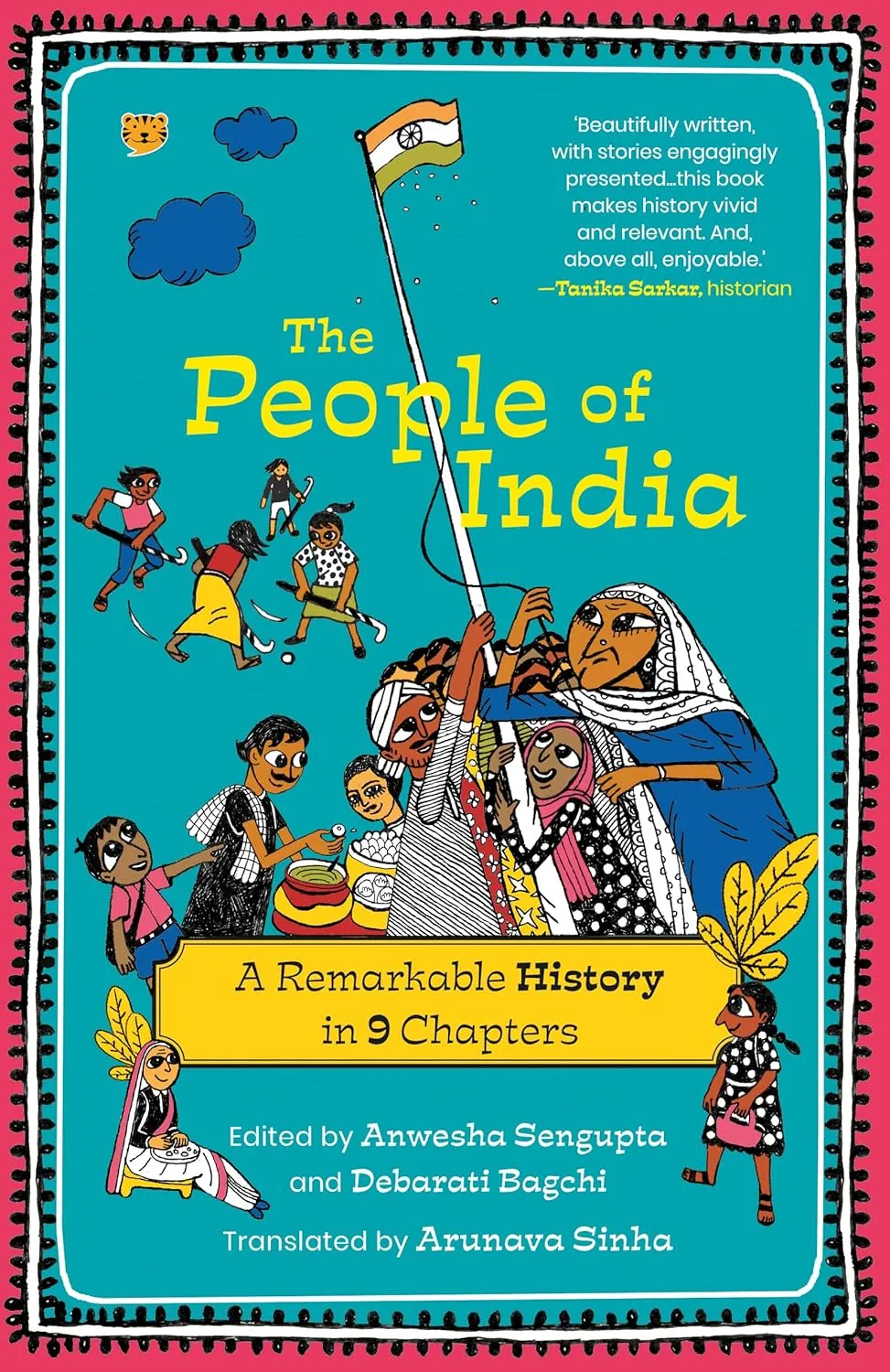
The People of India, a translated collection of nine short books aimed at middle-grade readers aims to shift the association between history and rote learning. Originally written in Bangla as part of the ‘Revisiting the craft of History-Writing for Children’ project between 2022 and 2024, the nine chapters delve historically into the topics of the Partition, citizenship, languages, rivers, war, tea, food, clothes, and sports in the Indian subcontinent. What stands out is that the book does not offer a chronological history of these nine topics – instead, each chapter functions as a lens through which young readers can begin to understand different approaches to the discipline of history.
Central to these approaches is moving beyond registering events and occurrences, to understanding why they happened the way they did, and their long-term significance. The first chapter, for instance, asks whether the Partition can be fully relegated to the past when its effects continue to be felt in the present. The book also weaves in anecdotes and personal experiences, allowing readers to see how occurrences from the past played out practically in people’s lives. This is not to say that the writers completely disavow mentioning facts and occurrences. They instead mention facts and occurrences that are not commonly found in school history books – like the increase in the number of women going to work after the Partition, the refugees from erstwhile East Pakistan who were sent to Andaman and Nicobar Islands, the economic background of those who participated in the Swadeshi movement, or how the British distributed tea from motorized vans to increase its popularity in India and how they killed zoo animals in erstwhile Madras in fear that they would escape if there was a bombing during World War II. Such details can pique the interest of the reader and offer them many areas to delve into further.
What the book delves into itself in great detail in perhaps every chapter is the impact of colonial rule. While it shows that this impact is most visible in the drawing of the Radcliffe line, it is felt in everything ranging from state divisions and language wars to farming practices, labour laws and exploitation, and even associations that different kinds of food have. Each chapter challenges the reader to grasp its lasting – and largely negative – magnitude. At the same time, it discourages readers from falling into the trap of imagining a perfect pre-colonial past, reminding them that “everything was wonderful earlier, but things have deteriorated so much now”, is a claim made by people of every generation. This is perhaps what is most special about the book – it prompts the reader to be alert and questioning at every turn.
Part of this nudge towards critical thinking is how authors open up terms that we may use unthinkingly, like ‘refugee’ and ‘infiltrator’. The chapter on citizenship does this through a helpful table that shows what these words have meant at different times, pointing out that words too have a history. Another facet of it is teaching readers to pay attention to how a certain history is being written. A history of wars need not necessarily deal with maps, dates, or borders. Instead, it can begin with questions – like ‘How does the natural world affect war?’ – that are answered by bringing together several wars. Similarly, writing a history focused on rivers may actually be about power relationships, like the Brahmaputra, the East India Company, and farmers in Bengal and Assam.
In this way, the book respects the intelligence of its young readers and shows that making history accessible is not the same as simplifying it. For middle-grade readers who find the subject of history to be tedious or boring, this book can show that history as a discipline is misunderstood. The introduction explains that the Bangla name for the series – ItihaseHatekhori – refers to the ritual of initiating a child into writing. In many ways, the book is a re-initiation into history, pointing out that history can even be found in the everyday. In tea, for example, one can find a history of the wage gap between women and men and in sports, the histories of different communities.
The People of India is amongst many such re-initiations at present in Indian children’s literature in English, including fictional stories engaging with the past and engaging historical non-fiction. The length of this book and the choice to make it all-text (the original nine short books feature several patachitra illustrations), however, may make the book seem intimidating or even tedious at first glance to its intended 11+ audience, especially when more attractive books about history are available at the same time. Even without illustrations, the book could have benefited from combining different ways of organizing text and displaying data. The book as it is may need involvement from librarians, educators, and parents to initiate children into it so that they can see that it is not what it looks like. This can work as the book also has great crossover potential as adults can learn a lot from it.
You can purchase the book here.

Anagha Gopal
Anagha Gopal is a PhD scholar at the Centre for English Studies, Jawaharlal Nehru University, where she is working on representations of the child reader in Indian Children's Literature in English. She has pursued BA (Honours) and MA in English from St. Stephen's College, University of Delhi. Awarded the gold medal at the University of Delhi post her master's, she went on to pursue an M.Phil. in English at JNU. Her academic work on children's literature has been published in LLIDS and Muse India. Her children's book reviews can be found at ACLiSA, Nature Writing for Children, and Usawa Literary Review. A strong believer in accessible research communication, she also reviews children's books on Instagram at @anaghag._.