
Review: The Right to Sex
Srinivasan problematizes sexual liberation, asserting that desire, consent, and justice are deeply…
Read more →Womanhood, framed as silent endurance rather than overt rebellion, critiques patriarchal systems that normalize compromise, exposing internalised subjugation as a lived condition.
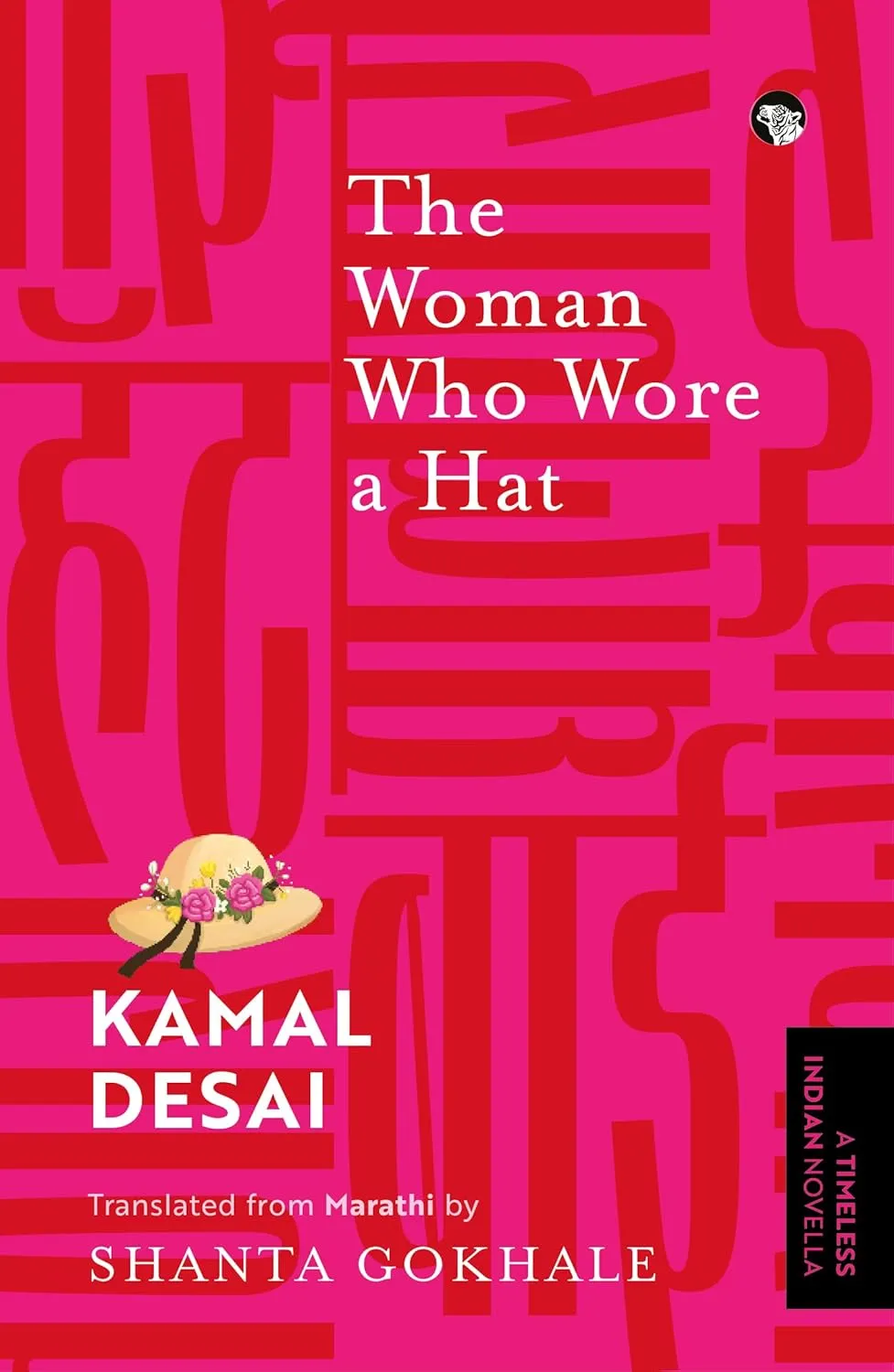
“She recognised that centuries old thing called womanhood. It was meant to be endured”
A novella whose relevance has lasted since it was first published in 1975 in Marathi. The English translated version of The Woman Who Wore a Hat by Kamal Desai puts forward a fresh reminder of the nuances of womanhood in a world that lives under numerous assumptions and prejudices. Through Shanta Gokhale’s striking translation, the ordinary moments of the characters’ lives become the voice of womanhood. The story defies the commonly understood ideas about feminist literature; it is rooted not in rebellion but in the ordinariness of the everyday life of a woman. The narrative treats womanhood as a symbol of endurance rather than distinct rebellion or overt resistance.
This novella revolves around the life of a woman against the backdrop of domesticity and the ingrained patriarchal ideologies. It echoes the longstanding claim of feminist theory that womanhood is something that one is trained into, rather than it being an innate identity. It treats womanhood as not merely an identity but as a condition shaped by repetition, memory, and social expectation. The idea of womanhood being endured is volumised, and the silent effect that this aspect of the narration creates is where the text gains its power. It lets the reader sit with the discomfort of a life shaped by compromise. It celebrates endurance but does not romanticise it; instead, it underscores the idea of questioning the very endurance that is normalised and should not be a part of the picture in the first place. It subtly brings into light the irony of how equality is conveniently understood in a patriarchal setting. The protagonist does not dramatically reject her circumstances; instead, she inhabits them, revealing how deeply patriarchal norms are internalised. Her endurance is not framed as a virtue but as a necessity. The narration, in particular, plays an important role in overtly pointing out the internalised misogynistic ideas that in most settings are never questioned. Shanta Gokhale, while translating the book, manages to reinforce the feminist subtlety it aims to put forward. The language remains controlled, precise and emotionally exact, which plays a major role in mirroring the inner world of the protagonist. The simplicity of the language acts as a reminder that feminism also lies in recognising that ordinary actions sometimes become the strongest form of rebellion. It sheds light on the fact that the experiences that seem humdrum can also be extremely significant.
The simple, everyday speech writing style also grounds it in lived reality rather than a literary narrative, reminding us about the women in real life whose lived reality mirrors the one in the story. Furthermore, it also nudges the thought that in patriarchal settings, speaking too much or too loudly is discouraged. The stylistic sense of the narration becomes an echo of social conditioning; it tactfully reminds us that the reality of issues that feminism aims to tackle is reflected in the things society deems as trivial. The lucid language is a strategic indication that emotionally complex ideas and actions do not require complex form. The narrative style and restrained language, much like the novella, play the role of a reminder that the fragments of what feminist literature seeks to critique are not just where there is overt rebellion, but also where there is endurance. This rather straightforward narrative that does not romanticise endurance but elucidates the fact that it is a requirement for many women out there. Narrating the story of endurance using a simple stylistic approach brings out the need to problematize the requirement of silent endurance for women, merely in order to live their lives.
The hat, in particular, is a significant symbol; in the context of the story, it suggests visibility without voice. It makes the protagonist seen but does not grant her agency. From her introduction in the story, the hat becomes her sole identity. She treats the hat as an announcement of her arrival, as it enters the room before she does. Every experience the woman has, the hat plays the role of a silent symbol that tells us that the woman is determined to make her way through a society that seems to be cemented on patriarchal ideals. The flowers on the hat serve as a visual analogy of the woman pursuing her filmmaking dream and blooming through her hardships. The hat encapsulates the paradox of womanhood: to be constantly observed and remain emotionally and socially marginal. It also mirrors the idea of the protagonist’s life, where individuality is depressed but only within narrow boundaries. The hat allows for a minimal assertion of herself, but does not aid in disrupting the system that surrounds her. Performance in femininity also comes into the picture, as the habitual action of wearing the hat emphasises the fact that femininity is not freely chosen, signalling an awareness of being seen and judged.
The Woman Who Wore a Hat understands womanhood not as an innate identity but as a role continuously performed and internalised. Simone de Beauvoir’s assertion that one is not born a woman but rather becomes a woman is reflected in the habitual compliance with social norms. Along with the absence of an overt rebellion, it also contains an absence of violent oppression, but reveals how power operates through normalcy and social expectations. It resists the romanticising of endurance by presenting it as a necessity rather than nobility. Silence, restraint, and compromise are shown not as moral strengths but as survival strategies cultivated within patriarchal structures. Mainstream feminist theory recognises that awareness does not always lead to escape and that many women continue to live within limiting systems. By grounding these theoretical concerns in the ordinary texture of a single woman’s life, the book transforms abstract feminist ideas into lived experience, making visible the quiet, persistent mechanisms through which womanhood is produced and sustained.

Anaya Karnik is a writer and postgraduate student of English Literature at SNDT University, Mumbai. Her academic interests lie in feminist literary criticism and contemporary cultural studies. A graduate of Wilson College, where she served as Student Editor of The Wilsonian, the annual college magazine, brings a thoughtful eye to both creative and critical writing. When she’s not buried in books, she’s usually writing about them, questioning, interpreting, and celebrating the power of language.