
✨ LATEST ISSUE •
From ULR
Issue 15 – REFUSE
Gokul Gopalakrishnan, Dy. Commissioner, cartoonist and comic art researcher in Conversation with Nithya Mariam John
NMJ: As Deputy Transport Commissioner and AGM, KMRL, with a background in Humanities and Social Sciences, how do the structures of high-level law enforcement shape the dark humor and human observations in your comic series, Small Talk?
GG: What I truly enjoy is absorbing the new knowledge that these diverse fields continually generate. There is a long-standing bias that places art, literature, and the creative arts above the so-called everydayness of administrative work or business. Yet there is as much beauty in solving an urban mobility problem as there is in appreciating an A. K. Ramanujan poem or an A. Ramachandran painting. These different epistemes constantly intersect and inform one another, often shaping the ideas and themes that eventually make their way into Small Talk.
NMJ: In Small Talk, you frequently use anthropomorphic characters—like vultures and pythons—to comment on human nature. Why do you think readers are sometimes more receptive to deep societal truths when they come from the mouths of animals rather than humans?
GG: Comic strips have long had a rich tradition of anthropomorphic characters, from Krazy Kat and Pogo to Snoopy, Hobbes, Garfield, and Mutts. The “funny animal” genre has been a distinctive and enduring part of comic-strip history. In fact, Art Spiegelman drew on this tradition in Maus, his poignant work on the Holocaust, where Jews are depicted as mice and Germans as cats. The work is as much a personal history as it is a reflection on World War II and its accompanying horrors.
Gary Larson, in The Far Side, has inverted the conventional human-animal hierarchy to great comic effect. I suspect that all these comics have, in different ways, influenced my own use of animal characters. When I first began drawing this strip, Animal Crackers was one of the comics that strongly shaped my choices. Perhaps anthropomorphic characters give us a certain distance from the world which we inhabit, allowing us to observe and comment on it as outsiders—which is, in many ways, what a comic-strip creator tries to do.
NMJ: Apart from Small Talk, you have featured The Small Picture for The Mint and As City Is for a Mumbai-based daily. The Sea Within was featured in MixTape 2. I understand that you were also an early contributor to Comix India, an indie, crowd-sourced magazine movement that acted as a launchpad for alternative comic creators in the country. How do you view the changes in the landscape of Indian comics and cartoons, especially in its reception, over the years?
GG: There has definitely been an upsurge of comics in India in recent years. New creators — many of them young and independent — are publishing, and often self-publishing, their work more than ever before. While Comic Con India has increasingly evolved into a cosplay-centric event, forums such as Indie Comix Fest have created valuable spaces for emerging creators to showcase and sell their work, while also building connections with fellow comic artists and readers. This growing interest in comic art may also reflect the fact that we are becoming an increasingly image-driven society. Yet comics are not merely a visual medium. They are a post-literary art form that draws upon image, text, sound, time, space, linguistics, shared social history, and visual culture. What is somewhat worrying is the tendency to position comics as something niche or overly literary, as though they require external validation. There is really no need for that. Comics, as a medium, possess their own inherent strengths in storytelling, and that is what we should truly celebrate.
NMJ: Do you think that to refuse to comply with the mainstream ideology is important in the world of comics? Also, have you ever picked up on something which was considered as ‘refuse’ by the others and featured it in your comic strips?
GG: Comic art has always carried a subversive and adversarial impulse. A political cartoon, for instance, can function like signed graffiti on a newspaper page, often confronting inconvenient truths through satire and visual wit. Comic strips and long form comics, too, emerge from a long history of questioning authority, challenging norms, and resisting cultural constraints. Alternative comics particularly embodied this spirit. Emerging in response to the heavy censorship imposed on mainstream comic books, creators deliberately adopted the term “comix” — with an “x” — to signal their engagement with mature, experimental, and subversive themes. Yet subversion in comics does not always have to be loud, aggressive, or overtly combative. Comic art can also operate through subtlety, irony, quiet disruption, and emotional nuance. The expectation that comics must always deliver forceful political statements or visibly “strong” commentary is a long-standing misconception that we should move beyond.
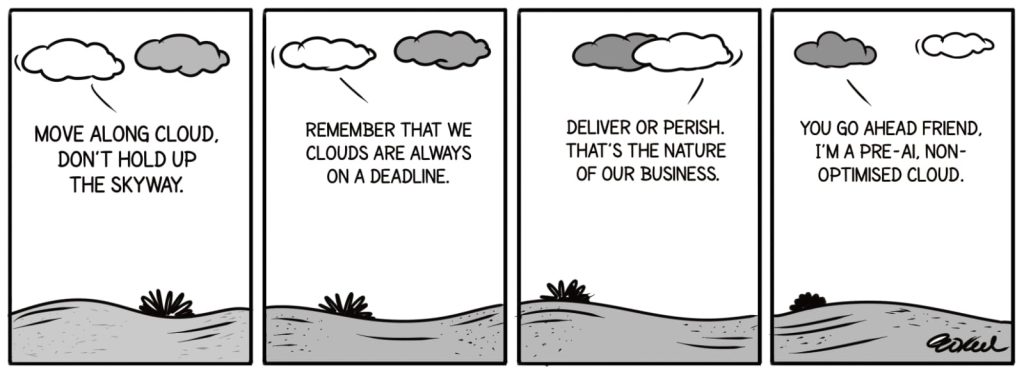
Themes such as alienation, data privacy, artificial intelligence, and environmental anxiety frequently appear in my comic strips. However, I do not approach these themes as ideas that have been “refused” or excluded by mainstream culture and therefore need to be foregrounded through ideological intervention. To frame them in that way would make the act of cartooning overtly political or doctrinaire, which is not what I seek to do. Instead, I engage with these concerns as ordinary yet deeply contemporary realities that shape everyday life and naturally lend themselves to reflection through comics.
NMJ: Comic strips follow a non-linear pattern. The gutters, those blank spaces between the panels, are very important for you. Why?
GG: Comics are, by nature, rarely linear. As mentioned earlier, they function as a patchwork of text, image, sound, time, and space, all constantly interacting with one another to generate meaning. The reader’s gaze in comics is therefore always shifting — never resting entirely on text or image, nor moving through time and space in a strictly sequential way. Instead, these elements are perceived simultaneously and relationally.
Even within a single panel, comics often resist linearity. Meaning emerges continuously through the interplay between what is shown, what is implied, and what the reader actively reconstructs. Reading comics, then, becomes a dynamic process of meaning-making — a complex dance between creator, comic, and reader. That is what I enjoy most about comics. This constant non-linearity of reading, seeing, hearing, and shifting between different modes of perception! More importantly, it is what makes the medium essentially participatory. Meaning is never simply delivered to the reader; it is actively assembled through the reader’s movement across text, image, rhythm, silence, and space.
NMJ: How do you use visual elements like font size, line thickness, and panel composition to craft a specific ‘voice’ and sense of timing on a silent page? Also, could you describe the process which you follow between the conception of an idea and its expression as a comic strip?
GG: Sometimes I begin by sketching aimlessly, and an idea slowly floats in through the act of drawing itself. At other times, the idea arrives suddenly and clearly. Usually, I work on the text first. One thing I always pay attention to is ensuring that the rhythm and intonation of the language match the pace and movement of the strip. The drawing process itself has become comparatively easier since I work digitally on an iPad, where corrections and changes can be made quickly. But there are also days when you almost have to force yourself to draw something, anything, just to break through the inertia. To be frank, my creative process is almost always driven by deadlines. Some days come easily, while on others it becomes a real struggle — staring at a blank page and waiting for something to emerge.
NMJ: Many of your comic strips ask a pertinent question on how the current political climate quietly changes the way we behave, talk, and treat one another in our daily lives. Don’t you think that the intersection of comics and the shifting political landscapes, ought to be studied deeper in India today?
GG: Comics are not something completely devoid of any sense of reality or contemporaneity. Even fantasy is, ultimately, only an alternate version of reality. So, every comic strip will, in one way or another, reflect the society within which it operates, knowingly or unknowingly, like a true ideological apparatus. Even when not political in the direct or conventional sense, all comics are political in the broader way that any art form or creative expression is ultimately political. They carry traces of the world that produce them — its anxieties, contradictions, values, and assumptions. There is really no escaping that.
NMJ: You have written and spoken extensively about K.P. Aravindan’s iconic Malayalam comic strip Cheriya Manushyarum Valiya Lokavum (Small Men, Big World) from the 1960s/70s, noting how it structurally functioned like an early graphic novel with an evolving plot. How much of Aravindan’s philosophy of “never getting too comfortable with your own characters” do you consciously bring into the world-building of Small Talk?
GG: G. Aravindan has been one of the earliest and most definitive influences on the way I approach comics. I first read the collected edition of his work when I was around thirteen years old, and I have remained deeply drawn to it ever since. What continues to fascinate me is his openness and restraint — his willingness to leave narratives unresolved, his trust in the reader and in the reader’s memory, and his unique understanding of both real time and narrative time. Equally remarkable is his boldness in bringing references from the most exciting developments in art, literature, music, and cinema into the comic strip form. In many ways, his work expanded the possibilities of what comics could contain and how those could reflect. The more I return to G. Aravindan’s comic strips, even after all these years, the more they continue to fascinate me. Each rereading reveals something new — a visual detail, a narrative rhythm, a reference, or an emotional undercurrent that I had missed earlier. Very few works retain that capacity to surprise us after sometime.
What I admire the most is that he was never afraid to chart his own path, even if it meant moving away from what was considered normal, successful, or expected. He did all of this quietly, without spectacle or self-mythologizing. As you mentioned, he was also unafraid to “kill his favourite” — to abandon familiar methods or successful formulas rather than become comfortable within them. For me, that remains the biggest lesson from his work: to be honest, to remain oneself, to trust the process, and to keep creating without fear. Everything else will eventually fall into place.
NMJ: Your non-linear short stories—like The Small Picture of Things Inanimate—are self-contained slices of reality. When you look toward publishing a full-length book or graphic novel, do you find the prospect of mapping a single, massive overarching plot liberating, or does the rigid structure of a long-form book feel restrictive compared to the quick, episodic freedom of your daily comic strips?
GG: A larger, novel-length comic requires a very different mindset and scale of planning. You have to work out the plot, the pacing, the transitions, the text, and the images that accompany it — all on a much bigger scale. It demands a different kind of sustained attention and commitment.
At this point, I feel that I would need much more time and mental space and time to immerse myself in something of that scale. Perhaps a collection of short comics would be more natural for me right now.
NMJ: Do you have any personal favourite in the world of comics, about whom you would like to share a bit?
GG: My current favourite comics artist is Tom Gauld, a London-based cartoonist, whose work regularly appears in The Guardian and New Scientist. His comics are deeply humane, infused with intelligence and wit, and remarkable for the ease with which they bridge two seemingly distinct—though ultimately related—epistemological traditions: the literary and the scientific. Gauld’s cartoons inhabit worlds that are mostly improbable but rendered with such internal logic that they feel almost plausible. They are populated by characteristic stick-like figures and governed by gentle and absurd premises. In one cartoon, for example, a truck pulls up at a Mathematics department every Friday to collect used numbers, which are then sorted, cleaned, and resold to manufacturers of clocks and calendars. The joke works because the impossible is treated with complete workaday normalcy. He is a gifted user of text and possesses a profound understanding of the semiotics of comics. This allows him to create a magical interplay between image, text, and the reader’s imagination, producing ideas and situations that could only be fully realised through the medium of comics. His cartoons suggest that imagination and reason are not opposing forces but complementary methods of understanding the world. That may be why they appeal equally to readers of The Guardian and New Scientist: both audiences recognize themselves in his improbable worlds.

Nithya Mariam John
Nithya Mariam John is a poet, translator and teacher from Kerala. A few of her works are housed in Kendra Sahitya Akademi’s Indian Literature, Kerala Sahitya Akademi’s Malayalam Literature Survey, Borderless, SETU, International Journal of Fear Studies and Samyuktha Poetry. Poetry Soup, Reflections & Ruminations and Bleats and Roars are short collections of her scribblings. She is a lazy scribbler on Mizhi (nmjs.in) and tries to climb over her unending ignorance by reading.