
Excerpt: Kitchen Poems
A cart bears Karia Co. Memories of life, shack, and children echo…
Read more →NMJ: How and why did you choose marine conservation?
DK: I grew up in a coastal city, and so for peace, I had to turn to the sea. I always wanted to work with animals. At first, I thought that I would be a wildlife vet; but later I widened my canvas and grew interested in conservation. The most known areas were either tiger or elephant conservation. I volunteered and tried out both, and found that I was not great at walking in the forests. I could swim well and knew more about the sea, so I decided to focus there instead.
NMJ: You were named as one among the 2025 Women of Discovery published by WINGS. Congratulations! Do you think the area which you work upon has received enough support on national and global levels?
DK: There is still a lack of understanding of how economy, development, nature and wildlife conservation are linked at the national level. Wildlife conservation is still seen as a very charismatic, forest-focused domain. Initiatives like the ones which I have engaged in, which link species conservation with wider issues like livelihoods, food, nutrition and industry are still considered outside the mainstream domain of national wildlife conservation. Globally, there appears to be a collective willingness to recognize these linkages, although many funders are still species-focused or domain-centred.
NMJ: People casually dump their refuse/garbage in public spaces. What are the different campaigns which you have engaged in or is engaging in, to make people realise that the divide between private and public is blurred, and what we dump in public spaces will eventually reflect in our private spaces too? How would you define the word ‘refuse’ in relation to sea conservation?
DK: Refuse can be any unwanted thing that is being dumped, ignored or abandoned in the sea. This includes everything from sewage to mining waste, ghost-nets and microplastics. Everything about the ocean is about sharing a common property. Even protected areas in the middle of the Pacific Ocean are now filled with the garbage from South and South-East Asia. Unlike land, connectivity is extremely visible in the ocean, and the impacts are made obvious within no time. However, to tackle issues like plastic and sewage, what we need is better recycling technology. We must bring down the usage of plastic. Sadly, corporates and other funders support activities like beach clean ups only, which have very little long-term impact. Rather, the focus must be on initiatives which reinforce plastic ban or long-term behavioural change.
NMJ: Tell us about your initiative ‘InSeason Fish’.
DK: It is a sustainable seafood initiative that connects responsible seafood eaters to sustainable fishing communities. The aim is to enlighten everyone in the seafood supply chain; in order to enjoy the right to consume seafood, they have to fulfil their responsibilities towards the ocean. We achieve this in many ways. One is by working with fishing communities to identify those who have put regulations in place and reward them by highlighting their catch to consumers.
Another is by engaging with restaurants and traders to make them buy directly from the identified fishing communities. InSeason Fish also tries to raise awareness among seafood eaters through Fishplorations, which are guided explorations of fish markets and fishing villages in order to help people identify fish, sustainable sources and buy directly. On social media and our website www.inseasonfish.com, we promote eating diverse and seasonal fish to avoid the breeding seasons of fish. Trainings are held in colleges, especially culinary colleges, and education programmes are organised for school students, with an aim to improve ocean literacy.
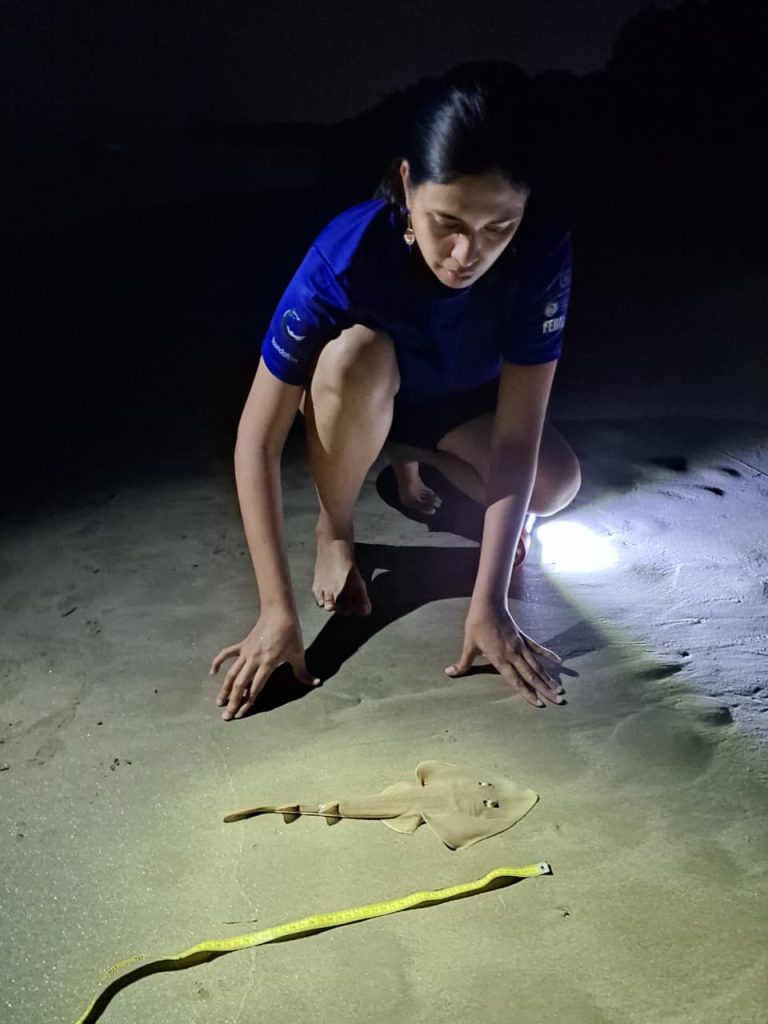
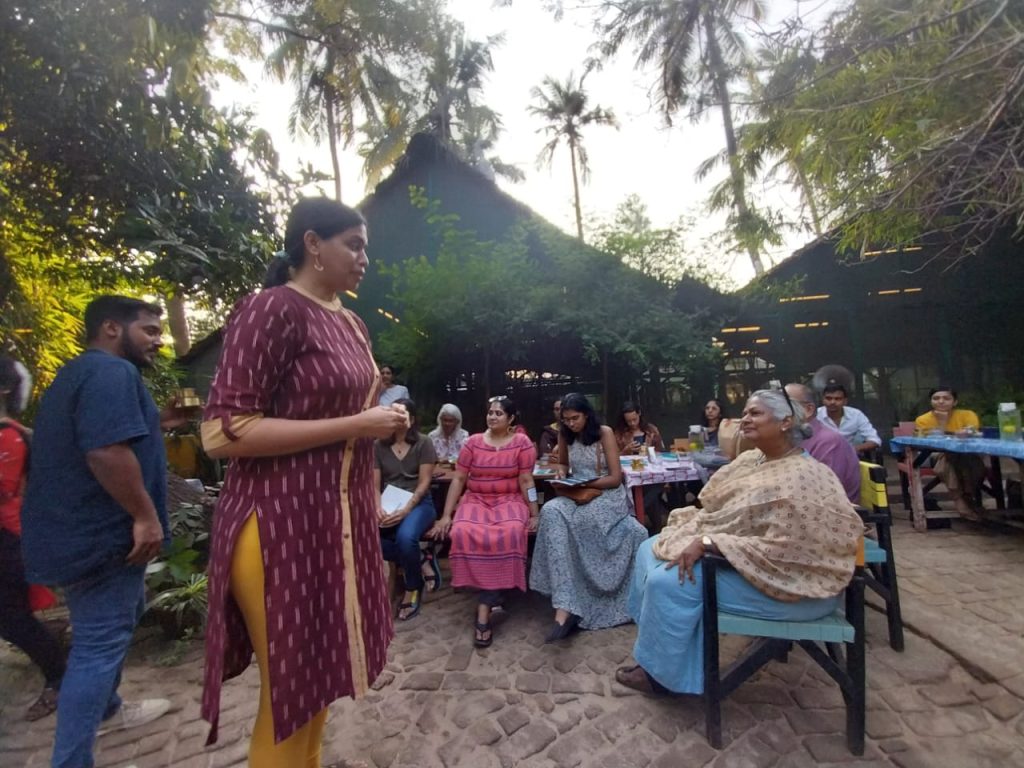
NMJ: You are the first woman to win the prestigious Future for Nature Award. In your experience, have you ever felt that working with sharks and sea fish as a woman researcher and conservationist, is more challenging when compared with men working in similar areas? Why?
DK: Fish markets and fishing villages have a good number of working women. Fisherwomen are very welcoming (once you get past the rough exterior). They have been very helpful for an outsider like me. At no point was I made to feel unsafe – even when I was at the harbour at 3:30 AM. That culture of women taking charge of the trade is a comfortable space for me to be in. The fishermen are used to the presence of working women and are approachable. There are taboos about having women on fishing boats, due to superstitions about the sea being a divine female (Kadal Amma) who may get jealous if there are women on board and react with bad weather or poor catches. Also, the boats are seldom gender-friendly (for instance there are no toilets onboard). So, it is difficult to convince the fishermen to take me on a fishing trip. My work is confined to land while my male colleagues go onboard for fishing trips. Fieldwork is often challenging for married women because societal expectations still disproportionately burden mothers with domestic responsibilities compared to fathers. In response to these double standards, many women find vital support and shared understanding through their conversations with fisherwomen who in one way or the other also face similar struggles.
NMJ: How are youngsters responding to InSeason Fish, especially young chefs and restaurant owners? How do you help them realise what they should consider while preparing a menu?
DK: The response from youngsters is promising, but behavioural change is a slow process. Since starting our public campaigns in 2018, it has taken us eight years to start seeing the results, where people approach us for sustainable seafood rather than us having to chase them. Though this is positive, the pace of transformation is very slow while addressing increasing, pertinent issues with regard to the ocean.
Culinary colleges have much to do in terms of integrating diverse and local seafood ingredients into the curriculum so that the next generation chefs know how to deal with all the species. For the moment, restaurants have to nudge their customers to choose more sustainably, by offering diverse kinds of fish on the menu. For instance, sea catfishes or barracudas could be a more sustainable substitute for seerfish (spanish mackerel). Highlighting the reasoning behind their choices on the menu cards would be a good way to convince the consumers to give it a try.
NMJ: Much of your work is based on the local communities. Would you briefly describe how the involvement of a local support system helps in the global conservation of sea fish?
DK: Local communities are the lifelines of fisheries management across the world. In so many places they have taken a holistic perspective, even before scientists thought of the concept of Ecosystem Based Management. Bringing together all the small, localised efforts together results in diverse, context-based solutions that are often as or more effective than top-down, government regulations which are strictly enforced. The advantage is having local buy-in and therefore compliance and monitoring. Local communities can also adapt rules to fit changing ecosystems more easily and faster, the kind of flexibility that is much needed in this era of climate change.
NMJ: Have you considered documenting your courageous and inspiring work as a book, Divya?
DK: I have been asked to do this before, but it seems like such an intense commitment that I have never got around to it so far. Maybe one day when I am done with the field research and find myself ready to spend time writing, I might. Luckily, others have documented bits of my journey. Anita Mani wrote about my work in her book Women in the Wild. It was an interesting process to see my life through someone else’s eyes.
NMJ: Would you like to share about your future projects ?
DK: I am aiming to learn from experiments in fisheries management, and shark and ray conservation from across the world. From small-scale fisheries sustainability certification in the UK, to fisheries management in Peru, I am involved in other global networking projects to see what lessons I can learn from them and vice versa.
Nithya Mariam John is a poet, translator and teacher from Kerala. A few of her works are housed in Kendra Sahitya Akademi’s Indian Literature, Kerala Sahitya Akademi’s Malayalam Literature Survey, Borderless, SETU, International Journal of Fear Studies and Samyuktha Poetry. Poetry Soup, Reflections & Ruminations and Bleats and Roars are short collections of her scribblings. She is a lazy scribbler on Mizhi (nmjs.in) and tries to climb over her unending ignorance by reading.