
Usawa Literary Review is headquartered in Mumbai, India.
PIN Code: 400050
Interested in working or collaborating with us?
Contact Us

Mind Matter and 2 other poems

From vanished smiles and fading streams, the solitary body claims strange endurance, forging profound agency and spirits sacred merger within vital memory.

How we lost the Wandering Philosopher Read Single →

After three days and three nights
He woke up.

Asked for water, thirsty for breath.
We gave him air, gave him water.

He smiled and said he needed a drink.
We tried reasoning with him

Said it was too early and first he must
Get well                 start walking                 get in shape.

But he waved his hand
And said: what there is, there is.

And pointing to his liver
He said he knew its ways more than anyone else

And promptly dozed off again.
Soon a doctor came on his rounds and banished us

To the faraway waiting room
Where we had parked for the night

From where you could see
The hill twinkling.

On the seventh day, we took him home
On the eleventh, he went to work

By the fourteenth, we forgot about him
Till he asked us, one day over the phone

If we knew the meaning of meaning.
This is when we gave up on him

And started looking after ourselves instead.
Apparently, he took the plunge seriously, into philosophy

Into time, into wisdom
And god knows where else he went next.

When we went to see him next
On the 51st day, he was not there.

His door was locked and neighbours said
He had taken his belongings as well

Also his diary, a ready to use toolkit
New address unknown.

And he disappeared from our lives
As soon as he had once appeared

Wearing a straw hat and a toothless smile
Asking if we knew Wittgenstein

And telling us stories of his interview
And how the job was fixed, in a quiet moment,

Revealing that the mouth of the universe was actually
Like a rose, pink and lush with meaning

And that he liked probing a little more.
He was looking for time, he said.

And that was when we realised
He was at heart a wanderer and not so much a friend

As a duty-bound discoverer of truth
That lived by street corners, huddled in winter blankets

Or basking for all to see, in summer sun
Like the headlines of our daily newspaper

A vagabond wandering in dim lit streets
Babbling about the end of the world

That has been postponed
By another season.

Mind Matter Read Single →

He was thinking of a sensory tool that could turn Descartes on his head. Microbiologists had been saying the gut controls the mind. For years, romantics and theologists believed there lived a heart somewhere, outside veins and arteries. He didn’t need to invent Freud and touch libido to reach there, the rage of the moment. The mind – as an extension of hands and feet – a river flowing neurons, electrons, synergies, synapses that connected one complex ecosystem to another, like an Amazonian rain forest. But who would be there to listen? Our ears heard what we wanted to. Our voices spoke what we thought. This was called choice. The dichotomy was left unattended. Mind-body, heart-hand.
This brought him to Tagore, Illich and Gandhi –all speaking on education. No, this was not a school project. His scientist brain told him about the utility of finding Alan Turing in a wall hanging. His algorithms had long outrun him in their ability to run engaged permutations of predictive thinking. His AI knew the solution before it knew the problem.
He was thinking of a way to feel time, not as discrete concrete structured blocks measured in time sheets but as rivulets of feeling, moments meeting moments, like Michelangelo’s fingertips.
He thought of biophilia, Gaia, the rest of indigenous wisdom, how we were strands in a larger, connected, yet dissonant universe, all beads and atoms and neurosis and what next. That too wasn’t his project. He wanted to understand synesthesia, make it predictable, as a signal from the fingertip, perhaps his left thumb, the one that would not bleed even when pricked. Or as the embarrassment of serendipity, just before it happened, possibly at a Board meeting. Something that went beyond intuitive pattern recognition.
This was strikingly Darwinian to some, but to him this was a lifetime’s memory, treasured like the ghost of Funes the Memorious, a product of Borges’ brain. It would remind him of oranges, when there were apples at the breakfast table. It would tell him good is sometimes great. It would walk into the classroom with crystal ball eyes, tell him if it would be a good class or another desperate one.
No one could share these thoughts with him. He wondered if he should simply call it an equation, or if there was more to it. Last time he felt like this, his memory cells were breathing flowers, fresh bougainvillea hanging from the windows of his soul. That was not what he was thinking. The last time he thought of this, he knew there was something inside gnawing at him, asking for a way out. And they simply called it psychology.
That was an embedded system. The materiality of being engulfed his senses like a premonition. Someone once called it a living breathing hypothesis. No one had yet emerged out of stone. That was the fundamental basis of life, to others still primitive thinking.
What would emerge from this, no one knew, not even him. But he knew the genie was already out of the bottle. It was only a matter of asking what the bottle was, what the genie wanted to do next. It was a little hard to know, because it meant tapping those fingers.
The brain resided elsewhere. It had changed direction, like the wind, as if to say et tu . A chorus still rang inside. Symphony of the elements. Beethoven had merged into those clouds.

The Taste of Living Read Single →

1. I can still taste life
Early morning, late evening, whenever in-between. Gold streams my morning door Fresh as prayer. All day I seek to find that feeling. As night changes to day. Afternoon tastes different. Its limpid air, languid and redolent Its magic solitary and ordinary as the passing sun. Evenings are best. The quiet undertow Keens in anticipation Lapping at the waters, tasting fullness of being. Soon it will be dark. Night breathes a strange silence in. The silence will reach my heart, prise open vast empty spaces. I will be a stroller on a foreign shore.

2. No taste in my tongue.
I can’t tell salt from sweet, tea from coffee. Can’t smell too. If there were noxious fumes around me I would think rose. I rely on memory – my only friend – For all those finer details.

3. Waiting
To get worse I get better Cure for an ulcer never found Make it simple. A sandwich, nothing special. Cucumber salad Boiled potato & lettuce Mayo for taste but you can Do without it. Try out other salads with the usual ingredients. As long as it takes, to make it. Sometimes an hour sometimes a life And then eat slowly, you have all the time And all day to chew it. Sometimes, you can take a little more – Maybe green chilli but better to avoid All spices till you recover And stay off spirits because one never knows Where they are hiding. A salmon sandwich is expensive. But once in a while everything is good Even anger which you should now curb to sublime perfection. Don’t let it rise from the stomach That’s where they should be. Anger reaches the head early and causes trouble – High BP & sullen kidney. Thank life for giving life. Thank those with fellow feeling who care. Yes, you can have the cup of tea, without milk and sugar And the occasional coffee too. My fee is the usual two fifty, but today’s session is for free.
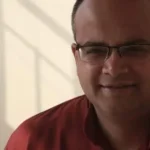
Amlanjyoti Goswami

Amlanjyoti Goswami ‘s new collection of poetry is ‘Vital Signs’ (Poetrywala). His earlier collection ‘River Wedding’ (Poetrywala) was widely reviewed. His poetry has been published in journals and anthologies around the world. A Best of the Net and Pushcart nominee, his poems have also appeared on street walls in Christchurch, exhibitions in Johannesburg, an e-gallery in Brighton and buses in Philadelphia. He has reviewed poetry for Modern Poetry in Translation and has read in various places, including New York, Delhi and Boston. He grew up in Guwahati and lives in Delhi.

Looking for more Poetry?

Browse the Poetry Archive →
Back to Issue

Support Our Work

If you enjoy our content, consider supporting us.

Support Us

We are an unfunded, independent feminist publication. We need your support to continue our work.