
Looking for vegetables in Mayur Vihar market in the evening of all time and 5 other poems
Through ancestral currents, women navigate patriarchys grip, forging deep resilience and reclaiming…
Read more →A mind seeks feeling time's rivulets, sensing whispered futures, where body and spirit finally merge.
He was thinking of a sensory tool that could turn Descartes on his head. Microbiologists had been saying the gut controls the mind. For years, romantics and theologists believed there lived a heart somewhere, outside veins and arteries. He didn’t need to invent Freud and touch libido to reach there, the rage of the moment. The mind – as an extension of hands and feet – a river flowing neurons, electrons, synergies, synapses that connected one complex ecosystem to another, like an Amazonian rain forest. But who would be there to listen? Our ears heard what we wanted to. Our voices spoke what we thought. This was called choice. The dichotomy was left unattended. Mind-body, heart-hand.
This brought him to Tagore, Illich and Gandhi –all speaking on education. No, this was not a school project. His scientist brain told him about the utility of finding Alan Turing in a wall hanging. His algorithms had long outrun him in their ability to run engaged permutations of predictive thinking. His AI knew the solution before it knew the problem.
He was thinking of a way to feel time, not as discrete concrete structured blocks measured in time sheets but as rivulets of feeling, moments meeting moments, like Michelangelo’s fingertips.
He thought of biophilia, Gaia, the rest of indigenous wisdom, how we were strands in a larger, connected, yet dissonant universe, all beads and atoms and neurosis and what next. That too wasn’t his project. He wanted to understand synesthesia, make it predictable, as a signal from the fingertip, perhaps his left thumb, the one that would not bleed even when pricked. Or as the embarrassment of serendipity, just before it happened, possibly at a Board meeting. Something that went beyond intuitive pattern recognition.
This was strikingly Darwinian to some, but to him this was a lifetime’s memory, treasured like the ghost of Funes the Memorious, a product of Borges’ brain. It would remind him of oranges, when there were apples at the breakfast table. It would tell him good is sometimes great. It would walk into the classroom with crystal ball eyes, tell him if it would be a good class or another desperate one.
No one could share these thoughts with him. He wondered if he should simply call it an equation, or if there was more to it. Last time he felt like this, his memory cells were breathing flowers, fresh bougainvillea hanging from the windows of his soul. That was not what he was thinking. The last time he thought of this, he knew there was something inside gnawing at him, asking for a way out. And they simply called it psychology.
That was an embedded system. The materiality of being engulfed his senses like a premonition. Someone once called it a living breathing hypothesis. No one had yet emerged out of stone. That was the fundamental basis of life, to others still primitive thinking.
What would emerge from this, no one knew, not even him. But he knew the genie was already out of the bottle. It was only a matter of asking what the bottle was, what the genie wanted to do next. It was a little hard to know, because it meant tapping those fingers.
The brain resided elsewhere. It had changed direction, like the wind, as if to say et tu . A chorus still rang inside. Symphony of the elements. Beethoven had merged into those clouds.
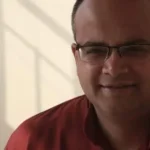
Amlanjyoti Goswami ‘s new collection of poetry is ‘Vital Signs’ (Poetrywala). His earlier collection ‘River Wedding’ (Poetrywala) was widely reviewed. His poetry has been published in journals and anthologies around the world. A Best of the Net and Pushcart nominee, his poems have also appeared on street walls in Christchurch, exhibitions in Johannesburg, an e-gallery in Brighton and buses in Philadelphia. He has reviewed poetry for Modern Poetry in Translation and has read in various places, including New York, Delhi and Boston. He grew up in Guwahati and lives in Delhi.