Visceral verses explore the fractured Self as a contested site of lived memory, navigating profound grief while reclaiming voice against systemic silence.
I am waiting for her at the edge of my body—
I look here, I look there—
endless road signs;
one by one, all traffic lights disappear.
The night is a naked knife,
the moon a convicted criminal.
Beyond the harbor, war photographs flutter
from burnt apartment walls—
children without shadows,
helmets filled with sand,
tanks dragging silence through the rubble.
I am rescuing wounded fish from the sea.
Black smoke rises like a second history
of my nameless nation.
Somewhere, flamingos crawl slowly
through fields of sleeping wheat.
Spring is here—
sirens continue stitching the dark together.
They return my body without its parts;
she believes it is me.
We offer prayers at gunpoint.
I sleep again in my zebra pants,
beneath ceilings cracked by invisible bombings.
Every day, the windows fill with lavender light—
I bite my lips, then rinse my face, brush my teeth,
pick at my skin even though I know better,
I spend my whole day
eating junk food, watching
YouTube videos of war in the desert.
slowly, the day sinks into the mirror of my bedroom,
all soldiers become dolls,
killing each other with painted, polished hands,
I keep to myself, scream into a pillow—
my body is covered in post-period spotting,
I start looking
for wads of toilet paper, something to erase it,
but see a landfill of stained cotton flowers
stacked like smiling gods waiting to be buried alive.
A pillar, monk-grey, still standing,
while the slumbering flesh of stone collapses
into the slow erasure of desire.
Hannah whispers—
verses submerged beneath Heidegger’s aging skin,
where existence rusts and rots
like warring nations laundering their sins.
They smoke their secrets through charcoaled memory—
eyes dripping with extinction memories.
Night thickens inside their freckled bodies,
underground terracotta soldiers searching their pockets
for dead bougainvillea.
Is this the unconscious history of violence,
or the repressed rage of toy tyrants?
Everything burns here, even the dust of moon.
The war has ended,
but there is no water in my desert city—
everyone carries milk in clay pots for the gods.
The thick syrupy scent arouses me
filling my body with strange cravings,
as if I have arrived somewhere unfamiliar
perhaps hostile.
Everything after war feels like intoxication.
like a steamy religious procession.
“Is this real or fictional?” I ask.
she does not answer
I stammer again—she knows
I have difficulty with speech.
She says, “let me save you from your thirst”.
I kiss her thick bleeding lips,
and suddenly I begin to explode like fat watermelons.
I wake up early,
arrange the antique rugs from Beirut
change the flowers in the vase,
the window glass trembles
like the silent love,
everything remains in its place,
even the vanishing moon in her eyelashes.
I realise
everything is so beautiful,
I rearrange everything again,
nothing is now missing
except my name.
I see—
they stand in the corner,
quiet and unmoving,
as if they had always been there,
beside their loaded guns.
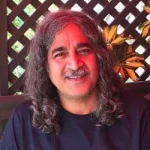
Ashwani Kumar is a poet, political scientist, and professor whose work has been widely published, anthologized, and translated into several languages. His poetry collections include My Grandfather’s Imaginary Typewriter, Banaras and Other Poems, and Map of Memories, and he is also the author of the acclaimed non-fiction work Community Warriors. He has edited major poetry anthologies, including Rivers Going Home, Scent of Rain, and River of Songs, co-founded the Indian Novels Collective, and edits the Hummingbirds Poetry Series in partnership with Red River. He was also a chief editor of Global Civil Society at the London School of Economics. He has held visiting appointments at leading international institutions, including Heidelberg University, the Korea Development Institute (KDI), and the German Development Institute (DIE). He also writes for publications such as The Indian Express, The Hindu, Financial Express, Outlook India, Scroll, and The Print. He lives in Mukteshwar and Mumbai.