
THE DOTTED LINE
Oceans redefine, their count a fluid question. Gulls, whales navigate blurring borders,…
Read more →Encounters with ancient verses, a body is not a soul. Instead, it—something else— resides within. A felt form, a haunting echo.
Poor soul.
Bless her soul.
Soul-mates.
Chicken-soup for the soul.
S.O.S.
How easily we say “soul”.
It was a soul-stirring experience. (Did the soul move?).
Remember when we bared our souls to each other? (Otherwise, we keep our souls typically covered?).
The word “soul” does not hand us a mental image, nor memory. Unlike “tomato” that we can touch, smell, see, taste, experience.
Is it a wisp, like smoke? Or like a genie inside a bottle, released (- homeless?) upon “death”? Is it transparent? Shaped like a human? Or are there different types of souls— your soul the image of owl, and my soul the image of wolf?
What if we had to explain soul to someone else?
When Krishna persuades Arjuna to fight in the war of the Mahabharata, one of the main arguments he uses is that the ātman (- which some translate as “soul” -) is indestructible.
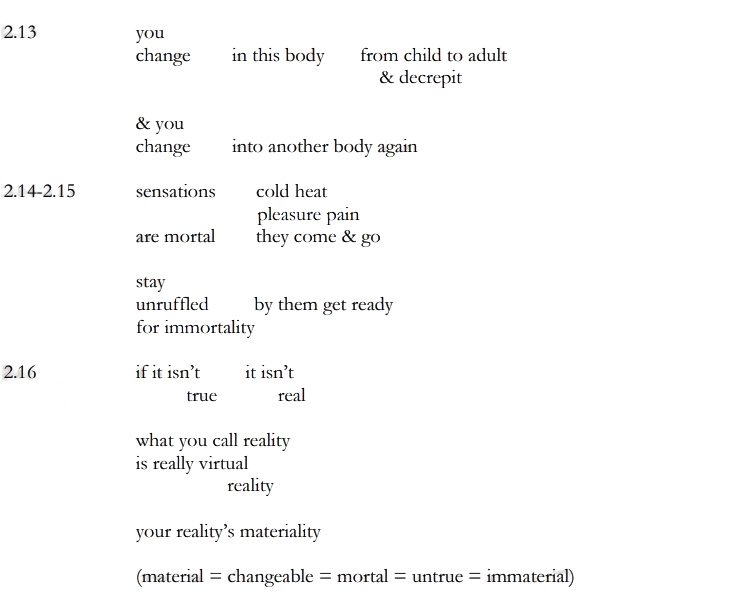
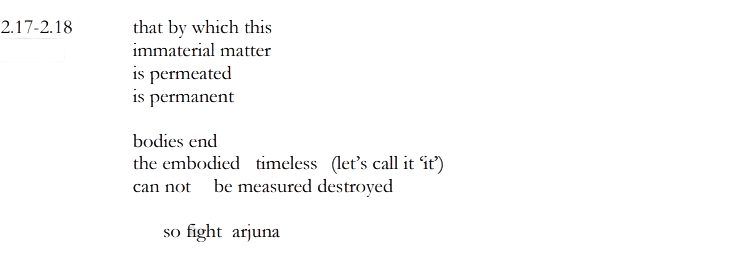
Krishna explains ātman in terms of the body. Instead of saying “ātman”, Krishna calls it “dehin” – that which has the deha/body. Stanza after stanza, he discusses the nature of dehin. And he calls it, “it.”
Body/deha, works as an anchor in the explanation of ātman/soul.
Arjuna understands what is body. As Krishna speaks, he can begin to think, what is this it that permeates the body?
That which has the body is himself.
He. Himself. His self.
He himself has his body.
He is not his body.
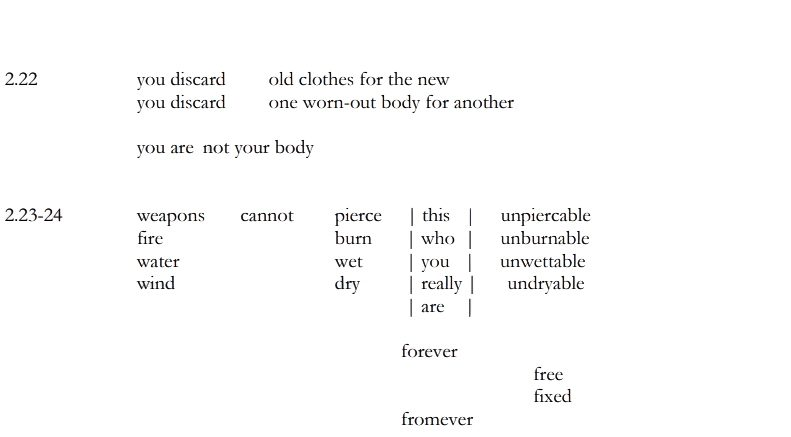
The excerpts in this essay are from the author’s translation of the Bhagavad Gita : God’s Song, published by HarperCollins (2023).

Mani Rao is the author of three books in translation including Bhagavad Gita: God’s Song (HarperCollins), Saundarya Lahari: Wave of Beauty (HarperCollins), and Kalidasa for the 21 st Century Reader (Aleph Books); eleven books and chapbooks of poetry including Sing to Me (Recent Works Press) and Echolocation (Math Paper Press), and a book based on research into mantra experience— Living Mantra: Mantra, Deities and Visionary Experience (Cham Springer). She was a visiting fellow at the Iowa International Writing Program, and held writing residencies at Omi Ledig House, New York, and IPSI Canberra. She worked in advertising and television in Mumbai and Hong Kong for two decades, and then returned to studies for an MFA in creative writing and a PhD in Religious Studies. She lives in Bangalore. https://linktr.ee/maniraopoem