
✨ LATEST ISSUE •
From ULR
Issue 15 – REFUSE
Translating Faiz: At the Still Point of the Turning Circle
A new English translation of Faiz Ahmed Faiz's Intesaab, one of Urdu literature's most enduring poems of dedication and dissent. Alongside the translation, an essay on Faiz's singular place in the canon, the poem's many lives — sung, recited, chanted at protests — and what it means to attempt a version that Agha Shahid Ali never did.
Original Language: Urdu
A Translation of Faiz Ahmed Faiz’s Intesaab (Dedication)
Agha Shahid Ali, in his introduction to The Rebel’s Silhouette: Selected Poems of Faiz Ahmed Faiz, writes:
“For me, translating Faiz has led to its own moments in which I am sometimes at the still point of the turning circle [emphasis added], sometimes part of its revolution. Sometimes the circle comes to a dazzling halt, and I manage to find my meaning as a translator.”
Since I first read that line last year, I haven’t quite managed to get rid of it. It lodged itself somewhere deep in the conscience and stayed there. It captures, with unsettling accuracy, the vertigo of reading, translating, and, in some sense, living inside the universe that Faiz inhabits.
I’ve been sitting with Faiz for a long time now. By which I mean: reading his poems, listening to his poems, listening to others recite his poems, mistrusting my memory of his poems, rereading his poems, and then reading various English translations and wondering, with increasing unease, whether we were all reading the same poet.
Faiz Ahmed Faiz (1911—1984) occupies a strange and enviable place in modern literature. He is canonical without being embalmed, political without being doctrinaire, lyrical without being absurdly evasive. In the Urdu-speaking world, he is read the way Spaniards read Neruda, Germans read Brecht, or Russians read Akhmatova: not as a specialist taste or a niche enthusiasm, but as part of the furniture of moral life. Few poets are as divisive. He is loved and loathed by Marxists and McCarthyists, Pakistanis and Indians, administrators and anarchists, Sunnis and Shias, pious believers and atheists alike. He is loved by friends of enemies and hated by enemies of friends. His poems circulate orally, musically, and illegally. They have survived bans, prisons, exiles, and well-meaning school curricula.
As Edward Said observed, in a passage quoted in The Rebel’s Silhouette:
“The crucial thing to understand about Faiz … is that like Garcia Marquez he was read and listened to both by the literary elite and by the masses. His major — indeed it is unique in any language — achievement was to have created a contrapuntal rhetoric and rhythm whereby he would use classical forms (qasida, ghazal, masnavi, qita) and transform them before his readers rather than break from the old forms. You could hear old and new together. His purity and precision were astonishing, and you must imagine therefore a poet whose poetry combined the sensuousness of Yeats with the power of Neruda. He was, I think, one of the greatest poets of this century, and was honored as such throughout the major part of Asia and Africa.”
Faiz was the first Asian poet to receive the Lenin Peace Prize (1962) and was later nominated for the Nobel Prize in Literature. He was associated with the Progressive Writers’ Movement, edited leftist journals, advised unions, annoyed generals, and spent years being shuttled between jail cells and exilic foreign capitals (notably Moscow and London). Remarkably, none of this turned him into a full-time pamphleteer. His greatest trick was to make resistance sound intimate and love sound dangerous. Even when he writes about the state, he does so as if addressing a wayward lover who has disappointed him deeply, but not surprised him.
Shahid Ali, who translated Faiz, whose family hosted Faiz in Kashmir, and who was himself smitten early on by the musical genius of Begum Akhtar, one of Faiz’s greatest interpreters, put the case plainly:
“Given Faiz’s political commitments, particularly his Marxist/humanist understanding of history, audiences may hastily assume that he was a poet of slogans. His genius, however, lay in his ability to balance his politics with his (in some ways stringently traditional, often classical) aesthetics without compromising either.”
For those interested in the translation question more broadly, I strongly recommend Ali’s introduction to The Rebel’s Silhouette. It is, admittedly, a little self-indulgent, but it is also a rare thing: part translator’s notebook, part memoir, part lecture on precision, rhyme, and what survives the crossing between languages. Manan Kapoor’s excellent Caravan essay on Ali’s translations of ‘revolutionary poets’ is also well worth reading.
Faiz, of course, like all immortal poets, continues to inspire poets writing today. Take, for instance, this fragment from Manash Firaq Bhattacharjee’s A Post Office Without a Country, from the Srinagar chapter of The Penguin Book of Poems on the Indian City :
In Srinagar, grief roams the streets
like a cat, looking for company.
The fish seller waits for a letter,
no one will send: a letter from god.
I hear Noor Jehan singing Faiz
on the radio, and I twist the refrain
to suit the elegy of our time:
Do not ask me of my old griefs, my love,
There are griefs other than your country.
Which brings me to Intesaab (اِنْتِصاب), one of my favourite Faiz poems.
It is a beautiful poem, and its breadth is best measured by the sheer variety of contexts in which it lives. It is recited, elocuted, sung, whispered, shouted, weaponized, mourned.
Take, for example, the moving musical rendition of Intesaab by Nayyarah Noor (1950–2022) from the stellar album Nayyarah sings Faiz. Noor’s voice lends to Faiz’s words an aching tenderness. Faiz himself often recorded recitations of his poems, and in some versions you hear him too. There is something quietly authoritative about hearing the poet read his own lines, as if this were not merely one way to hear the poem, but perhaps the way he imagined it being heard.
For a more formal example, take Naseeruddin Shah’s declamation and analysis, delivered at the Kolkata Literary Festival 2012 with his characteristic regal seriousness and gravity. Then there is the rawer and more overtly political version by Ammar Rashid, a Pakistani activist, politician, and artist who was arrested, and later released, on sedition charges. He performs his version of Intesaab in Delhi, at JNU no less.
That this poem can survive, and even thrive, across such radically different registers for such radically different audiences tells us something important about its architecture.
The title Intesaab itself is dresists easy translation. It is often rendered as ‘dedication,’ since the poem originally appeared as a dedication in one of Faiz’s books. But it has also been translated by others as ‘preamble,’ ‘preface,’ ‘attribution,’ and even ‘acknowledgement.’
The poem itself is short and spare. It seeks to address power without flattering it with the dignity of direct confrontation. There is no ranting, no crescendo, and almost no form. Instead, Faiz lists. He reminds. He notes.
What makes Intesaab unsettling is precisely this restraint. There is no release at the end, and the verses refuse catharsis. The words promise neither redemption nor closure. Tyrants appear here not as monsters but as clerks who have misplaced some documents and will, eventually (maybe on the Day of Reckoning), be asked to produce them.
I’ve been trying, and failing, to translate Urdu poetry for several years now. Mostly Ghalib, mostly the ghazal, mostly in pursuit of a kind of formal and tonal precision that is probably unhealthy and likely impossible. [For genuinely inventive Ghalib translations, see Maaz Bin Bilal, who manages to be both faithful and mischievous.] Faiz, of course, has been translated superbly by many gifted hands, most notably Agha Shahid Ali. But as far as I can tell, Shahid Ali never translated Intesaab.
There are, to be fair, several English versions of the poem already in circulation. And yet, for reasons that are partly aesthetic and partly temperamental, none have sat right with me. Two notable and thoughtful versions are by Mustansir Dalvi and Raza Rumi.
I’ve tried to translate Intesaab into the poem I wanted to read and could not quite find. This version makes no claim to authority, linguistic purity, or moral superiority. No translation ever can. I wanted a version that did not inflate Intesaab into a manifesto or deflate it into a mood piece. An English version that could, as the poem often does, be chanted at a university protest, set to a soulful ghazal, or recited on a sombre occasion by a Naseeruddin Shah-type figure without changing a word.
The translation follows. Apologies to the purists. Objections are welcome. Alternative versions are inevitable. Faiz, I suspect, would have preferred disagreement to reverence.
Dedication
Intesaab | इंतिसाब | اِنْتِصاب
Poet: Faiz Ahmad Faiz | Translator: Bilal Moin
Here’s to today
and
to today’s grief,
to the day’s grief that stands estranged
from life’s full-blooming garden.
To the grove of yellow leaves,
to the grove of yellow leaves that is my land,
to this assembly of anguish that is my land.
To the clerks with listless souls,
to moth-eaten hearts and moth-eaten tongues,
to the postmen,
to the tonga drivers,
to the railwaymen,
to the workshops’ hungry heroes.
King of the World,
the Lord of all else,
and God’s deputy on earth.
To the peasant
whose livestock tyrants have seized,
whose daughter bandits carried away,
from whose palm-sized field
one finger the patwari has severed,
the other finger the state has sliced
under the guise of yet another tax;
whose turban lies ripped to shreds
under the feet of oppressors.
To those mourning mothers
whose children’s cries cut through the night
and, beaten by sleep, cannot be steadied
in their weary arms
who do not voice the pain
that petitions and pleas cannot soothe.
To those damsels
in whose eyes flowers bloom
on the trellises of lattice screens and windows
that have withered in wait
To those brides
whose bodies, set out night after night,
have grown bored of the betrayal of beds
To those widows
To those hovels, alleys, and _mohallas_
in whose filth the moon returns nightly
to make her ablutions;
in whose shadows one hears
her wailing and weeping,
the henna on hems,
the chime of bangles,
the perfume of tresses,
the stench of breasts swelling with desire,
scalded in their own sweat.
To those students
who knocked at the doors
of the custodians of art and learning
who stood strong, arms outstretched,
demanding books and pens.
To those innocents, who, in their innocence
set off with their lamps in search of hope
but reached the heart of darkness
where shadows swept them in a never-ending night.
To those captives
in whose chests the night-bright pearls of tomorrow
pearls that, in the frenzy of imprisoned nights,
have burned, burned like scattered starlight.
To the messengers of the days to come
those who, like the fragrance of a rose,
have been all but consumed by the message they carry.
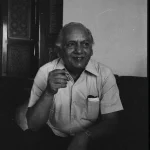
Faiz Ahmed Faiz
Faiz Ahmed Faiz was born on February 13, 1911, in Sialkot, India, which is now part of Pakistan. As a Marxist, he rejected the notion of "art for art's sake". He has been described as a "committed" poet who used his simple verse to probe not only beauty and love but also humanism and justice. His imprisonment was evident in more than his two collections of poems written during his political detention. Faiz was a nominee for the Nobel Prize and, in 1963, was the first Asian poet to win the Lenin Peace Prize. (Source: Library of Congress)

Bilal Moin
By day, Bilal Moin is an economist. By night, he is a writer, poet and photographer. Most recently, he edited The Penguin Book of Poems on the Indian City (2025), an anthology of 375 poems—translated from over 20 languages and set in 37 cities—spanning a 1500 years of Indian urban poetry. His writing has appeared in Rattle, Oxford Isis, Indian Literature, Himal Southasian and elsewhere. His first collection of poetry was published in 2018. He was born and raised in Bombay, or Mumbai, depending on your persuasion.