
A.R. Venkatachalapathy on ‘Coffee, Caste, and Colonial Tamil Nadu’ in Conversation with Sayani Sarkar
Venkatachalapathy traces how coffee hotels in colonial Tamil Nadu became sites where…
Read more →Abrona Aden examines Lepcha poetry and indigenous identity, revealing the Rongring script's visual rebellion and the politics of personhood. The discussion interprets writing as a "bloody business" central to reclaiming a marginalized voice.
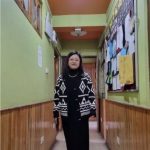
Abrona Lee Pandi Aden is an Assistant Professor at the Department of English, Sikkim University, India. Her short stories and poems have appeared in Muse India, Mekong Review, Sapiens Anthropology Magazine, The Bangalore Review, among others. She translates from Nepali to English. She is a recipient of the ICM Global South Translation Fellowship awarded by the Institute of Comparative Modernities, Cornell University, in 2022. She has been the Charles Wallace India Trust Creative Writing Fellow at the University of Kent, Canterbury, UK during their Spring Term, 2024.
SS: Today I am in conversation with writer, poet, and professor Abrona Lee Pandi Aden to explore the powerful world of Lepcha poetry and indigenous identity. We talk about the visual rebellion of the Rongring script, the politics of personhood, and why writing poetry is sometimes a beautifully “bloody business.” The questions are based on the excerpts from The River of Blood and Dreams by Abrona Aden published by Red River 2026 from Matchbox by Usawa March 2026 edition.
Note: The Lepcha language is also referred to as Rongring. The term ‘Rong’ here is the general term for Rongring used by the Lepcha community.
First Encounter
SS: How did you first come across the history of the Lepcha language and community, which remains the essence of this book?
AA:Lepcha history, language, vignettes of Lepcha life—all these were a part of our lives as I grew up. This was not something I chanced upon, or discovered in an archive, as such. My paternal grandmother passed on a lot of stories to me, her knowledge of the land, the language, the people. I think I started to grow aware of terms like “history of the Lepchas” as I started reading books about the Lepchas, books not all necessarily written by Lepcha people themselves. “Lepchas” as a case study in research, in documentaries, that kind of thing intrigued me and made me wonder about the processes and nuances of knowledge-making about people and places. I have a Lepcha anthropologist friend with whom I could think out loud, and most of these poems are also in many ways extensions of those conversations. (As an anthropologist from the community she was my first safe space). Some of my poems carry this sense of wonder, and enquiry.
The Spark
SS: What compelled you to start writing poems specifically about the Lepcha experience? How does this experience differ from prose writing?,
AA: I wonder aloud about the “Lepcha experience” in my poems to contemplate, to enquire, but also, to rest in poetry. Poetry allowed me that range and depth of being: of contemplation, of enquiry, of wonder, of curiosity, of love, of healing, of liberation. Poetry gives you a safe space, where you needn’t explain or justify every single utterance. It frees you, rests you and loves you back. That is what compels me to write poetry, to be in poetry.
Writing poetry is different from prose for me. I write both short stories and poems and once, I had started to write a short story called “The Room” about a woman who is struggling to write, struggling between silence and writing given the constraints of her life as such. However, I simply could not complete that story, and then that story became a poem. I tried writing a poem instead and “The Room” came to be.
Some experiences can perhaps only be distilled through poetry, perhaps it is only poetry that has the language of access to what we feel, emote, live. Poetry has this magical power to unravel elemental mysteries your mind, your body, your heart and being hold; things you cannot explain in prose sometimes shine through instead, in poetry. I think that’s the fundamental difference for me.
The Conversation
SS: What conversation about caste, religion, language, or place do these poems open?
AA: Not so much about caste, but the poems in The River of Blood and Dreams try and look at ways in which indigenous identity and personhood, womanhood, motherhood coalesce to make art, not despite but because of the lived realities in these hills I call home. These poems mull over the predicaments of being a woman and a poet. They look at how the Lepcha language is endangered, the mother tongue flayed through the lens of a history of disenfranchisement. Place is very important for me, most of these poems are tied to a place, to Mayel Lyang, to my hometown Kalimpong. Some poems came to me in London, some in Scotland, some in New Delhi, some at airports as I was passing through immigration with my “weak” passport. These poems speak to how place and identity cleave intimately together and are permeated by politics of language, of gender, of indigeneity as such.
The Line That Stayed
SS: Was there a moment, image, or idea in this book or a specific poem that has lingered with you?
AA: There are many, actually, but if I were to choose one it would be from “The Colour of Silence.” This poem deals with the constant struggle between speech and resistance, speech and silence. It’s a “bloody” poem because it’s a “bloody” discourse: the speech act is violent because is seeks to disrupt silences that have been justified, consolidated, fortified and naturalised by the powers that be. The act of speaking thus becomes inscribed with violence though it is trying to speak against the idea of violence itself. Poetry is not just pretty. I think writing poetry is bloody business sometimes! The lines:
“Silence is Red
The colour of my tongue
Tasting blood
From all the words
That have been bleeding from it
Red
The colour of my words
Bleeding forth
Drying up
And bleeding again.”
Pass It On
SS: Name one book by a woman, marginalized, or feminist-forward writer that more readers should discover.
AA: Alice Te Punga Somerville’s Always Italicise: how to write while colonised has been the most phenomenal book of poems I’ve read in recent times and I think more people should read her. This book is published by a University Press (Auckland University Press) and though University presses publish stellar work, the target readership is more or less people from academia which is why people outside academia may not be able to access them as easily. Given a chance, one should definitely pick up this extraordinary book where she addresses the cost of writing as a Māori scholar and poet.
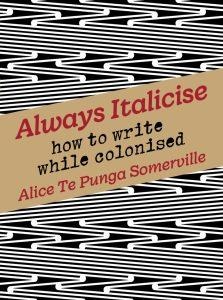
(Image caption: Always Italicise: how to write while colonised by Alice Te Punga Somerville, Auckland University Press, 2022)
Craft Rituals
SS: Do you have any routines or rituals you follow before or during your writing sessions?
AA: I do find that writing in the mornings are more fruitful and productive for me. I try to get as much as I can on paper, get the first draft out as flawed as it may be. With pen and paper, on nice notebooks if I can help it.
I don’t really have rituals per se. But I do wish I could say I had a ritual like sitting down with a cup of fancy tea, but all that fancy tea gets exported, doesn’t it?!
SS: Alice Te Punga Somerville’s Always Italicise got me thinking about how we constantly italicize non-anglophone words. Do you think colonization changed the aesthetics of writing in print even though we have come a long way from Gutenberg days to digital writing?
AA: The aesthetics of writing has definitely been changed by colonisation across cultures and spaces and people and tongues. When one reads a text in English, the “foreign” words in italics stand out, their difference at odds with the rest of the text. They become “othered” in a sense. What got me so drawn to Alice Te Punga Somerville’s Always Italicise is how she looks at the conventions of writing in English per se and turns the tables on them by italicising all the English words in her work, because they are “foreign” to her. An excerpt from her poem “Kupu rere kē”:
Now all of my readers will be able to
remember
which words truly belong in Aotearoa and
which do not.
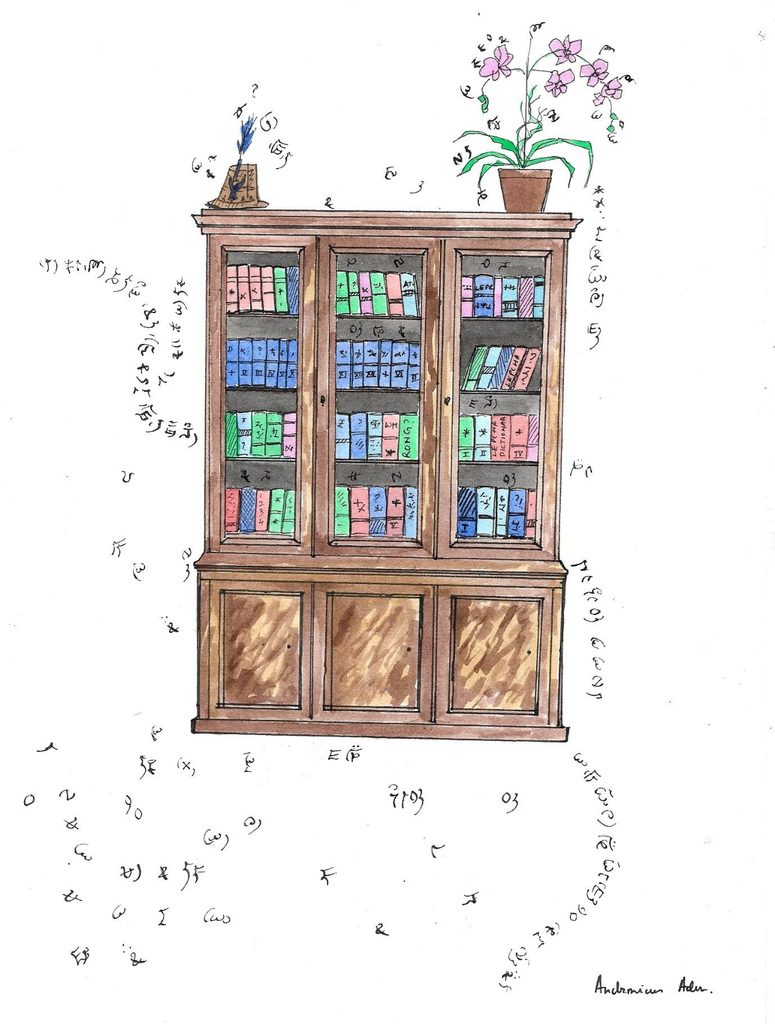
SS: I am fascinated by the illustration for the poem “My Rong Tongue”. The bookshelf with the outpouring script and a Lepcha dictionary on the shelf. Tell us about your collaboration with the illustrators for this book.
AA: When I first saw Andronicus’ illustration for “My Rong Tongue” I was struck by how striking the visual interpretation of the poem was. I had asked the illustrators, Andronicus and Rongnyoo, to work with poems of their choice and interpret them any way they saw fit. I was bowled over by their rendering of the poems into illustrations, to be honest. I think I got extremely lucky with the illustrators because I didn’t really have to explain anything to them. There was a tacit understanding that came to be amongst us, and we let art do the talking.
The illustration for “My Rong Tongue” features a colonial-era book-shelf that hosts a number of Lepcha texts, including a dictionary. The illustration reflects on how Lepcha literature, knowledge surrounding Lepchas are all squeezed into one space, archived, documented, circumscribed and rendered inaccessible. The Lepcha letters themselves long to be free of these spaces and so they seep out of these confines and break free.
Tea or coffee is such an essential ritual for many writers. And yet, all the Darjeeling ends up in warehouses abroad. I’d love to hear your thoughts about the politics of the tea industry and how it deprives us experiences of comfort.
Yes, perhaps tea and coffee are essential and valid rituals for many writers but I somehow do not have any such ritual. Tea has been part of our lives since our growing up days, I drink tea but I don’t have a writing practice built around tea or something to that effect. In our home, we always bought loose leaf tea from known sellers in town, we never “experimented” as such. Having said that, I must tell you I was stumped by the variety of tea I saw up for sale in the UK two years back . Seeing Darjeeling tea in all sorts of different concoctions and combinations on the shelves at M&S made me truly wonder at the variety of teas being offered up to consumers there. And for a moment I thought, “so this is where all the tea is at!”
