
From
Matchbox – April ’24
Review: Knife
Rushdie’s account delineates the existential fight for artistic autonomy and free speech against violent fundamentalism, framing language itself as a defiant weapon against revisionism.
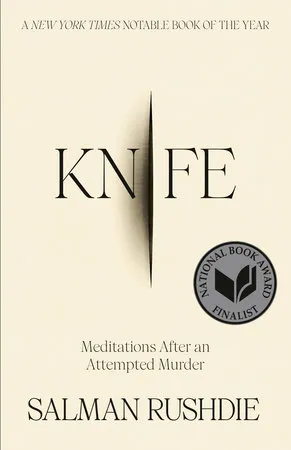
At first, it reads like a diary, innocuously filled with medical procedures, family members’ travel plans, love, friendship, books and films, and thoughts on the nature of art and violence. But Knife is much more than that: this is Salman Rushdie speaking directly to the reader with his characteristic humor, an uncharacteristic tenderness, and absolutely no apology.
“I am content to be judged by the books I’ve written and the life I’ve lived. Let me say this right up front: I am proud of the work I’ve done, and that very much includes The Satanic Verses. If anyone’s looking for remorse, you can stop reading right here. My novels can take care of themselves.”
In contrast to the epic scale of his rich, layered storytelling, redolent with intertextuality, filled with characters bordering on the mythical, in language that itself is a living, breathing creature, this memoir is written with minimal literary embellishments. Here is a man gravely injured by a knife attack, yelping in pain, dealing with unpleasant and seemingly unending medical treatments, worrying about finances, concerned about his son’s fear of flying, all while deeply loving and being loved by his wife, the poet Rachel Eliza Griffiths:
“Let me offer this piece of advice to you, gentle reader: if you can avoid having your eyelid sewn shut…avoid it. It really, really hurts.”
“What makes hospitals happiest is when the patient says he is having bowel movements.”
“Striding forward, seriously distracted by the presence of the brilliant, beautiful woman I’d just met, and as a result not really looking where I was going, believing myself to be stepping through an open space, I hit the glass door hard, and fell dramatically to the floor. It was such a goofy, uncool thing to do.”
For decades we have come to associate Salman Rushdie with flamboyance, glamor, and gregariousness, and often forget that he is, after all, human: a writer of irreverent, brilliant, successful novels who creates magic realism on the page but does not believe in miracles in real life, who aches for the comfort of his own bed, his own home after weeks in the hospital. Knife is that rare memoir that brings to us the everydayness of his personality without letting us forget his genius as an artist. The attack left Rushdie blind in his right eye, with reduced function in his left hand, and partial paralysis of his lower lip. Blindness has been his deepest fear, and he is now forced to live with one eye, which is also under treatment for macular degeneration.
And then there are the bigger themes the book addresses: Should Rushdie have withdrawn the Satanic Verses which he calls “my poor maligned book” or apologised to those he had offended to a murderous rage, or led a low-key, low-visibility life? Many thought so. However, Rushdie did none of these; he wrote. And he lived. He fell in love multiple times and lived a life filled with friendship and public engagements. And finally made America his home.
Rushdie also shares his deep love and yearning for India. While sharing the statements of President Biden of the US, President Macron of France, even Boris Johnson of the UK condemning the attack on the 12th of August’22, Salman Rushdie shares, “India, the country of my birth and my deepest inspiration, on that day found no words. ” Later, he recounts his nightmares caused by PTSD, “I dreamed of returning to my beloved Bombay—not Mumbai—and kneeling to kiss the tarmac as I came down from the plane, but when I looked up there was a crowd shouting at me, “Dafa ho.” Begone.”
Satanic Verses is that rare book that managed to infuriate many Muslims, Hindus, and Western intellectuals at once. Banned in India, Pakistan, Sri Lanka, Sudan, Malayasia, and later in many other places, the novel unleashed a series of violent attacks across the globe: In 1991, Ettore Capriolo, who translated it into Italian, was attacked and stabbed at his residence in Milan. Shortly after, Hitoshi Igarashi, the Japanese translator of the book, was fatally stabbed near the university in Tokyo. In 1993, William Nygaard, the Norwegian publisher of Rushdie’s book, was shot near his residence in Oslo. Knife, clearly, has been a popular weapon with these assassins attempting to protect the world from books as dangerous as the Satanic Verses. Law enforcement officers in Chautauqua, New York also found numerous knives in the assassin’s confiscated bag.
Rushdie writes, “A gunshot is action at a distance, but a knife attack is a kind of intimacy, a knife’s a close-up weapon, and the crimes it commits are intimate encounters. Here I am, you bastard, the knife whispers to its victim.”
And later meditates, “When a knife makes the first cut in a wedding cake, it is a part of the ritual by which two people are joined together. A kitchen knife is an essential part of the creative act of cooking. A Swiss Army knife is a helper, able to perform many small but necessary tasks, such as opening a bottle of beer.”
And finally declares, “Language, too, was a knife. It could cut open the world and reveal its meaning, its inner workings, its secrets, its truths. It could cut through from one reality to another… Language was my knife. If I had unexpectedly been caught in an unwanted knife fight, maybe this was the knife I could use to fight back.”
In parts the book is sombre – many of Rushdie’s friends are dying or dead, and he himself goes through pangs of survivor’s guilt, in parts an affirmation of his conviction in the power of art, but above all, this is a love story between Salman and Eliza and to the fearlessness of a writer who in spite of the knife attack still chooses to declare, “I understood that my second-chance life could not content itself with private pleasures alone. Love, above all things, and work, of course, but there was a war to fight on many fronts—against the bigoted revisionism that sought to rewrite history, whether in New Delhi or in Florida”
This is a book we must all pick up and read – or listen to the audiobook in Salman Rushdie’s own voice – so that we don’t end up hating books without reading them or defining people solely based on press clippings. Above all, we must read this book to take a long, hard look at our own relationship with art, the idea of free speech, and violence in the name of religion.

Smita Sahay
Smita Sahay served as Associate Editor for 'Veils, Halos & Shackles: International Poetry on the Oppression and Empowerment of Women'. Her works have appeared in national and international journals, newspapers and anthologies. She is the Editor-in-Chief of Usawa Literary Review, and the Poetry Editor for SPEAK, the Magazine. A visiting faculty of Creative Writing at Whistling Woods International, Mumbai, she is an ISB alumna, class of 2015. A survivor of C-PTSD, she is also the founder and Somatic therapist at Calm Space Healing, a trauma-informed therapy and healing practice.