
When will you be home & Justice
Queer identity's strain on domesticity contrasts abstract justice with the poignant erosion…
Read more →The analysis explores how veiled homoeroticism in historical texts complicates their categorization, revealing enduring tensions between personal expression and pervasive censorship.
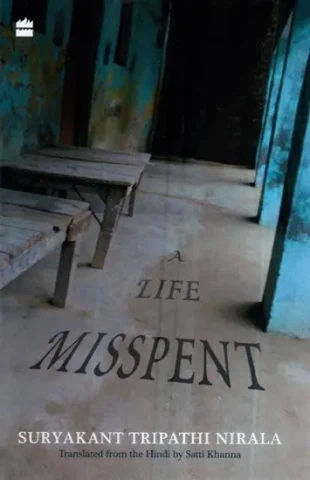
A Life Misspent
Suryakant Tripathi ‘Nirala’
Because if you walk into a room and notice what is missing from it,
It’s still there, isn’t it?
The first poem I wrote that wasn’t about you
was still about you.
– Caitlyn Siehl, What We Buried; from “A Letter To Love”
First published in 1938 as Kulli Bhaat, A Life Misspent—translated by Satti Khanna—has been hailed as a lost classic of Hindi queer Literature. But is it?
A Life Misspent is the autobiography of one of the most prominent Hindi poets of the Chhayavad movement, literally “shadowism”, Suryakant Tripathi ‘Nirala’. His poetry is informed by an engagement with the self, the omnipresence of nature, and intersecting through these elements, the connections of the mystic and spiritual. Some other major figures of the movement are Jaishankar Prasad, Sumitranandan Pant and, Mahadevi Verma. But it is Nirala who emerges as a progressive writer, who was unafraid to write about queer themes in his work. He also edited Matvala, a Hindi weekly headquartered in Calcutta, which is said to have published the first major same-sex short story in India in 1924: “Chocolate” by Pandey Bechan Sharma ‘Ugra’.
The ambition of the book is double-pronged. It is as much an autobiography of Nirala as it is a biography of Kulli Bhaat, an ordinary man from Dalmau, Nirala’s wife’s village, which had a lasting impact on the education and development of the poet’s understanding of literature, history, and life. In lieu of a dedication in the book, Nirala writes: “I could not find a worthy person among the eminences of Hindi letters to whom this book could be dedicated. Eminences who possessed individual qualities similar to Kulli’s seemed inadequate in comparison to the sum of Kulli’s character.” Naturally, one expects that Kulli must be a strong influence on Nirala.
The book narrates the events after Nirala’s marriage at the age of thirteen, and how he navigated the tides of the plague-ridden, desolate 1920s as he came of age amid socio-political turbulence. The book introduces his wife, Manohara Devi, as a gentle and supportive but silent presence. Her family serves as a chorus to project all the social biases of religious differences and caste violence that continue to plague India even today. Nirala writes the book with a certain dispassionate distance; the episodes by themselves are snappy and scattered, as if he is observing them in retrospect. Which is not to say that the events are not related with care. In fact, Nirala writes about the select few events in the book in painstaking detail, with elaborate dialogue. The achievement of this slim novel is indeed this erratic narrative structure, which manages to sweep an incredibly vast canvas representing the intimate lives of a broken family and country.
As an autobiographical novel, and a Künstlerroman at that, we must assume that each event relayed in this slim less-than-hundred-page narrative must have a special meaning for the author. The most remarkable, however, are the exchanges between two men: the author himself and Kulli Bhaat.
The first meeting between Kulli and Nirala occurs almost by accident, as the latter is offered a ride home from the railway station in the former’s trap. Kulli looks at Nirala with a gaze that he does not recognize at first: “I did not recognize the gaze then; I do now. It is the sort of gaze bestowed upon an exceedingly beautiful woman at the height of her beauty.” Interestingly, Nirala feminizes himself in this description. But the gaze is not troubling. Rather, as it becomes clearer, it is this gaze that makes him real, even to himself. To love, as it is often said, is to be seen.
Immediately after this meeting, however, when another is proposed by Kulli, Nirala’s mother-in-law offers a word of caution:
‘He is not a good man,’ Mother-in-law said gravely.
‘But he is a man, and therefore…’
‘I didn’t say he was a creature with horns. Only among men do we distinguish those who are good from those who are not.’
Tellingly, the conversation skirts around masculinity. What defines a ‘good man’ in 1920s India? As Kulli appears on the scene after this exchange, he is described by his physical attributes and immaculate appearance: “Hair freshly oiled, a waistcoat over his muslin kurta, a cane, socks even in the heat of summer. A pale-faced supplicant. I remembered a line from Kalidasa for no reason: ‘Small talk from the lover like cooling breezes…’” Is this description deriving from a common gay stereotype? Is it appropriate for us to read the description from over a hundred years ago, with the scrutinous “politically correct” gaze of 2024? The next event in this scene suggests something in the affirmative.
Nirala writes: “I was not averse to flattery then. I did not understand its hidden meaning. Nor did I have Kalidasa’s knowledge of sexual matters. Had I been wiser I would have dismissed Kulli instantly. I accepted the cardamom Kulli offered me for sweetening the breath.” By this point in the narrative, it has been hinted that Kulli is nurturing homoerotic tendencies for the 16-year-old Nirala. Kulli himself is tentatively 25 years old. It is interesting to see how Nirala figures that difference in the lines above. Had he known better, and had he been more experienced in sexual matters, he would have “dismissed Kulli instantly.” However, it is not the 16-year-old Nirala writing this narrative. By 1938, Nirala is in his 40s, so why is this retrospective innocence referred to?
When they meet next, the dynamics remain unchanged, but the drama progresses. As Kulli answers Nirala’s questions about why the village folk treat him differently, he simply explains his situation as someone who lives alone, with “no wife and no children… I live to please myself, but this does not please my neighbours. If I have a weakness or two what is that to others? It’s my money that I spend.” Why indeed should his lifestyle be a matter of public discourse? In provincial Uttar Pradesh, the consequences of social dysfunction have always been adverse. In Kulli’s case, there is collective disgust and forced amnesia about his presumed perversions. But Kulli is glad to find a support system in Nirala, and seeing as he is not immediately disgusted by him, Kulli lays claim to the silent solidarity between them: “‘Fortunately there are people like you and me who aren’t intimidated by gossip-mongers,’ Kulli said. He offered me a paan tenderly, adding a little squeeze as our fingers brushed.” One feels the tension between the characters, which is undercut immediately by Nirala: “Just like a brother-in-law, I thought.” Kulli is unfazed, like the resilient chaser he is: “’How wonderfully the paan juice traces your lips,’ he said, ‘turning them into daggers.’”
In their third meeting, the tension crescendos. “There was a large mirror on the wall hung with small garlands at each corner. He put his arm around my waist, and when we looked in the mirror we seemed to be garlanded even though we wore no flowers. I was pleased with the effect.” Critics have read this as a scene which represents an ambitious marriage between the two; initiated by exchanging flower garlands. That it happens in a mirror world, and is only possible in one, is a grim statement about the legal indifference towards queer rights and marriage equality, since time immemorial.
As the men spend more time together, the scene becomes ripe with anticipation. “He wiggled towards me on the bed, then wiggled back. I wondered if he had taken ill. He cast a look of longing perhaps in my direction. ‘I had better lock the door.’ But his voice died even as he uttered these words.” Something compels Kulli to withdraw his advances. Nirala is curiously silent on the reasons. But in that moment, which he is—as it bears repeating—reporting after almost twenty-five years, his emotions are different. “I grew afraid, not of him but for him. I didn’t think that Kulli could injure me in any way, but I feared that his illness—for that is what it must be—would bring him harm.” For Nirala, the diagnosis is complete. Perhaps the scene has been garbled in his memory too, one cannot avoid the suspicion, since it is reported in this strange incompleteness. We never really access Nirala’s emotional response to the scene, except that he enjoys the attention. The conversation continues: “’I can use force if…’ and he wiggled towards me again. I burst out laughing. Kulli remained where he was, but he said indistinctly, like a person drowning in a well, ‘I love you.’ ‘I love you, too, I replied. ‘Come. Let’s go then,’ he said and drew himself to his full height.”
After this meeting, an interval is posed in the autobiography, in which a few other events take place. Nirala loses his entire family in a tragic series of deaths due to the epidemic. Which makes this book one of the only documents of the time in India. The deaths are reported as in a stupor. Nirala leaves his well-paying jobs on whims, and decides to pursue more liberating but less lucrative interests like writing and editing. He becomes an eminent poet over time. His fame, as he writes, spreads “as rats fan out in a field of grain.” Fame, then, perhaps for him insinuates or foreshadows a pestilence. Even as he moves to Lucknow with the surviving members of his family, his nephews and two children, Dalmau calls him back. In one of the most visceral passages in the book, Nirala fawns over the beauty of this provincial town: “Scenes of Dalmau’s natural beauty would appear in my mind-the flow of the Ganga, the open riverbanks, the wide horizons. The strongest attraction was to Kulli. I could hear his affection calling out to me: Come back to Dalmau, come back.”
In the final meetings with Kulli, a deep sadness malingers in the narrative. “Kulli’s face looked bright, but his body was emaciated, as of a person in the evening of his life… He sat without moving. I had never seen him this quiet before. I sensed he was on an interior journey, having shown the world the path to follow…” In the duration apart from each other, both the men have managed to grow their life beyond their unresolved desires, but life has not been kind to either. Kulli lives with a Muslim woman and entertains Dalits in his household. His removal from the putrid world of caste and socio-religious hierarchies is three-fold. He has worked tirelessly for the freedom struggle and the Congress: “He pushed himself running from village to village in the heat, signing up members for the Congress Party.” But he remains an outsider, easily discarded in his sickness. In the final scenes of the book, Kulli is reduced to an acrimonious example of a life misspent. His lower body is rotting away because of a venereal disease. Nirala’s brother-in-law reports it with an uncanny joy found only in our social thirst for scandal concerning the Other, which exacerbates especially when it is implicitly tied to taboo. In this case, homosexuality.
‘The genital organ is missing.’
‘Missing?’
‘It wasted away, that’s what people say. Even if he survives, they say,
what use will he be to his wife?’
Why is it necessary for this final act of emasculation and castration to happen? Kulli dies a painful death, which is not reported in the narrative. As Nirala confesses:
“When I learn of the passing of a dear person or fear their demise, I fall into a kind of
stupor. I was in the sitting room when I heard Kulli was dead. I was in the sitting room
when I was told his corpse had arrived in Dalmau. A social worker came to summon me
two or three times. I was in the sitting room when the funeral procession set out. I said I
was unable to join. People cremated him and returned. I was seated as before.”
The repetitive yet static act of sitting creates a hypnotic effect. Kulli’s death is the final blow of misery in A Life Misspent. Pandits in Dalmau refuse to perform the rituals pertaining to last rites, and so Nirala himself must do them for this friend.
How does the book perform as a queer classic? In A Life Misspent, attention is drawn to the missing. It is registered by the tangible presence of absence. If poetry is the art of suggestion—and Nirala is one of the keenest masters of the art—this book is the progeny of a master of that art at work. Nirala enjoys the flattery and misreads, or at least misrepresents, the truths from his life. In the end, this is a book about deeply buried secrets, which reveal themselves momentarily as sharp winds blow off their cover. “Because if you walk into a room and notice what is missing from it / It’s still there, isn’t it?” One of the last passages in the novel is stunning: “In their last days, Premchand and Jaishankar Prasad shared some confidences of their lives with me. I will keep their secrets safe. Making them public would only stir gossip and cause pain to the departed souls. Kulli, too, lived with a secret. Premchand and Jaishankar Prasad parted with their secret late.” Queer lives have always been secret, so perhaps even the suggestion of suspicion planted in our minds can restore their historic omnipresence. Raising more questions than offering answers can perhaps be the best way to do so.

Kartik Chauhan is a Delhi-based literary reviewer and writer.