
From
Matchbox – June ’24
Sex, Poetry, Tantra and The World In-Between – Vikram Kolmannskog in conversation with Kabir Deb
Poetry challenges shame around queer and explicit embodiment, asserting a material spirituality that redefines artistic truth and the boundaries of literary expression.
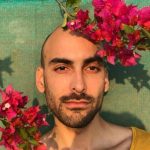
Vikram Kolmannskog
Vikram Kolmannskog is a writer, psychotherapist, and fulltime professor of Gestalt psychology. He has a mixed heritage with a Norwegian father and a mother born in Kenya to Gujarati parents. He lives outside Oslo together with his husband Daniel. Among his publications are The Empty Chair: Tales from Gestalt Therapy (Routledge, 2018), Taste and See: A Queer Prayer (Mohini Books, 2018), Lord of the Senses: Stories (Team Angelica, 2019), Becoming Buddha: Meditations (Mohini Books, 2021), and The Garden Tantra (Red River, 2023), and Rhyheim: A Porn Poem (Broken Sleep Books, 2024).
KD: We usually do not go towards writing something unless there’s a reason or trigger involved. What, according to you, is the trigger that made you write poems?
VK: Since early childhood, I have been fascinated by how a few words can hold great beauty and truth. For example, there are four simple words that I treasure: ‘no mud, no lotus’. These are the words of Zen master and poet Thich Nhat Hanh. When we look with interest and openness at ourselves and the world, we can come to some important insights; and sometimes these can be formulated in words – very often poetry – and become pointers for others.
Reading and writing poems can be quite similar to my meditation practices, and there is certainly a cross-fertilization between them. This is how The Garden Tantra (Red River, 2023) was written: spending time, with awareness, in my garden and surrounding forest, reading and writing poems, doing formal sitting meditation but also being with other animals, plants and minerals with interest and openness.
There can be a tension between first-order reality/experience and language, and I also practice letting go of words and appreciate silence. However, I can also enjoy working with this tension, and I can enjoy the experience of words and working with words. Poetry can include an appreciation of paradoxical and upside down truths, attention to sounds and form, and leave much silence and open space. In this way, it can get very close to what is true and beautiful – and sometimes the apparent separation may collapse entirely. One of the poems in The Garden Tantra is titled ‘I Write to Celebrate Life’ and includes the lines ‘There is air and rain and soil and sunshine in words / just as there is in leaves, // there is space inside and all around, / there is movement and sound.’
KD: In the queer community, what is the basic condition of poetry? People, in general, do not subscribe to poetry unless they have an additional influence in their life. Is it the same when it comes to the poets of the queer community?
VK: The queer community is very diverse, of course. Many great poets were and are queer, and it varies how much this shines through in their work. One anthology that I recommend is 100 Queer Poems (Vintage Publishing, 2022).
Personally, I have written some stories and poems during (and as part of) the mobilisation for queer rights in India and many were published in Indian queer magazines such as Gaylaxy. I am also active in a queer artist collective in Norway called Pride Art, and more recently I wrote the poem ‘He’s So Gay’ (included in The Garden Tantra) in response to a terror attack on Oslo Pride in 2022. ‘He’s so gay’ is a common insult, but I am turning it on its head in this praise poem. The anaphora includes ‘He’s so gay / he picks flowers / with his eyes’ and ‘He’s so gay / he feels divine pride, / knowing everyone and everything / everywhere is divine’. It is important to find some recognition in a story or poem, to have your identity and experience validated, not least for those of us who are regularly marginalised and oppressed. This has been important to me. Queer literature certainly speaks to me in a special way.
I believe queer, literary platforms such as Gaylaxy and The Rainbow Lit Fest are tremendously important. During the last Rainbow Lit Fest in December, I felt so free and happy and at home. A friend and I are also making a small contribution through Mohini Books, a queer-centric publisher. Our latest book, Queers in Quarantine, is an anthology of poems, stories, essays, and more, and can be downloaded for free at www.mohini.no Finally, I also want to mention the anthology The World That Belongs To Us: An Anthology of Queer Poetry from South Asia (HarperCollins India, 2020).
Having said all this, I am happy that others who do not identify as queer also read and appreciate my work. I certainly read and appreciate poems by both queer and straight people. We are all human, after all; not that different, though the particularities of our longing, loving and heartbreak differ somewhat. I believe all good literature deals with the complexity of life and can potentially be enriching to everyone.
KD: In our society, we have seen people coming out of the box to write erotic poems layered with metaphors. You, on the other hand, write about the silhouette of our body like it is. What do you think made you go through this path which is a double-edged sword?
VK: I really dislike the flowery ways of writing about sex. I welcome good metaphors and images. But often I suspect there is shame and other concerns dictating the writing rather than poetic considerations.
I’ve written several erotic stories and poems in the past, but my latest book, Rhyheim: A Porn Poem (Broken Sleep Books, 2024), is my most explicit work. It has definitely been a process for me. I have had – and still have – some shame related to sex. Sex is after all a main reason why we queers were – and still are – considered sinful, criminal, sick or dirty. While I still may feel some shame, I try to bring awareness to it and make an active choice: I don’t want to be governed by a shame that is damaging to our growth and pleasure. Courage means that I may still feel some shame and fear but I keep writing and publishing erotic work. I believe awareness and courage are important virtues for an artist to cultivate.
However, it is often difficult to clearly distinguish between healthy boundaries and oppressive shame since societal shame permeates our body-mind-hearts. What feels too intimate and personal to share? How much is this influenced by societal shaming? This is a constant consideration for me, and I don’t claim that I am always right in my choices. In Rhyheim, I am very explicit and also self-disclosing, even using my own name and loosely drawing upon intimate experiences with my husband. I should say that my husband has of course read and consented to this. The fact that my husband too is very relaxed about sex has definitely helped me a lot.
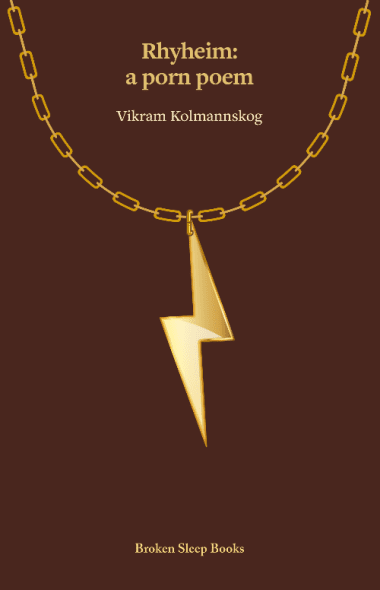
KD: Rhyheim: A Porn Poem is a tale of love told through the lens of graphic sex. What was the first thought that came into your mind before you took the decision to write the book and get it published?
VK: I think it was during the pandemic that I first came across the Black American porn star Rhyheim Shabazz. His entire body, including cock, is absolutely delicious, but what really caught my attention was how his films include so much more than fucking. And even in the fucking, he seems to truly pay attention to the other person(s). I discussed this with a friend, and joked that I should write a praise for him. And then I actually started on a poem – and it soon turned into a book-length poem. I didn’t think too much about getting it published. When UK-based Broken Sleep Books was enthusiastic and wanted to publish it almost without edits, my first reaction was to become quite anxious. It is, as I have mentioned, very explicit and I self-disclose quite a lot. But the publisher’s enthusiasm was supportive, and I do believe it is a good poem. Here is a glimpse of the intensity and gentleness I notice between Rhyheim and another porn star:
‘Dark honeycomb-like clouds form
Over, inside and all around
Drops on his awesome face shining
Brilliant black cock crashing
Veins flashing
Rhy lifts him up
Puts him down
Stretches his long arm and places
A pillow under his head’
KD: Tantra addresses spirituality through practice which relies on our body. Your book ‘The Garden Tantra’ functions around the body too. What made you choose the title? And what is the objective behind documenting the human body?
VK: A split that is quite typical in many cultures is to see ourselves, our essence, as separate from nature. We also do that in spirituality and religion. According to many if not most traditions, humans and the divine are somehow different from and above nature, and liberation means transcendence. In contrast, I practice a very material, embodied spirituality, drawing on Zen, Bhakti, and Tantra. This is reflected in The Garden Tantra as well as much of my other work. Spatial metaphors are often used when talking about the divine. For example, God is often seen as above, and higher often means better. In the poem ‘Locating Souls’, I write,
‘Perhaps there is not a soul
in the brain. Perhaps in the heart.
One place is certain.
Remove your shoes and be aware
here where the pressure is high
yet you remain so very sensitive,
here where you find the grassy, gritty origins
of humility and humanity.
Vira Vikram knows. Only those who are still lost
discriminate between high and low.’
I was unsure about using the word ‘Tantra’ in the book title. For some in India, the association is first and foremost black magic. For most people in the west, it means a form of sexual practice. And then there are what one could call the traditional or classical Tantric practitioners. For these practitioners, Tantra is a wisdom tradition and approach found in several religions, including Hinduism and Buddhism. The word can also refer to some of the texts in this tradition. Etymologically, it can mean instrument (tra) for expansion (tan). There are a few reasons why I ended up using the term in the title of a poem and the collection as a whole. One reason is that the book is, as mentioned, influenced by Tantric practices and wisdom, and hopefully the garden poems can be instruments for expansion. Another reason is that it rhymes a little with ‘garden’, and poets trust sound as much as anything else.

Kabir Deb
Kabir Deb is an author/ poet based in Karimganj, Assam. He works in Punjab National Bank and has completed his Masters in Life Sciences from Assam University and is presently pursuing his MCW from Oxford University, London. He is the recipient of Social Journalism Award, 2017; Reuel International Award for Best Upcoming poet, 2019; and Nissim International Award, 2021 for Excellence in Literature for his book ‘Irrfan: His Life, Philosophy And Shades’. He runs a mental health library named ‘The Pandora’s box to a Society called Happiness’ in Barak Valley. He reviews books, many of which have been published in magazines like Outlook, Usawa Literary Review, The Financial Express, Cafe Dissensus, Sahitya Akademi etc