
Excerpt: These Tongues that Grow Roots
Dreams flood a waiting lake, fissures yearn, a mother warns of words.…
Read more →Iyer’s memoir critiques the systemic pressures on aging women, positing individual autonomy and chosen solitude as crucial acts of liberation against entrenched societal expectations.
Virginia Woolf’s use of the metaphor, “Angel in the House” was a contemporary response to the long, gruelling struggle for women’s rights and equality. The speech was delivered in 1931, but the idea of the ‘angel’, a systemic set of expectations that burdens women, remains relevant deep into the 21st century. Woolf was addressing the woes of working women, but it is an affliction that runs riot across our socio-cultural-political-economic spheres of being. While gendered roles and expectations stymy women at almost every stage, perhaps it is most obvious in their struggle to exist as individuals and as women climbing the age ladder.
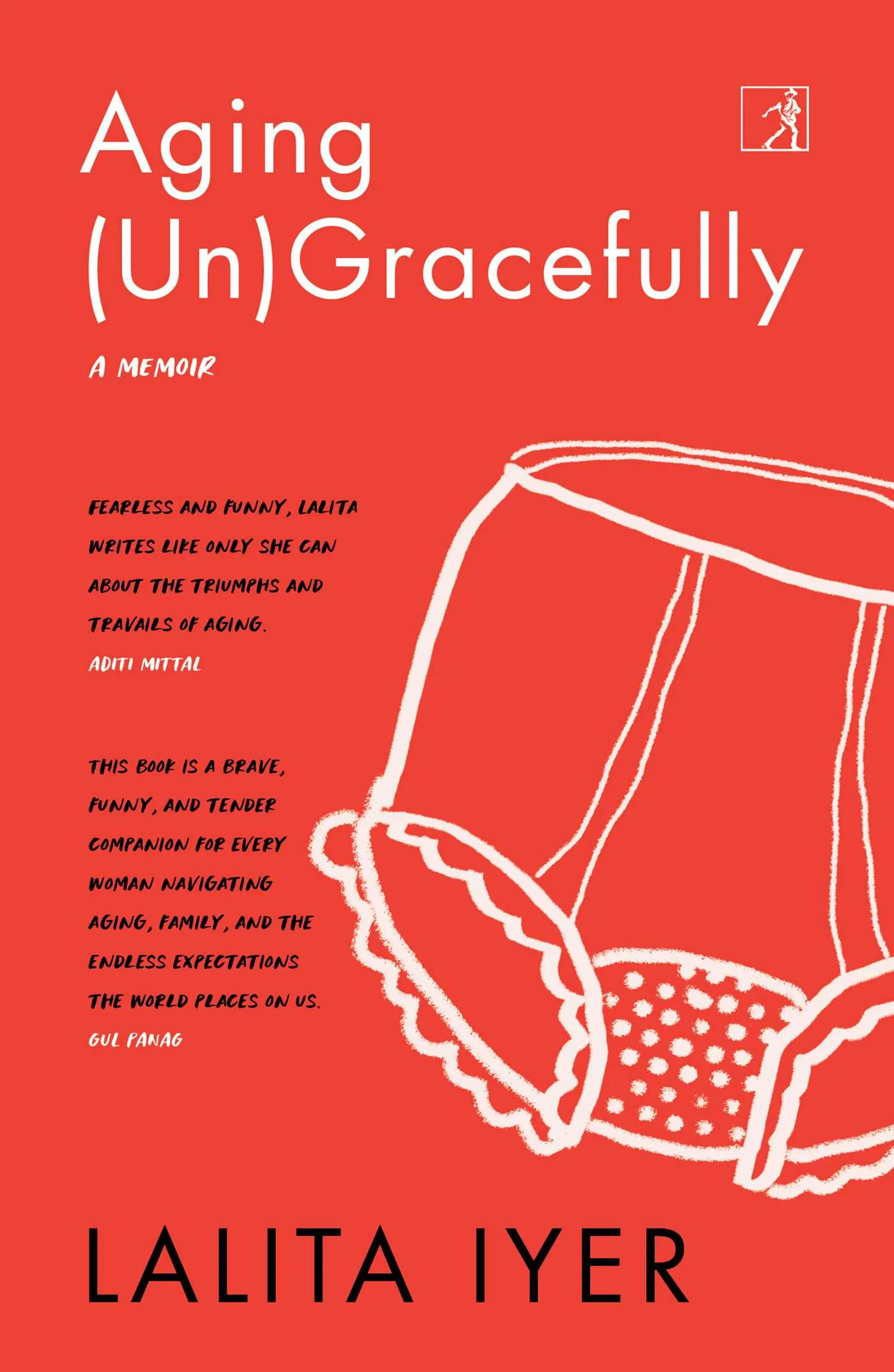
Lalita Iyer’s Aging (Un)Gracefully – A Memoir, addresses this dual struggle through the lens of the woman’s body and the perception of women as they choose to walk alone and to age in their own ways.
The title stakes a claim; it challenges unsaid taboos around the concept of women’s aging. Claiming the self is in itself a horror that defies notions of womanhood that veer between the image of woman as devi and woman as a witch. For the woman claiming the self is protest, proclamation, assertion that ‘I am enough in myself’.
Sometimes, this journey from perception/ expectation to belonging-to-the-self comes through small mundane, everyday acts of resistance and discovery.
I have discovered my own capabilities—how to build a home and a network everywhere I go, how to negotiate paperwork, how to advocate for my child in school, how to make him advocate for himself and for others, how to stand up for myself in spaces where I was once made to feel small. I have learned that I am enough – I always was (pg. 14).
The realisation of one’s potential and promise need not be tragic or humourless. It is a journey of discovery, and discoveries come in all forms and hues – some difficult, challenging, demeaning, enervating, but also those that are simple, energising, uplifting, comical. The folds of skin, wrinkles on the face as a woman ages, are natural, but for some, these could be nightmarish. For others, like the memoirist, acknowledging and accepting this ‘more’ on the body is liberating.
Less is more and more is good enough: This could well be the book’s defining idea. Paring down, cleaning up, jettisoning – these rituals of living lighter, of living with the self rather than with things and with others, is something many women in their fifties arrive at naturally, as if the body or the mind sends out a signal to lighten up, to dismantle and recreate with fewer resources. Simultaneously, there is a sense of ‘more’ that seems less intimidating: more flesh and weight perhaps, more time for the self, more thoughtfulness, more mindfulness, more immersion in the present.
None of this is handed on a platter. One has to work at it, daily, every hour. The yearning to be with oneself takes courage to acknowledge and accept. It takes much more courage to speak it aloud to the world that expects women to be always and only ‘giving’, taking care, thinking of others. That a woman may want only herself is an abomination in the eyes of the world.
Most of the time people are mystified that I can be alone and yet lead a fulfilled, creative life that doesn’t feel incomplete. My son will leave the nest in two years and I will be done with the daily motions of motherhood. By then, I am guessing one or both of my parents will be gone too.
And it seems almost ungrateful and cold of me to say that I cannot wait.
Because, for a woman to be alone and happy without anyone to look after is against the order of life, is it not? (pg. 167)
Iyer’s memoir could be the memoir for generations of women, an individual voice expressing a collective response to life, living, loving, nurturing, being. It also contains a retrospective judgemental look at the past, at youth and being young that does not always cut ice, but when it returns to the present, an evolving time of self-growth and self-discovery, it offers women everywhere a way of looking at the act of living without guilt and the baggage of other people’s opinions and wants. It is this that the ‘angel’ finds the most difficult to achieve.
Iyer’s book splits this journey across 18 short chapters that are intensely personal. Yet, the personal is also the universal, the narrative thread looping and winding its way around collective experiences and recollections of aging. For the memoirist, finding joy and satiety in solitude is one of the discoveries in the process of growing older. The satiety is underlined by the rediscovered joy of housework, of slow time and conversation. Of watching the plants grow, the dough rise, the sun set. Of noticing the tiny details, the repetitive rituals that make a home of a house. And in so doing, of choosing to be a ‘domestic goddess’, rather than being forced to be the angel.
This difference between choice and compulsion is a marker of women finding themselves, of feminism’s heft. It balances the tension between agency and conforming to social mores, making the act of nurturing therapeutic rather than rushed and compulsive. An immersive-ness that helps to slow down, get in touch with one’s inner world, understand what one really wants without ‘reinforcing patriarchal norms’.
Iyer brings the lens to various interpersonal interactions and relationships that mark and guide our lives: Friendships. Family equations. Marriage. Sex. Bodily changes. Personal needs and urgencies. Memories that the body keeps count of … and through it all, the constant need to take stock, to ‘recalibrate’, to reclaim. It takes a toll and one learns to step back or work harder. For most women, growing into the 50’s is a lot about looking back and mourning – ourselves, our pasts, relationships, losses – then looking into the present and remembering to count one’s blessings in the evolving moment, to cut down on expectations, to express ourselves to our children, parents, our friends, to let go.
And early along this muddled, uncertain path, comes the sombre reality. Menopause. To many of us who have retained our sanity through this oft-prolonged period, it is one of the most liberating experiences, in spite of the trauma it entails. Suddenly, we are free. Suddenly, we are unafraid. Suddenly, we are ready to be gloriously invisible, the invisibility not a facade or a shell or even an armour, but we ourselves, confident in our skin, the scars on our bodies and minds signs of having struggled, fought, and emerged victorious for ourselves …
My heart soared as I read some of these chapters, my mind screamed, Yes! That’s me, too. But then there are the chapters where the writer looks back at youth and its many “un-necessities”: its fears, uncertainties, insecurities, challenges, worries, arrogances, conceits… The narrative around this seems to put youth and aging on a see-saw, allowing for youth to weigh down with too much negative retrospection, making it tonally too flat to sustain. But it’s a memoir, and one gives a wide berth to individual remembrance and remembering.
The book meanders with equal amounts of seriousness and humour through the writer’s professional and personal experiences, a failed marriage, child-rearing years as a single parent, caring for parents, and dealing with financial worries … with searing honesty and with trust in the reader to understand this odyssey in all its glamour and its ugliness, its exhilaration and despair. The personal narrative constantly draws upon the possibility of collective memory, and this approach of suggesting that we are in this together, that we have been together, makes the narrative accessible for readers who are either on the brink of this crossing or those who have walked across already, and it offers them a different possibility. It enables other readers to understand a woman’s physical, mental and emotional shifts as she grows into her fifties, of her ability and right to live alone and contented if she so chooses, of defying norms and expectations, of setting her own goals, choosing her own path. It provides a perspective into the idea that liberation is not something that one has to be given but a way of being that one can create.
That’s the thing about being young-old. It is not a descent into irrelevance. It is a rebirth, a reclaiming of the self. It is a declaration of independence from the expectations of youth. It is the moment you stop striving and start being. And in that, there is liberation (pg42).

Sucharita Dutta-Asane is author and independent book editor. At present she edits the online literary journal Kitaab (www.kitaab.org). In 2018 she published her collection Cast Out and Other Stories. She was the recipient of the inaugural Dastaan Award, 2013, for her short story Rear View. In 2008, she received the Oxford Bookstores debuting writers’ (second) award for her collection The Jungle Stories. Her short stories have appeared in various national and international anthologies including Juggernaut Books, the Africa-Asia anthology Behind the Shadows (2012); Zubaan Books’ Breaking the Bow, (2012); Unisun Publications’ anthology Vanilla Desires; APK Publishers’ anthology of short stories by Indian women writers titled Ripples. Her stories and book reviews have also appeared in online literary journals including Dwarts (Nigeria), Bhashabandhan Literary Review, The Four Quarters Magazine (TFQM), Café Dissensus, The Bangalore Review (TBR), the Out of Print Blog, Earthen Lamp Journal, Open Road Review, and Asian Cha among others.)