
Lalita Iyer in Conversation with Rituparna Mukherjee
Iyer's memoir refuses the polished narratives of graceful aging, locating instead a middle space where nothing collapses spectacularly but everything quietly shifts. Her account insists on the messiness preceding freedom, the grief embedded in recalibration, and the gaslighting women face when they resist disappearing politely.

Lalita Iyer
Lalita Iyer is a journalist and essayist based in Kodaikanal. She is the author of Sridevi: Queen of Hearts, I’m Pregnant, not Terminally Ill, You Idiot!, Raising Mamma, and other books.
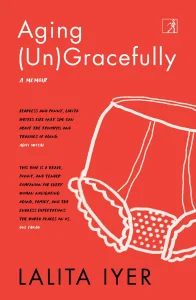
RM: Hello Lalita! It’s so good to talk to you. Thank you for taking out time to talk to us and hearty congratulations on your memoir Aging (Un)Gracefully. It is earnest, engaging, witty and a really good read. You mention at the very beginning how certain points in your life brought about major shifts and moved you to take a stock of your life. What spurred you to write this memoir?
LI: Thank you, Rituparna, that’s lovely to hear. I think the book emerged from a series of quiet reckonings over a few years rather than one dramatic moment. There were enough life events – parenting a teenager, watching my parents age, leaving cities I thought I would grow old in, work that no longer thrilled me in the same way – for me to realise that the old templates no longer applied. I was still functional, still competent, still productive and alert, but something inside me was asking for a slower, more honest audit.
Aging, I realised, wasn’t something that was happening to me—it was something I was actively navigating, resisting in some places, embracing in others. I wanted to write about that middle space where nothing is falling apart spectacularly, but everything is quietly shifting. The memoir became a way of making sense of those shifts, of naming the discomforts and the unexpected freedoms, and of saying out loud what women are often encouraged to smooth over or keep private.
RM: Recently, Lisa Roy was talking about the lack of representation of women in their 40s and 50s in the fashion industry, which she finds ironic because it’s the women in that age group who have the means to purchase high-end fashion. You talk of aging as a thing of beauty and joy, and I especially loved what you say about the clarity, perspective and freedom on the other side. How important has it been for you to be upfront about your experiences, expectations and struggles in this context with the readers in mind?
LI: It felt essential to be upfront because there is so much gaslighting around ageing—especially for women. We are told to be grateful, to age “gracefully,” to not complain, to disappear politely while still looking effortlessly put together. I wanted to resist that neatness.
Clarity and perspective arrive because you've waded through confusion and self-doubt. Freedom comes when you've stopped auditioning for roles that no longer fit.
There is beauty and freedom on the other side, but it doesn’t arrive gift-wrapped. It comes after a sense of loss or grief, a realisation that there are versions of yourself that no longer exist, and a recalibration. This is messy. Being honest about the messiness felt like the only ethical way to write this book. I didn’t want to sell empowerment as a lifestyle upgrade. Clarity and perspective arrive because you’ve waded through confusion and self-doubt. Freedom comes when you’ve stopped auditioning for roles that no longer fit. If the book does anything, I hope it reassures readers that they’re not late, broken, or failing – they’re just in the middle of becoming or unbecoming, depending on how you look at it.
RM: City life, the nature of most jobs at present and the conditioned construct of hustle and overextending ourselves to achieve goals has led many to burnouts, especially for women who are additionally tasked with emotional and domestic labour, often under-appreciated at best. You mention that your time in Goa and the shift to the hills has been key in slowing down, finding satiety and happiness. Although COVID has been a deeply unsettling time for us, do you think it also enabled most of us to recalibrate, to use your term, and rethink about the quality of our lives and slow down even if a little? Would you consider slowing down a privilege and what does slowing down mean for you personally?
LI: COVID was deeply unsettling, but it also stripped away a lot of the performative urgency. It forced many of us to confront how much of our busyness was habit rather than necessity. That said, slowing down is absolutely a privilege, and I’m very aware of that. Not everyone has the option to step off the treadmill without consequences.
For me, slowing down has less to do with doing nothing and more to do with doing fewer things with greater attention. Living in Goa and later in the hills recalibrated my sense of time. Days stopped being measured by productivity alone and started being shaped by weather, meals, walks, silences. I became more alert to satiety – not just in food, but in work, relationships, ambition. Slowing down, in that sense, became an act of refusal: refusing exhaustion as a badge of honour, refusing to overextend emotionally, refusing the idea that worth is tied to constant output.
RM: I am so glad that you talk extensively about emotional labour and caregiving, of the depletion of our emotional reserves, the challenges of caregiving and the many sacrifices it necessitates, especially from women who are for all intents and purposes primary caregivers in most cases. I really feel this is an aspect that is not talked about much. What I found remarkable is how you differentiate between the love for one’s child and the love for the act of parenting that is often conflated. What has helped you to navigate your own caregiving responsibilities along with holding on to a firm sense of self? How has your own writing factored in this mix?
LI: I think separating love from labour was a turning point for me. Loving my child has never been in question, but loving the work of parenting—its relentlessness, its emotional negotiations, its invisibility—has been far more complicated. Once I allowed myself to admit that without guilt, things became clearer.
What has helped is acknowledging my limits and resisting the idea that good caregiving requires self-erasure. Writing has been central to that resistance. It has been the space where I am not needed by anyone else, where I am not useful in the traditional sense. Writing insists on solitude, on attention, on taking my own thoughts seriously, and allowing myself to sit with them. In a sense, it has functioned not as an escape from caregiving, but as a reclamation of the self alongside it.
RM: You mention how a return to your roots has been important to you to come fully into your own—rebuilding your relationship with the food you grew up with, decluttering and minimizing objects, gardening, enjoying the quiet rhythm of banality—how has a life in the hills brought about a shift in perspective, especially in terms of creating a work-life balance?
LI: The hills reintroduced me to banality, and I mean that as a compliment. There is a steadiness to everyday life here that cities rarely allow. Spending time in the garden, even if I am not growing anything actively, restoring and repairing through my mending projects, baking sourdough, cooking familiar food, living with fewer objects – it all brought me back to a version of myself that wasn’t constantly overstimulated or aspirational.
Work-life balance stopped being a theoretical ideal and became something more tactile. Work found its place rather than bleeding into everything. There is less urgency, fewer distractions, and a greater respect for natural rhythms. I stopped trying to optimise my life and started inhabiting it.
RM: In talking about domesticity in one of your chapters, you speak very candidly about how feminism is often misunderstood as a radical position that puts constraints on choices. Do you think there is a gap between a perceived stance on feminism and real feminism? There is a certain dichotomy with which the professional and personal choices of women are viewed even by the most well-intentioned friends. I found your earnestness about freeing yourself from the constraints of 9-to-5 jobs, valorised motherhood and performative sex particularly meaningful in this context. What has been your strategy in bridging the gap between perceived feminism and real feminism?
LI: There is a significant gap, and it often shows up in how women’s choices are policed—especially by other well-meaning people. Real feminism, for me, is not about prescribing correct choices but about expanding the space in which choices can be made without punishment or moral hierarchy.
My strategy, if I can call it that, has been to live my contradictions openly. To step away from the 9-to-5 without romanticising precarity, to question valorised motherhood without rejecting care, to opt out of performative sexuality without shaming desire. Bridging the gap has meant refusing to explain myself endlessly and trusting that coherence doesn’t have to look tidy from the outside.
RM: In talking of your conflicted relationship with your body and your loving acceptance of your “wobbly bits”, you take us on a journey most women traverse every day from a locus of desire. What has been your greatest tool in disassociating yourself from the societal gaze and the preparedness for that gaze?
LI: Time, mostly. And fatigue. Walking inward reintroduced me to parts of myself that I would choose any day over sterile company. At some point, the effort required to constantly monitor and manage the gaze becomes unsustainable. I grew tired of rehearsing myself for visibility. Accepting my body didn’t come from self-love affirmations but from a quieter truce—this is the body that has carried me through, and I no longer wish to be at war with it.
RM: Bell Hooks says sisterhood is power and you have often fallen back on your female friends for advice, support and a general good time like most of us do. You also talk about various kinds of friendships and how they need to be nurtured or forsaken with time. Writing is essentially a solitary activity and you talk of the necessity for ‘aloneness’ for summoning your truest self. Alongside, writing also flourishes in and sometimes necessitates a community. As a private person how have you balanced this tightrope? Also, why do you think as a culture we are so afraid or suspicious of the need for ‘aloneness’?
LI: I’ve learned that aloneness and community are not opposites—they are interdependent. Writing requires solitude, but living well requires chosen kinship. I rely deeply on my female friendships, even when I retreat from them temporarily. The balance lies in honesty—being clear about when I need company and when I need quiet.
As a culture, we are suspicious of aloneness because it resists consumption and control. Aloneness is often mistaken for loneliness, when in fact it can be a deeply generative, stabilising state. For me, it has been essential—not as withdrawal, but as grounding. A woman living by herself, mostly content and thriving is unpalatable to many.

Rituparna Mukherjee
Rituparna Mukherjee teaches English and Communication Studies at Jogamaya Devi College, Kolkata. She enjoys writing short fiction and flashes. A multilingual translator of Bengali and Hindi fiction into English, her original work and translations have been published in Samovar, The Bombay Literary Magazine, Usawa Literary Review, Skipjack Review, Hakara Bilingual, State of Matter, MuseIndia among others. Her debut translation, The One-Legged, translated from Sakyajit Bhattacharya’s Ekanore , has been shortlisted for JCB Prize in Literature 2024 and won the KALA Literature Awards 2025. She is currently translating a political thriller set in West Bengal as well as a memoir dealing with gender issues. She is the fiction reader at Usawa Literary Review.