
Supriyo Chakraborty in Conversation with Aditi Dasgupta
Chakraborty positions Penprints between cultural necessity and market viability, navigating the tension…
Read more →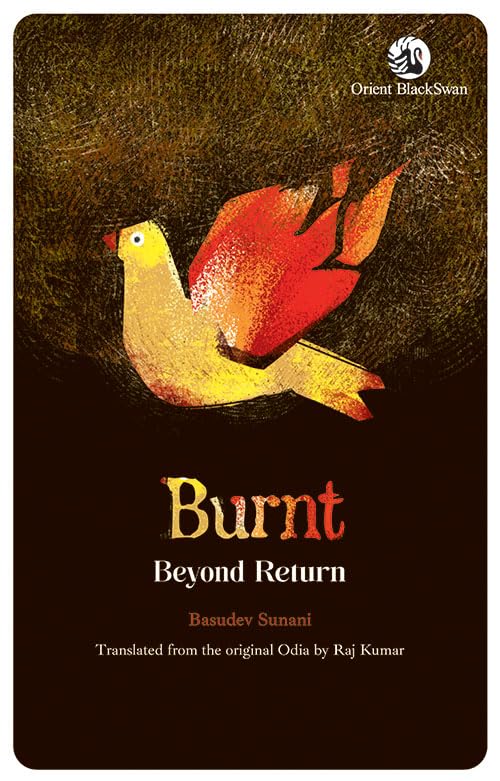
Basudev Sunani’s Burnt Beyond Return is a kaleidoscopic projection of the Dalit suffering that hasn’t changed its emotional vocabulary of survival for decades. Based on a true incident in 2012, where an entire Dalit village was burnt to ashes due to caste rage, this book unpacks far beyond the injustices endured by this marginalized community. It is a book about how oppression becomes tradition and faith becomes both a burden and a language of endurance is slowly unpacked in the course of the novel. Sunani’s language bears the scorch of lived memory, and it is through this fire that Raj Kumar’s translation finds its own fidelity. In his taut, unsentimental yet scathingly honest translation, the prose carries the original’s singed edges, its fury and a blatant refusal to heal neatly.
In the book, the characters are etched with a background and their eventual hand in the fire, opens up a landscape that is hard to watch passively. Every character is a ghost of their own decisions and yet there is nothing spectral about them. They are vividly human yet they are also vividly Dalit. The grit and grime of the caste is incombustible; it cannot escape us as readers once we are in ‘Lathore’. This visceral closeness to the soil is not only thematic but linguistic as well.
The translation preserves the rough grain of Odiya language. It is anglicized but crafted in the safety of the Dalit cultural ethos. Its idiomatic sharpness, the textures of lament and irony and the catharsis stay with the reader long after the last page is turned. In doing so, Kumar performs what Lawrence Venuti calls the “ethics of foreignness” in translation—resisting domestication so the reader can feel the friction between languages, cultures and castes. We see this during the conversation between Chitrasen and Makaru that can be also marked as one of the most revealing passages of the book.
“We left all our ancestral traditions behind, vanquishing our caste identities, in the hope of becoming like the touchables…”
The book frequently brings to us the turmoil that comes with spiritual loss as an indictment of internalized hierarchy. The deliberate abandonment of their deities Gadia Gajapati, Chhuti Gudi, Nialimali and Mahalaxmi for the worship of Shiva, Durga and Hanuman encapsulates Spivak’s “epistemic violence”. Indigenous knowledge systems in the Dalits are erased under the guise of this Sanskritization. This gesture toward upper-caste assimilation mirrors the tragic irony of colonial mimicry. The oppressed here, strive to become like the oppressor, only to be marked perpetually as “almost the same, but not quite.”
In Burnt Beyond Return, Sanskritization becomes a slow violence and is the visible spiritual mirror of caste capitalism where identity is traded for proximity to power. Makaru’s exile, then, becomes the human echo of this spiritual deracination. Sent away as a child under hostile circumstances, his second self-willed departure carries another layer of complexity. It is not merely a geographical estrangement but also an existential one. Leaving the burnt basti behind, Makaru, in his second departure, undergoes severance of faith, too. His walk towards the train station resonates with postcolonial literature’s great exiles, echoing the ache of alienation—as if the soil itself rejects his return to his home. Sunani renders this moment as a meditation on displacement within one’s own homeland.
Time in Burnt Beyond Return is another paradox. Within the Dalit community, time stands still. Its rituals, perineal poverty and caste hierarchies are in a loop. Yet time is transient as well as visible in the decay of the basti, corrosion of faith and restless economy. Sunani reasserts the Dalit experience to show that the past is never gone but is merely sedimented in the present. Memory becomes both inheritance and imprisonment. This strain is visible in the female community in the Dalit landscape as well. Their space is precarious as well as doubly marginalized—by caste and by gender. Their suffering gestures toward what Dalit feminist theorists like Sharmila Rege describe as the “double burden of silence and servitude.”
In the novel we see them as the custodians of a culture constantly under erasure. In hindsight, one can say that the novel is steeped in invocation. Worship becomes both a mode of survival and a symptom of subjugation. And through this, Sunani raises profound questions: what is lost when divinity itself becomes hierarchical? What remains sacred when God, too, is stratified by caste? Raj Kumar’s translation then, does not merely transmit the text. It plays a crucial interpretive role as well. His sensitivity to rhythm and register ensures that the spiritual tension in the shift from local deities to pan-Hindu gods retain a political sting. His translation, like Sunani, does not universalize this experience; it situates it firmly within the cultural landscape of Dalit Odisha, allowing English to carry the echo of Odia without consuming it.
Burnt Beyond Return is a novel that resists neat resolution. It does not end in deliverance but in a deeper recognition and the fire in the village is also a way of reclaiming their leftovers. It is a book that resurrects how the Dalit community continues to live among ruins. Through its layered narrative and the translator’s attentive craft, the book transforms private Dalit grief into a historical witness. This makes Basudev Sunani the Baburao Bagul of the East. This makes the book a timeless testimony to a community that continue to speak from its ashes.

Aditi is an ordinary feminist with an extraordinary hunger for stories. A researcher at heart, her MPhil in English literature delved into postcolonial traumas in Indian literatures. She honed her craft through a Diploma in Translation & Creative Writing at Ahmedabad University, a residency at Yale, and the Institute for World Literatures at Harvard. Her book, Silencing of the Sirens , has drawn critical acclaim, and her words echo in Borderless Journal, The Wise Owl Literary Magazine, The Hoogly Review, WritingWomenCo, InkNest Poetry and The Writer's Hour Magazine, weaving history, pain, and resilience into narratives that refuse to be silenced.