
Review: The Last Free Naga
Kasom's collection centers Nagaland's periphery, revealing how local narratives expose universal human vulnerability and the profound political costs of systemic conflict and neglect.
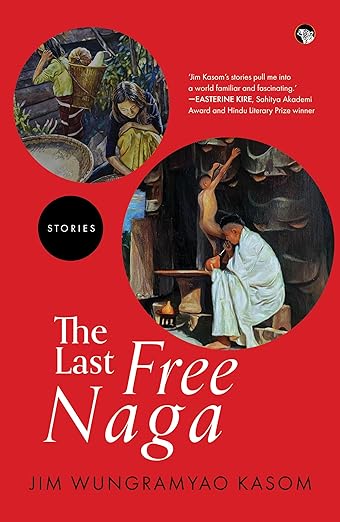
Stories written from the position of privilege mostly fail to address the fascinating concentrates of the familiar worlds. They primarily focus on the fragility of the vulnerable sections without identifying vulnerability as an important human trait that develops curiosity, strength and a certain ‘non-harmful’ pride on one’s own identity. Jim Wungramyao Kasom’s The Last Free Naga is a collection of short stories that paints a picture of Nagaland and its culture through characters, their memories, precarity and mysteries. The stories not only give shape to their remote homeland but also presents before us an idea of the development of their personalities. These twelves stories surf from one human psyche to another since our physical space is a wheeze of our mental leeway.
Kasom brings the spirit of Khangayei, its mystery and social misunderstanding through his story Season of Cicadas. The energy is mostly considered evil, but the writer approaches it from the idea of a conditional fear and acquired kindness. It is easy for a writer to bring out a morbid horror out of the story that Khangayei is a part of, but here the writer dives into the origin of the spirit to cultivate a terrifying but balmy experience. It becomes political in parts when Kasom points out that people who go missing often turn into a Khangayei. It is a craving for freedom that could be a plausible reason. The story also states how remote places or locations often go unnoticed and so, Khangayei hides during scarcity. No one can bear relentless depression and if observed from a geopolitical lens, the North-Eastern hilly states have always been kept away from the mainstream. So, Kasom makes even the spirit a daily experience which does its tricks, but people at least have a companion.
The Mountain Man is a satirical fantasy fiction about abandonment, discrimination, quiet abuse and the first steps of freedom. Women are pushed to monotony so that other agents of society can stay content with the image of servitude. But Kasom brings a matriarchal concept in this story where the power to stay and escape lies in the hands of Leiya, the protagonist. He does not become preachy, and doesn’t disturb the forum of choice. He writes violence in a loud and brutal manner by coalescing it with fantasy to pierce the condition with a better arc. Kasom’s intention to blend the human life with nature runs in parallel with his pathological social commentary. Human lives are made up of chimeras of various kinds and the writer projects it on a raw level to haunt us with the visuals and meaty power. It is a story that is given the form of fantasy to make it more believable by maintaining a balance with reality. Its politics is both domestic and aligned with the outer space.

Image Courtesy: Uddip Phukan
In the short story The Last Free Naga, we finally meet the writer addressing two most notorious, relevant and political issue of Nagaland: the ethnic conflict between Nagas and Kukis; the subjugation of Naga people, its army by the state through its force. The entire story is written by wearing the lens of innocence and curiosity. The state of war for both the communities has never been resolved by the government without engaging in any politics. Even the implementation of AFSPA to control disorder is questioned by the writer where he, through a character, asks, a thief has to be punished so that he doesn’t steal again. How will he learn then? It is based on correction which the state never wants since the issue of disorder is a byte, an election boost, an adrenaline rush. But those who are in the brink of this chaos have stories to tell, a life to live and lessons to gather. Yet in fear, even an open door seems like freedom, but is that enough for those who dare to dream?
Kasom’s story Malice as Old as the Land is a definitive study of hatred in human hearts for what they possess and what they can inflict to send a message to diminish their discomfort. Pride over what we have in our hands or around us has always been detrimental since in times of chaos this pride mutates into agencies of detestation and othering. The characters in this story come from different sections of the society and are driven by their own belief systems. Conversations on healing is subdued by a concentrated accumulation of ego. Hope is at war with its total absence; dreams are afraid of coming out in its fleshy form with better possibilities. The writer solidifies the emotion that people have about their homelands and how this particular emotion can draw them towards doing something good, but that isn’t always the only case. The same emotion could lead people to ingest hatred without any remorse. The story’s politics is determined more by what the writer has been observing in his state than what is shown or told in the mainstream media or even in literature.

Image Courtesy: Reuters
We get to read the writer questioning the elements of everyday life in the story What is Heaven Baking Today? It moves from the convergent stretch of life to the divergent one by placing some of the characters in life’s see-saw since others are comfortable in sitting without any change in their own lives. While the latter stands against evolution, the former’s questioning mind channelizes a sense of encouraging tumult. Kasom analyses this particular human psyche through this story. In Good Samaritan on a Rainy Day, the writer deals with existential crisis when the objective is to develop a better life but without sacrificing the source. With tenderness and sensitivity, the writer gives his readers an idea of migration for the sake of a developed life and how it goes wrong in an unaware world which is obsessed with putting people in isolation. It is a story that’s dark but does not disturb the readers since sometimes, a tender approach can magnify what is untender and gloomy.
The Last Free Naga: Stories is a collection of important stories which are not just about Nagaland but also about a territory which is thriving in its own conflicts by finding its own healing processes. Jim Wungramyao Kasom is an important writer who knows what his state was in the past and how its present condition has been mirroring the past to not let the powermongers hijack its beauty and culture. The stories are written with clarity and without losing hope over humanity. The language flows because the writer doesn’t stylize his craft and keeps it simple. It also does not alienate the readers from other communities by exaggerating the cultural contexts. The book delivers what is needed to make us look at stories like the ink of a pen. If the pen is able to write, it is because of the ink, if society is able to construct its moments, it is because of stories.

Kabir Deb
Kabir Deb is an author/ poet based in Karimganj, Assam. He works in Punjab National Bank and has completed his Masters in Life Sciences from Assam University and is presently pursuing his MCW from Oxford University, London. He is the recipient of Social Journalism Award, 2017; Reuel International Award for Best Upcoming poet, 2019; and Nissim International Award, 2021 for Excellence in Literature for his book ‘Irrfan: His Life, Philosophy And Shades’. He runs a mental health library named ‘The Pandora’s box to a Society called Happiness’ in Barak Valley. He reviews books, many of which have been published in magazines like Outlook, Usawa Literary Review, The Financial Express, Cafe Dissensus, Sahitya Akademi etc