
Review: A Guardian and A Thief
The novel dissects how ecological collapse in Kolkata reconfigures human morality, blurring lines between guardianship and thievery as characters struggle for survival.
Dadu knew he was close—closer than he had ever been—to his own vanishing from earth. It was a matter of time. But perhaps he would live in Mishti’s recollections of the life she had as a child in this city, a place glorious and abundant in every corner, even in this time of peculiar crisis. He would have contributed to making these years of Mishti’s life a little beautiful. That would be his mode of immortality.
(Page 109)
What do we live for? Most of us are organically constructed to take care of others—first, our families, next our community, and thereafter the world. We mostly work from the inside out and yearn to leave our mark on some corner of the cities we inhabit, the people we grow up and grow older with, living on in their memories when corporeality fails us. That is why perhaps, we as a species value storytelling more than facts. Stories stay. Facts dissolve in thin air every time life takes over.
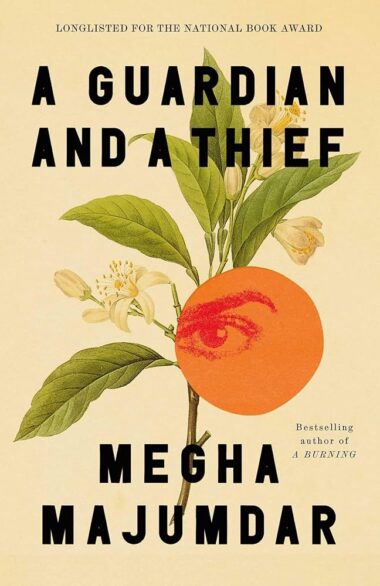
Megha Majumdar’s timely tale, A Guardian and A Thief, ponders the issue of memory and survival, of people and places, of food and the earth that yields it, or fails under duress to meet our needs. If one were to categorize this novel for the sake of categorization, it would be clubbed under the many texts urgently joining the canon of ecological dystopia, urging us to look around in prudence, in consideration, in appreciation and empathy and realize the truth of what we are doing to the world we live in. But the book, at mere 205 pages, is an exploration of human morality, a subversion of all the lies we tell ourselves to make ourselves look good. It looks at individual and collective conscience and the malleability of it in crisis.
Our earth is vulnerable, and is steadily headed towards greater precarity as the rising instances of hurricanes, extreme temperatures, heat, lack of ground water, and industrial pollution have already shown us. We are on the brink and this novel is located in the near future, in the city of Kolkata, teetering and bent out of shape with heat, and flooding, with the punishing sun and incessant rain. And as the city suffers from an acute food shortage, those old enough to know the history of the city are afraid to call it what it actually is—famine.
While the specter of famine looms large, the central characters of this novel—Ma, Dadu and Mishti—are potential climate immigrants to the United States of America, that touts its magnanimity in foreign policies, only to debunk them in reality. Ma’s husband, a professor at Ann Arbor, awaits the reunion with his family, putting aside provisions for their new home. The three of them are safely ensconced enough in their middle-class location to get their passports ready at the American consulate and have creature comforts of a large house in the heart of South Kolkata, working air conditioners to keep the heat at bay, water supply, refrigerators to cool them down, electrolyte pills and above all, basic ingredients for a simple meal, stashed away safely in a store room, food that Ma steals from the shelter for poor where she is a manager.
Her paths cross with Boomba, a young migrant from the Sundarbans, who joins arduously, several other migrants to the city with a simple desire—a home for his family, a basic shelter that keeps at bay mosquitoes and other harmful, invasive pathogens plaguing his village, assailed by repeated flooding, and loss of entire livelihoods, where the river eats up chunks of earth, and along with it, their domiciles. But the city that is already on the brink of collapse doesn’t care for people from the fringes. So, Boomba must think on his feet and fast. He follows Ma home one day and slides his narrow body through the bars of an open window and steals the food Ma had stored along with the purse that contains her phone and their passports. Now this loss and its aftermath is what drives the narrative forward.
Each chapter is the progression of the events of a day culminating in an unfortunate incident on the seventh day, that strikes terror at the reader’s heart. Is this where we are headed as individuals and as a community? Megha’s enquiry in the entire novel is into the issue of morality—how do we respond to crisis as individuals? Does the individual conscience take over collective conscience in the effort of being guardians and providers for our families? Majumdar cleverly chooses a woman, an aged and a two-year-old child as protagonists, characters that are already vulnerable either due to age or gender, and pits them against Boomba, a thin, twenty-year-old youth, whose vulnerability resides in his limited access to resources. While the former has a degree of privilege in being financially fluid, money doesn’t buy them nutritious meals once their store is raided by the latter, who just wants to sell off the food items and make provisions for his parents and little brother to come to the city. Each is a guardian. Each is a thief.
Food and hunger are recurring motifs in this text, and how the simplest of meals is luxury in trying times. While the old woman back in Boomba’s village yearns for the days when she could have omelets made with generous heaps of onions and green chillies, sizzling merrily in oil, a memory that brings nothing but salivating tongue at present, Ma and Dadu yearn to feed Mishti her favourite vegetable—cauliflower, to be savoured with steaming rice and dal. When Mishti refuses to have the government issued protein bars or fried onions and Dadu and Ma put aside the synthetic paste and choose to stay hungry instead and swallow water and electrolyte tablets, Dadu ventures out in the heat, hunting markets to bring back something edible, something that is not plastic, that resembles actual food.
“Where are you going?” said Ma.
“Mishti is not sleeping well,” he said. He pointed a trembling finger toward where she lay on the mattress, still for the moment. “There is hunger in her stomach.”
Ma went into the room to give Mishti the Gems if she woke, and Dadu stepped out the door. Candy would not do. He needed to find Mishti nutritious food to eat.
(page 103)
What follows thereafter is a harrowing search and hunt for food, in which Dadu sheds his urban, middle-class, Bangali bhodrolok skin and fights tooth and nail for scraps of food, something that he finds morally repugnant but essential, scenes that leave the reader haunted. His reward? Mishti’s happiness and sudden appetite for home-cooked deliciousness after what seems like ages. In another scene, Ma scavenges for the passports in a heap of garbage and is tempted to make away with a plastic wrapped pound cake but ultimately makes do with a packet of synthetic Gems candies for her daughter, in fear of the eyes gleaming with feral hunger right in front.
The novel also takes a look at the aspect of philanthropy in times of crisis, through the figure of the billionaire woman, dripping in diamonds, far-removed from the heated city, sequestered in her own Eden named the Hexagon. She is the last of the billionaires in the city who chooses to stay back, sending donations to the mainland, handouts to the shelter she has created, all in a constant bid to spin a narrative of philanthropy in social media. When she invites the guardians of the city with their children to partake a delicious meal abundant in vegetables, fish, meat and desserts, the situation goes awry, as the rest of the city, starved and deprived, loses its gratitude at being fed and stomps on the privilege by looting whatever they can get their hands on. As the woman and her family are airlifted out of the space, the boat carrying the loot sinks, people escape, people die, and the episode is sensationalized on social media as an instance of cultural entropy. It not only portrays the fragility of the urban ecosystem but also power relations within it. A key impact of this incident is felt at the end of the novel where the xenophobia of the West is brought to light.
Aside from being a dystopian tale of a city in disarray, this novel, in many ways, is an ode to the city of Kolkata and its culture that faces steady dissolution. Especially brought into focus is its community, the warm familiarity with which people greet others from different walks of life, something that Dadu, a relic from the city’s thriving past, embodies. There is a constant comparison between the old and the new, tempered with the typical Bengali nostalgia for the good old times, but especially for the teeming markets, something that is already being hit with the onslaught of online food supplies that render community relations broken and impersonal.
Interestingly, this nostalgia is undercut by the city’s harshness to outsiders who populate its fringes, people like Boomba, who arrive by the thousands and want to move to the heart of the city to carve out homes and identities. It takes us through the city’s unnerving underbelly with its unsavory crooks, and exacting landlords. Culturally, the novel is on point, the writer weaving in the imagery, the dialect, the nooks and crannies of the city, that smacks of Kolkata. Anyone who has been here will be able to relate to it with a warm reassurance. However, in trying times, with hoarding, rationing, and thieving of food, encroaching territories, and new realignments of social hierarchies, who succumbs to this changing ecosystem and who survives? —that’s the question this masterful novel leaves us with.

Rituparna Mukherjee
Rituparna Mukherjee teaches English and Communication Studies at Jogamaya Devi College, Kolkata. She enjoys writing short fiction and flashes. A multilingual translator of Bengali and Hindi fiction into English, her original work and translations have been published in Samovar, The Bombay Literary Magazine, Usawa Literary Review, Skipjack Review, Hakara Bilingual, State of Matter, MuseIndia among others. Her debut translation, The One-Legged, translated from Sakyajit Bhattacharya’s Ekanore , has been shortlisted for JCB Prize in Literature 2024 and won the KALA Literature Awards 2025. She is currently translating a political thriller set in West Bengal as well as a memoir dealing with gender issues. She is the fiction reader at Usawa Literary Review.