
Review: Song of the Clay Pot: My Journey with the Ghatam
Chandrashekar's narrative exposes the patriarchal exclusion of women in Carnatic percussion, staging a cultural confrontation over gendered artistic domains and bodily expression.
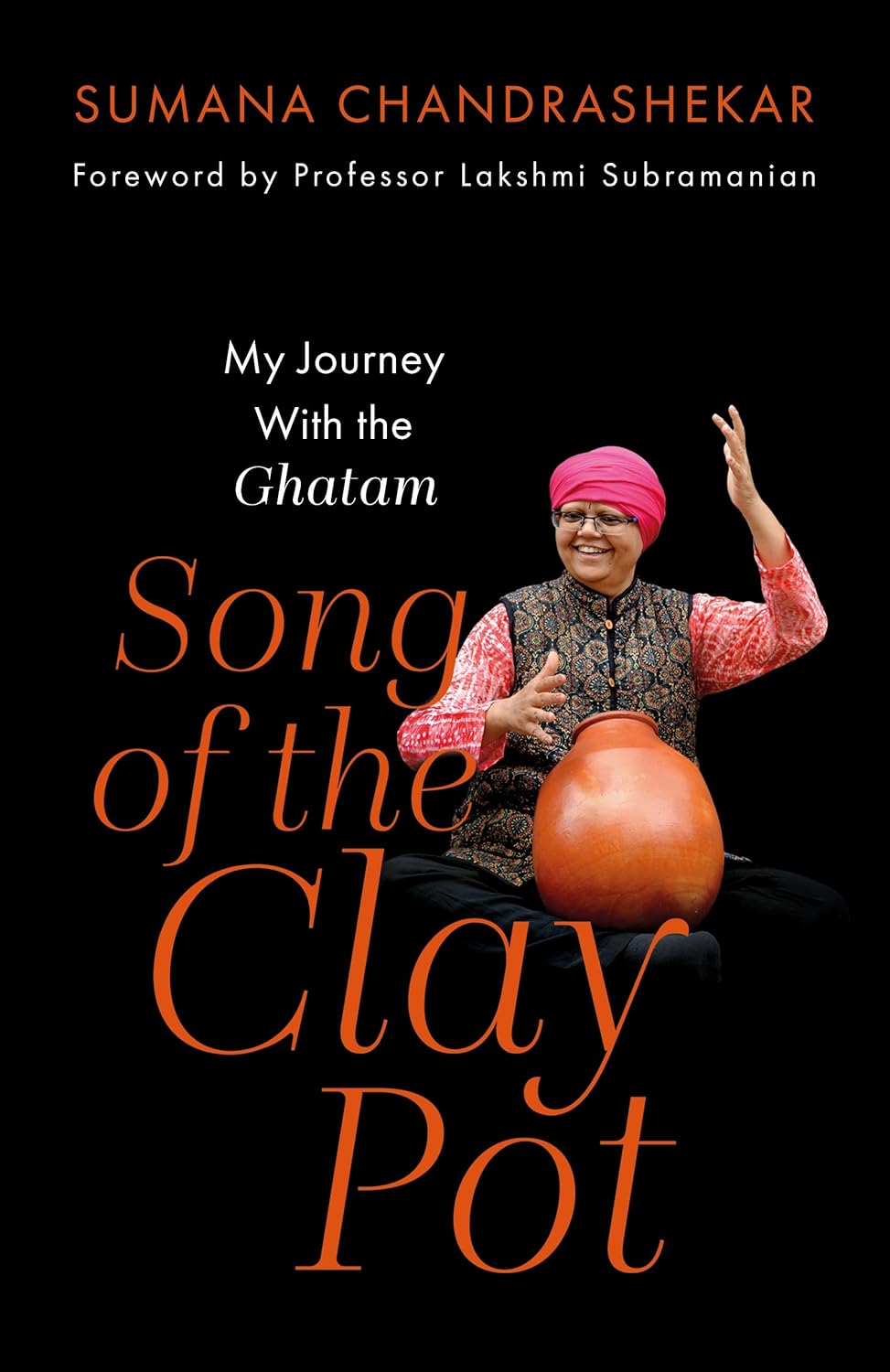
We are often prone to not understand and comprehend the quality of regular elements brewing a compelling effect. The fascination of watching or listening to life coming out of an instrument that comes alive is a transcendental experience but, at the same time, it challenges the generalist thought. This very idea makes people take a stand against everything that hinders monotony. Sumana Chandrashekar’s Song of the Clay Pot: My Journey with the Ghatam documents the correlation between music, society and the human body by putting commentary on how women musicians still remain marginalized and what drives the living to find a way into the craft of music – an act against monotony that patriarchy brings in the forefront. It also explores humanity whose brutality and kindness gets more vivid with her life and journey using the ghatam.
Life is oriented to be approached from both masculine and feminine perspectives. In a patriarchal society, the former corrodes the latter. Chandrashekar, in the introduction of the book, writes that the intention behind the book is to address the body, its experiences, and possibilities. Music and its agencies take birth differently in the presence of women. Patriarchy has issues with the difference female musicians bring. The marriage of her own body with the ghatam denounces any kind of detachments between both of them. It also connects the dots which society inflicts but manages to hide or justify its loud and latent violence. She unravels factors which drive her towards the ghatam where home means the body, the earthen clay of the instrument and the state of being.

Sukanya Ramgopal, one of the first women to bring Ghatam into the mainstream
The Carnatic music associates the mind with the body making them complement each other. The musician here identifies that its strength, especially in women, is because of its invisibility and cleverness. Body, on the other hand, is visible and does not or cannot fake itself. So, when Chandrashekar writes “the mind is clever, quick learner and sometimes cunning”, the system is not targeting the mind, it is targeting the body of women by censoring their visibility, hence, what they do with their body in the field of music remains in the dark. At the same time, it is the body that defends itself, resists and becomes a source of power. For Chandrashekar, her art, her ghatam, happens to be the source of questions raised against the patriarchal system. The ghatam, like human body, is made up of the five elements of nature, blending both with a certain kind of divine energy. It unites both without giving birth to any other semblance of reason.
Patriarchy has issues with the difference female musicians bring. The marriage of her own body with the ghatam denounces any kind of detachments between both of them. It also connects the dots which society inflicts but manages to hide or justify its loud and latent violence.
Percussion instruments have always been tied to the male members of the society, making it a tool of patriarchy. Chandrashekar’s chose to play the ghatam since the sound resonated with her. But, in the later part of her life, it becomes an instrument that began flowing against the tide of the system dominated mostly by men. The support came from her parents and they helped her frame herself in various boxes so that she can explore the different dimensions of not only music, but also what lies beyond. It becomes evident when she quotes her Amma, who after she confronts her about her choice of playing the ghatam, said to her Appa, “let her learn. I am sure she has a thought about it”. She considerably upended the patriarchy in music by taking a percussion instrument that is mostly associated with the male members of the society.
Questions were raised on Chandrashekar and her women peers who took the ghatam as their instrument. They were called weak and the ghatam was traditionally considered a man’s domain since women lack the expected physical strength. Chandrashekar writes, “many male mridangam players categorically criticized him – the guru – they had many reasons – what will society say; women lack the physical strength required for percussion, they will not (be allowed) to play once they get married.” But even amidst patriarchs, there are men who refrain from questioning a person’s dreams. Chandrashekar was fortunate enough to have a teacher who guided her without any discrimination based on her gender. Their guru-shishya bond went against this system of patriarchs.
For Chandrashekar, the ghatam becomes a permanent agent which penetrates her consciousness and weaves itself around her body. The musician recalls it as a ‘calling’, a state where both the ghatam and its player cannot stay away from each other.
Percussion instruments have always been tied to the male members of the society, making it a tool of patriarchy. Chandrashekar’s resistance was to play a percussion instrument that gave her the call. It was a conspiracy that urged her to flow against the tide. The support came from her parents and they helped her frame herself in various boxes so that she can explore the different dimensions of not only music, but also what lies beyond. She considerably upended the patriarchy in music by taking a percussion instrument as her weapon and it gave birth to several rough rides. Questions were raised on Chandrashekar and her women peers who took the ghatam as their instrument. They were called weak and the ghatam was traditionally considered a man’s domain since women lack the expected physical strength. But even amidst patriarchs, there are men who refrain from questioning a person’s dreams. The musician was fortunate enough to have a teacher who guided her without any discrimination based on her gender. Their guru-shishya bond went against this system of patriarchs.

Sumana Chandrashekar in the British Ceramics Biennial
But even then, her guru was susceptible to what patriarchy holds. When Chandrashekar writes, “women were invariably paid less than their male counterparts. Since men did not prefer the ghatam, ghatam players mostly played with women and had to be content with the meagre amount they received from the concert that was already underpaid”, it clarifies that women ghatam players are either curbed or underpaid in several gathering out of a fear that they will inspire other women to take ghatam as their instrument of choice.
In my interpretation, equality for Chandrashekar rested in the beats her fingers thumped on the ghatam. Fingers in motion exhibit the equality that the society deserves, especially when it comes to gender, music and having a stand against exploitation. In percussion, only when all the fingers work together in unison, a decent music can be heard. Similarly in society, men and women have to complement each other to construct a society that’s equal for all.
Chandrashekar’s ghatam was Jimmy Page’s guitar because the latter revolutionized the 12th note of guitar whereas the former made women revolutionize the importance of defying a cultural hegemony.
Are we really ready to witness a woman playing ghatam? The book asks this question because even with modern education, influencers, and introduction of a new civilization, we still feel stunned to see a woman playing percussions. Our mind is conditioned to listening to men mastering the musical instruments that fall under percussions but with time, a woman’s decision to enter their territory is a matter of surprise. Although the book’s title is about the clay pot, it is rooted in understanding the dynamics of earth and how it reinforces the gender equilibrium. Chandrashekar’s ideas are mainly based on seeking the feminine in percussion, and so she writes, “the way a male body plays percussion has become the standard, the yardstick against which women’s playing is constantly measured”. To grow an identity, as a woman, in a male-dominated field, is challenging but Chandrashekar succeeds in doing that with her devotion towards her art that unconsciously, challenges the system of patriarchy as well.
Song of the Clay Pot is an intimate and personal approach towards music, the human body, mind and all its dynamics. Sumana Chandrashekar documents her personal life which subverts every social construct that comes as a hindrance for women in art. The musician has her own strength and so victimhood is not glorified. Rather, the process of getting out of it is projected through this particular memoir. It is an important book to understand the present dynamics of Carnatic music, its various fragments and how the introduction of women, with time, has slowly led to discovery of several points of origin with a broader outlook.

Kabir Deb
Kabir Deb is an author/ poet based in Karimganj, Assam. He works in Punjab National Bank and has completed his Masters in Life Sciences from Assam University and is presently pursuing his MCW from Oxford University, London. He is the recipient of Social Journalism Award, 2017; Reuel International Award for Best Upcoming poet, 2019; and Nissim International Award, 2021 for Excellence in Literature for his book ‘Irrfan: His Life, Philosophy And Shades’. He runs a mental health library named ‘The Pandora’s box to a Society called Happiness’ in Barak Valley. He reviews books, many of which have been published in magazines like Outlook, Usawa Literary Review, The Financial Express, Cafe Dissensus, Sahitya Akademi etc