
From
Matchbox – March ’26
Review: That’s a Fire Ant Right There
Khadeer Babu's work delineates a transitioning Indian small town's complex social realities, particularly women's agency and inter-community dynamics, underscoring translation's role.
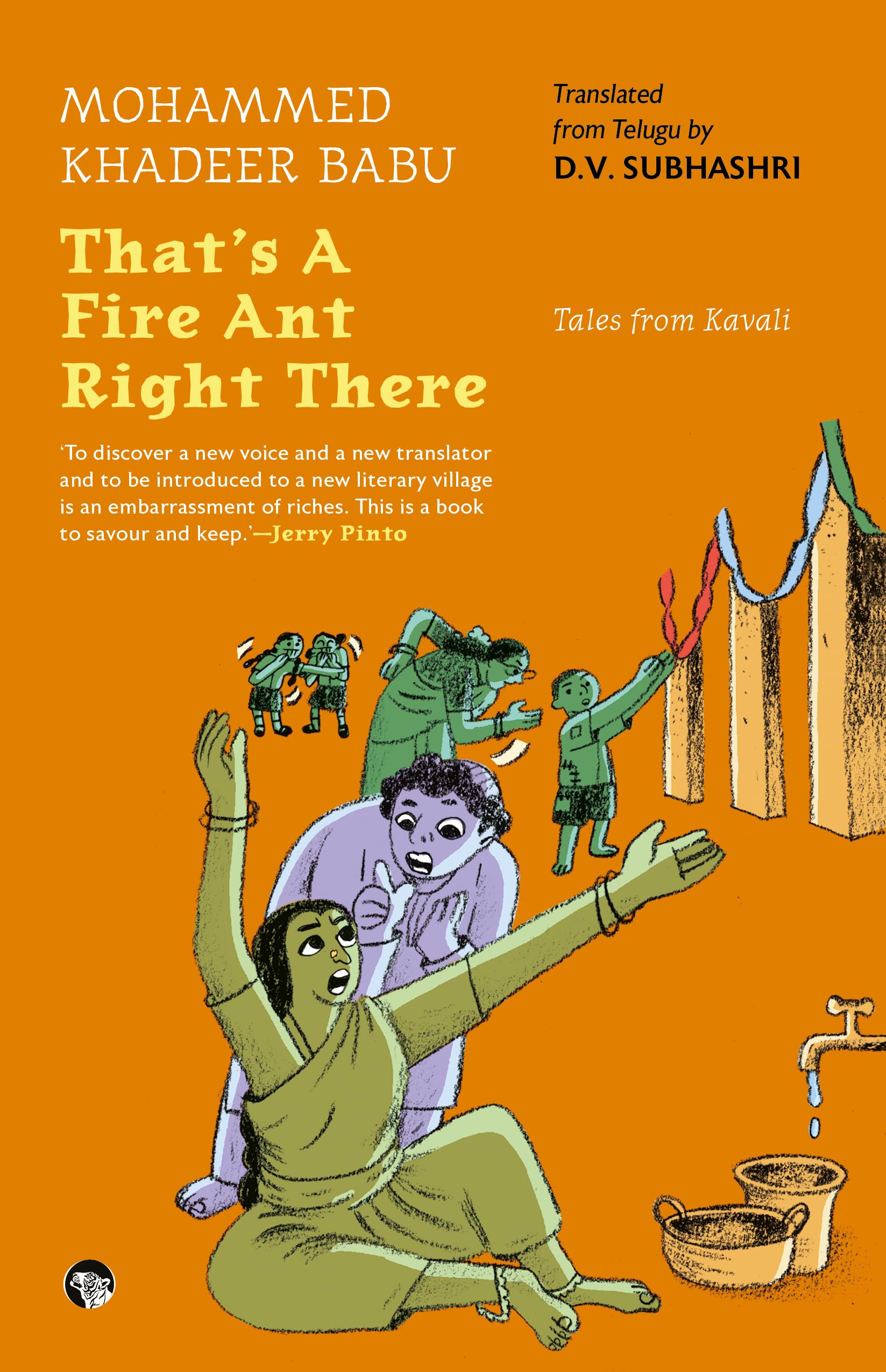
R.K Narayan’s Malgudi Days remains such an abiding classic because it creates a loving and humorous microcosm of the Indian small town in transition from colonial rule to its own freedom, charting changes in the socio-political and cultural landscape of South India. Mohammed Khadeer Babu’s That’s a Fire Ant Right There: Tales from Kavali translated by D.V. Subhashri and published by Speaking Tiger Books, has a cultural distinctness that is equally evocative and endearing as Narayan’s seminal work. The fifty stories in this collection, divided in two parts as Dargamitta stories and Polerammabanda stories, unfold in short, often anti-climactic and humorous episodes that offer its readers snippets of small-town life at Kavali, near Nellore in coastal Andhra Pradesh. Told conversationally from the point of view of a child, this coming-of-age narrative set in the 1980s is a nostalgic homage to small-town life before the liberalization of the Indian economy and spans a period of roughly six or seven years in a place on the cusp of socio-economic upheaval.
The two parts of the text, dedicated to his father and to his friends respectively, cover the formative years of the narrator’s junior school and senior school life in two localities of Kavali—the first in the Muslim majority neighbourhood of Kasaabgalli and then in the Hindu majority part of Polerrammabanda. What draws the readers immediately to the text is the narratorial voice which is frank, humorous and observant, redolent with the sights, smells and sounds of Kavali. It talks about quotidian Muslim practices, household and societal dynamics without an agenda and even though the text is drawn from the author’s own memory, each story is stark, honest and shows middle-class Muslim life in all its banality. And this is where the stories, in their ordinariness, not only render themselves engaging but also highlight through observational humour issues relating to caste, class, religion, gender, public school education, economy and unemployment in semi-urban spaces grappling with modernity. What stands out as a result are carefully nuanced characters, each with their own idiosyncrasies, that become easily identifiable and relatable, especially for Indian readers.
The large-hearted, honest father, the cantankerous grandmother, the strong-willed mother, the responsible elder brother, the clever principal and the whole paraphernalia of gossiping neighbours and aunts hold the familial fabric together. But what is interesting in this text is the portrayal of Muslim women that subverts the contemporary hegemonic portrayal. The women in these stories are anything but victims—they exercise agency within the parameters of family life, have a clear voice in family matters and often are the ones that hold the fort while men languish and work. For instance, the narrator’s mother anchors the family, she is the major decision-maker, the cook as well as the entrepreneur who starts a flower-selling business after all her household chores. The grandmother is not just the matriarch; she is also the Urdu and Arabic teacher to headstrong children who resist learning the language because they feel so comfortable in Telugu. Zareena, the narrator’s aunt is married to a lazy spendthrift but somehow scrapes by, pilfering resources to put a plate of food in her children’s hands.
Both neighbourhoods in the stories reflect deep community spirit and easy religious harmony. Neighbours lend each other groceries, landladies step in to help tenants cook Semiya for festivals, friends gather to share food, especially across cultures. There is gossip and playful banter, a bit of rivalry and the occasional quarrel. Yet when storms hit or trouble comes, the same people open their doors to the vulnerable and stand by one another. One such instance is the unique Roti festival in Dargamitta, in which faith becomes bigger than religion. Both Hindus and Muslims travel to the holy place on the second day of Muharram and make a wish, and exchange rotis, those whose wishes have been fulfilled give their rotis to those to make the wish—all manner of wishes are exchanged by the women in form of ‘health roti’, ‘income roti’, ‘happiness roti’, ‘education roti’, ‘soubhagya roti’—wishes that frame middle-class existence of uncertain finances, drunk husbands, wayward children—and the narrator humorously depicts how even amidst festivities the performative aspect of gender persists:
But the one roti with the highest demand, more than any other roti, was the ‘Offspring roti’. Women would fight for this roti as if fighting for a movie ticket at the booking counter. Everyone believed they’d definitely beget children if they ate an Offspring roti’ here. (117)
Another instance that is equally impactful shows the barter economy that was once prevalent in small towns. The narrator speaks of the itinerant sweet potato sellers that settled in the outskirts of Polerammabanda every summer, filling the quiet neighbourhood with their activities, bartering tubers for rice, leaving only when all their produce was sold and they had enough paddy to last them the year. The calculations are arbitrary and based on years of informal transaction and trust: “a seer of paddy for a viss of tubers—that’s a quarter kilo of paddy for a kilo-and-a-half of sweet potatoes” (168). Now, these nomadic farmers keep watch over the homes, guarding them from thieves so people can sleep easy on their terraces. They also track and kill the bandicoots that come down to feast on the sweet potatoes. When a high caste priest in the locality objects to their presence and din, complaining that “your womenfolk keep trespassing into our house on the pretext of getting water, and touch our cots and pollute them” (170), this caste pride is momentarily shed when one of the sellers suffers from a scorpion bite and needs help. The priest’s timely aid elevates his status to a ‘mahanubhava’, a great man. Similarly, while the narrator is affectionately welcomed by two of his friends’ families, he isn’t allowed inside his friend Sridhar’s house because of his grandmother’s Brahmin caste and class pride and also because the narrator was a meat-eating Muslim, nonetheless that doesn’t impact their friendship.
In fact, friendship is one of the foundations that enables the narrator to finish senior school and find a career as a journalist and writer. Although poor, the narrator doesn’t miss out on anything because he sometimes dupes, and is mostly supported by his friends and family, finding ways to navigate his poverty and participate in his public-school curriculum. The text offers an insight into the drawbacks of the Indian government schools that mostly run on low budgets and are rife with corporal punishment. Yet, despite these setbacks, that will probably draw harsh criticism today, a few of these aivorus are wholeheartedly dedicated to the development of their students. The narrator and his three friends experience the same capers, eventful functions, examination scares, and growing up rites-of passage like wearing full pants for the first time, sitting alongside girls in a private tuition, bunking school to watch matinee shows, the senior school farewell where autograph books are the latest trend—as any of the youngsters now.
What makes Kavali and its vibrant, colourful life come alive is the considered, masterful translation. In the translator’s note, Subhashri mentions that translating humour was one of her predominant challenges. But that is surmounted quite well because the situational and narratorial levity is carried across really well. It is helped by the generous use of ideophones, onomatopoeic words and reduplications to indicate mood, movement and texture. So, tempers rise ‘sarrr’, thunders clap ‘dada-dadaa, bada-badaa’ and slaps land ‘pattt’, and people ‘gargle garagaragara’ (27), blood boils ‘sara-sara-sara’ (239), and children wolf down meals ‘gaba-gaba-gaba’ (222). Reduplications such as ‘big-big’ or ‘cut-cut’ to indicate volume, importance, intensity or immediacy are distinct features of Indian languages that translate quite well into the target language. Along with these, there are distinct terms of address like ‘nayaana’, ‘abba’, ‘saar’, or the more affectionate ones used between friends like ‘mama’; ‘emmey’ or ‘mey’ for women, or the most informal ‘orey’ that carry the distinct regional flavour of the Kavali-Nellore dialect, making the text spatially evocative.
The stories are liberally sprinkled with Indianisms and forms of Indian English interspersed with Urdu and Telugu words whose meanings can either be gleaned from context or come followed cleverly with the English gloss such that it doesn’t seem a mere formality and flows organically with the text. A few good examples would be— ‘halka-dalka lightweight one’ (220), ‘this fellow forgets everything, all deen-duniya once he goes to work’ (26) and ‘she’ll feel pashchatap, prayschit, paropakaram idam shareeram and whatever else people feel when they repent’ (273). The dialectal ending “ra!” slips neatly into the English lines, adding a clear rhythm, tone, and easy familiarity: “Orey! Orey! Stop your prattle, ra! Dhoop-chaavs and collar kurtas are not going to fly, ra” (239). This deliberate use of dialect grounds the language in a sharply local context, sets it apart from other forms of Indian English, and heightens the reader’s enjoyment of its world and ethos.
That’s a Fire Ant Right There presents a vivid, humane portrait of small-town life where everyday moments quietly reveal deeper social realities. Its humour and childlike perspective capture the intersections of caste, class, religion, and gender with subtlety and ease. Crucially, D.V. Subhashri’s translation sustains this texture, thus preserving the rhythm, idiom, and cultural specificity of the source text through its playful use of dialect, Indianisms, and sound patterns. The result is a work that is both locally grounded and widely resonant, functioning as a nostalgic archive as well as a nuanced reflection on a society in transition.

Rituparna Mukherjee
Rituparna Mukherjee teaches English and Communication Studies at Jogamaya Devi College, Kolkata. She enjoys writing short fiction and flashes. A multilingual translator of Bengali and Hindi fiction into English, her original work and translations have been published in Samovar, The Bombay Literary Magazine, Usawa Literary Review, Skipjack Review, Hakara Bilingual, State of Matter, MuseIndia among others. Her debut translation, The One-Legged, translated from Sakyajit Bhattacharya’s Ekanore , has been shortlisted for JCB Prize in Literature 2024 and won the KALA Literature Awards 2025. She is currently translating a political thriller set in West Bengal as well as a memoir dealing with gender issues. She is the fiction reader at Usawa Literary Review.