
From
Matchbox – April ’26
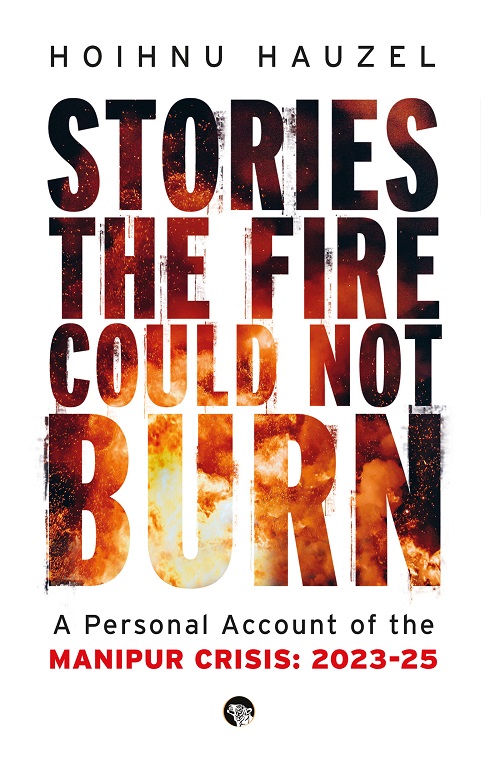
Review: Stories the Fire could not Burn
Hauzel's memoir confronts the existential stakes of home and identity, exposing how state failures and engineered divisions enable systematic ethnic violence and collective erasure.
If home is found on both sides of the globe,
Home is of course here—and always a missed land.
-Agha Shahid Ali, “The Land”, 2009
What is it about ‘home’, this four-letter word, that is so evocative universally? Home is where we grow, where we find our voice, our roots, it is where our belief systems are structured, and from the spaces of home, safe or otherwise, we frame our connections to the world, whether it is a locality, a city, a state or a nation. It is from home that we start and it is to a home that we return. It is the first point of belongingness in the vastness, the only point of permanence in a steadily perishing world. Yet for many, and increasingly so, home is becoming an increasingly fraught space as the largest democracy of this world is edging back to its feudal past, fraying at the seams of democracy. Manipur, the land that Hoihnu Hauzel calls home has an intensely tenuous relationship with Indian democracy, an area that being far from the mainstream imagination is homogenized, misunderstood or worse, neglected. In this personal memoir of the bloody civil strife, Stories the Fire could not Burn, published by Speaking Tiger Books, Hauzel documents the bloody civil strife and massacre that tore through Manipur in 2023, and whose fire still rages, away from the mainstream nationalistic jingoism.
Hauzel, a journalist based in Gurgaon, mentions at the very outset that it is a personal memoir wherein she leaves her journalistic chops behind to observe, narrate and provide a window to the intense suffering of the Kuki-Zomi/Mizo tribes following the brutal civil war on and from May 2023. In doing that, her motive is to fill the silence in the mainstream media noise that doesn’t cover the personal cost of these minority communities. In calling this account personal, she places herself firmly within the traumatic landscape that absolves her of the apparent necessity to maintain journalistic balance. She tries to address what she calls the ‘bias’ against these minority tribes since the inception of the state. It is important to understand that the root of this problem is largely economic. The tensions between the dominant group Meiteis and the minority Kuki-Zomi/Mizo tribes arise not only from their geographical situatedness but also from the race to access resources that is masked under the larger identity politics.
Manipur’s people have been historically precarious with insurgency movements and routine clashes between the army and local insurgents normalizing gun culture and violence in the area. Yet as Hauzel notes, there used to be a tenuous understanding between the majority Meiteis and the minority Kuki-Zomi/Mizo-Hmar, Naga and other Chin tribes that populate the state. Their spatial allocation has a lot to do with the present conflict. Manipur is geographically divided into the Imphal valley which covers about 10% of the total land area while the other 90% of the Manipur lies in the surrounding hill areas. While the valley is traditionally dominated by the Meiteis, the other tribes populate the hills. But here lies the problem. The numbers obfuscate from the national imagination the actual living conditions. Most of the hills are uninhabitable and those that are inhabited have very poor infrastructure, healthcare and education. The roads are unpliable most of the year due to rain and landslides, leaving very little choice at the hands of these tribes but to move to the valley, the centre of all development, that holds the promise of a better life.
And so, Hauzel’s family had moved from the hills of Churachandpur like many others and settled in Imphal, in a locality they named ‘Paite Veng’. This locality, situated near the airport, is an upscale area with significant commercial activity. The Evangelical Baptist Church formed the heart of the community. Yet this influx wasn’t taken kindly. The Kuki-Zomi tribes have experienced discrimination over time based on their linguistic, cultural, and religious differences. As Hauzel points out:
The Meiteis and our community coexisted in the same city yet led entirely separate lives—as if they were parallel worlds that never truly intersected. There was no exchange of traditions, no borrowing of customs, and little effort on either side to understand the other beyond the surface. It was a silent, unspoken divide. (p.72)
Both the state and the central governments in keeping the development Imphal-centric exacerbated this divide that runs on the same neo-colonial script as the rest of the country. Historically no attempt has been made to understand the individuality of tribes which has always fuelled resentment and a certain fear among the minorities. The dominant Meiteis, who have maximum access to resources, effectively disfavour the hill tribes by lumping them together with the slur “hao macha”, the same policy that is adapted by the Indian mainstream towards anyone who doesn’t pander to the imagination of who is rightfully Indian.
The present crisis, that had come to a head in April-May 2023, was a result of the Meitei demand for the ST status alongside the state government’s declaration of much of the hill region as reserved forests. This move effectively endangered much of the livelihoods of the poor in the hills and they immediately protested “against erasure, exclusion, and state overreach” (p.42). But shortly after the fragile peace between the tribes lay in shreds as the clashes were followed by “orchestrated arson” (p.44) in which the Meiteis tried to eviscerate Kuki identity by targeting symbolically significant areas in the hill districts, especially Churachandpur. This violence soon spread over to the Kuki-Zomi localities of Imphal, Hauzel’s own locality Paite Veng, where house after house, structure after structure was torched and the residents escaped with barely anything, only to see their life’s work in ashes.
The attack was premeditated, systematic and organized by a well-rehearsed playbook. The betrayal was sharp because the very people who had been life-long neighbours, were the ones to give the Kuki-Zomi/Mizo tribes away since they could not “rise above (their) Meitei identities” (p.49). Hauzel doesn’t villainize all Meiteis, accepting that a few helped them escape, those that upheld humanity over their Meitei identity and also acknowledges the grief on the other side. All the same, she emphasizes that the scale of suffering and dispersal simply does not compare. She leaves a bigger and more important question in the wake of this continuing crisis—what propels completely normal individuals to consecrate such violence and atrocity.
What Hauzel points out—and this is where the traumatic landscape of the memoir becomes both acutely personal and a severe indictment of the identity politics that shapes our national lives at the moment—is who do we make into the Other? What contributes to a celebratory jubilation in burning and utter destruction of collective identities? Why does one ethnicity wish for the complete subjugation or worse, annihilation of another? In relating her own memory of home, her family’s brickfield, her mother’s gardens and her father’s library, Hauzel takes us through the embodiment of their collective family life. In describing each object of the home in meticulous detail as well as how they were destroyed by the rioting crowd, Hauzel’s trauma and that of her community is established. Home is a space for social gatherings, for building and sustaining community life, with each new addition marking a new phase of life. As Hauzel says:
My parents built their home in Paite Veng slowly in stages—there was no blueprint or grand plan. Each addition came whenever they had the means, brick by brick, room by room, shaped by patience and perseverance (p.82).
She talks about her father’s books and his red Remington typewriter, the piano on which her nieces played, the dolls that they left behind and now pine for, to not just humanize the extreme loss but to evoke how home is not merely a space, but also the objects that hold emotional value and deep psychological attachment. Of particular poignant note, is the episode where her traumatized father smiles for the first time after the incident when Hauzel gives him her own typewriter. The residence thus becomes a microcosm of the larger state that burns.
And in this cyclical traumatic narration of the material history of her home and community, spread over seven chapters of this book culminating in her search for her lost home, is Hauzel’s attempt to understand why despite extreme violence, many of her friends and family choose to return to a precarious landscape. Hauzel foregrounds the emotional and psychological damage that revisiting such atrocities can have, especially through videos and photographs circulated endlessly on social media. She moves from the personal to her community at large where victims and their families have been made to relive this violence over and over again.
Hauzel calls out this appetite for consuming the pain and trauma of the Other and contrasts it with the utter silence from state and central authorities whose mishandling of the situation compounds the existing betrayal. She talks about the expanse of the skies amidst mountains that is lost in the crowded urbanity of the new shelters and what that visceral loss means to a displaced and exiled people whose ways of living have been rudely altered, yet whose resilience in face of such loss and pain remains remarkable. Yet who remembers this forbearance in an age where so much is happening everywhere? This memoir is Hauzel’s tribute to a home that lies vandalized, to a community that is broken but definitely not beaten, a testament against complete erasure of material history that is very much a part of collective social fabric.
At a certain point I lost track of you
They make a desolation and call it peace.
-Agha Shahid Ali, “Farewell”, 1997.

Rituparna Mukherjee
Rituparna Mukherjee teaches English and Communication Studies at Jogamaya Devi College, Kolkata. She enjoys writing short fiction and flashes. A multilingual translator of Bengali and Hindi fiction into English, her original work and translations have been published in Samovar, The Bombay Literary Magazine, Usawa Literary Review, Skipjack Review, Hakara Bilingual, State of Matter, MuseIndia among others. Her debut translation, The One-Legged, translated from Sakyajit Bhattacharya’s Ekanore , has been shortlisted for JCB Prize in Literature 2024 and won the KALA Literature Awards 2025. She is currently translating a political thriller set in West Bengal as well as a memoir dealing with gender issues. She is the fiction reader at Usawa Literary Review.