
Beena Kamlani in Conversation with Ankush Banerjee
Kamlani's debut novel reimagines an uncle selected by Gandhi as a future…
Read more →1934 England: Lucy's flamboyant spring attire clashes with Shiv's dull suit on the train to Lewes. Class whispers, revealing deep colonial inheritances.
Pages: 129 – 133
On 28 May, 1934, they boarded the 2:53 p.m. train from Victoria Station to Lewes. Lucy looked stunning. His skin was glowing, the pink and white suit he was wearing was meant to create a stir—only someone like him could carry it off, Shiv thought. The sharp sculptured planes of his face like one of Balthus’s young girls, his expression cool and consciously indifferent, the shoes pointy toed and white, the green of his eyes and the pink of his suit evoking spring’s bounty, his smile detached and engaging at the same time. He had on a cream-coloured panama hat with white trim. His entire get-up, his style, felt Parisian, or Venetian, certainly not English. The oblique admiring looks aimed in Lucy’s direction spoke of his effect on some of the passengers. Stuck to his side, it was attention Shiv felt he could do without. His eyes were red- rimmed from lack of sleep, his pin-striped suit looked staid and dull. Even the small touch of flamboyance he’d reached for—a yellow tie—failed to perk up his general appearance. How did he seem to them—a lackey, a paid servant of some sort, a rajah for hire? He sat next to Lucy with mounting anxiety.
The compartment was full of young men in suits and top hats, women in dresses that were calf length or ankle length. Dressed in sensible garb, the women had accessorised with pearls, the flashier ones with diamonds and emeralds, but they all seemed dowdy and fusty compared with Lucy. Some of the women were in high-heeled shoes; others in wellies. “Wellies?” Shiv asked.
“Yes, they’re the knowing ones. There’s going to be a lot of mud in those fields.”
“So you wore white!” Shiv said, laughing and shaking his head.
The animated women kept up a spirited conversation about nannies, cooks, children, horses, housekeepers. The men discussed amenities at their clubs, the dull concert season, new actresses in musicals playing in the West End, and where they would be shooting grouse at the start of the season in August.
Lucy said, “You’re going to hate us all by the end of the day. Even I find it intolerable and I’ve been listening to this stuff with a half-shut ear since I was a child.”
“What do they do?” Shiv asked.
Lucy laughed. “Nothing. They’re pretty good at that. Some of them collect art; some breed horses. They don’t have any real interests. They meet one another—the men, that is—at their clubs, at shoots, and at the races. At the theatre, they are nodding acquaintances. It’s essential to have eyes you can meet and heads you can nod at across boxes.”
“I find that impossible to believe. Such ruddy specimens of humanity doing nothing! How do they live?”
“It’s largely inherited. Invested heavily—telephones, electricity, diamonds, steel, coal. The Empire. You see why industrialisation of the colonies is so important to this lot. And horses, of course, which is why the races are a huge social event. They do money quite well.Some make it; some blow it. The ones who do well cannily opine on world affairs with an eye on their chequebooks. Service is for Boxing Day.”
“So what do they really care about?”
“Society. To never breach the rules of society, which are unwritten of course, and inherited largely at birth. It’s the sure knowledge of these that allows them to walk into a room with a confident air and to take their place within it. Violate those rules, and you’re out. There: a short course on English society.”
Shiv saw someone who looked like Lady Sophia. Dressed in a crimson cape, crimson court shoes, her neck bubbling with large pearls, waving fingers studded with stones, she came eagerly towards them. “Oh, it’s Polak’s lodger, isn’t it? I thought I recognised you! Fancy meeting you here, dear boy!” Her lips had been smeared thickly with lipstick and it sat like cream on her smile. Shiv got up from his seat, shook hands. “Meet my friend—”
“Oh, Lucy,” she cooed. “Naughty boy, hiding behind the newspaper. I didn’t see you! His mother and I were at school together. I’ve known this boy since he was a babe in his nanny’s arms.”
Lucy cut in, “He’s my guest.” He went back to his newspaper. Lady Sophia blinked several times. “I would never have taken you for an opera fan.”
Shiv said, “It’s my first.”
“Ah, you lucky man,” she purred. “You’re beginning at the top. Mozart. The Marriage of Figaro. It doesn’t get better than that. We are all giddy with excitement—marvellous Mr. Christie, to have pulled off the event of the season in the middle of pastureland! He’s got the best singers in the world to come. Simply extraordinary!”
“So I’ve been told. The danger, of course, being that nothing else will ever come close again.”
“Well, I hope you enjoy it.” She appraised him again, surprise never leaving her face, and then gave him a broad smile, her ivory teeth flecked with bright pink lipstick, her cheeks already a bright tomato red. “Henry Polak was right. Young man, you bright natives will have the run of the colonies after we’re gone. Perfect wogs!” Lucy’s newspaper crackled furiously behind him. He had been paying attention.
Shiv felt a chill run through him. Again. That inevitable comparison, are you wanting or not, are you capable or not, are you one of us or not, can you be trusted to be one of us when we want you to be one of us, and not one of us when we don’t want you to be one of us. He bowed stiffly, not saying a word.
“Tell your mother I insist on meeting Harry.” She turned to Shiv. “It’s her new obsession—a new breed, Bichon something. Quite a charmer, I’ve heard.”
Lucy flicked his newspaper aside. “Frise. Bichon Frise. He’s had a name change yet again—Hector, after Greece. Poor little fellow! Doesn’t know if he’s Greek or English now.”
She laughed. “Funny boy! I see you’re just as witty as ever! Well, cheerio! See you at the concert,” she said, moving back to her seat.
They sat in silence as bright green countryside shot past the windows. “Cat got your tongue?” Lucy, his face bright pink with rage, lowered the newspaper and glared at him.
“What?”
“She called you ‘lodger’—did that just sail past you? She called you a ‘perfect wog.’”
Shiv shrugged. “Yes, I’ve been called those names before.”Lucy shook his head. “I wish you’d fight back. You take it. It’s bloody infuriating. You make me want to be a monster for you.” He put his newspaper down. “The French have a term for it—avaler les couleuvres—to swallow grass snakes.”
“What?”
“Yes, when insults are so deep, one’s stunned into silence. Was that it?”
“You would have wanted me to make a scene? Here?” He puzzled
over Lucy’s words.
“Yes, here,” Lucy said, going back to his newspaper.
Bit it off, he wanted to tell him. Bit off that tongue, didn’t I, when I was told my opinion wasn’t worth a penny. Mr. Polak’s enraged face swam into his consciousness—lie low, don’t question, don’t offer your opinion. I bit it off to make it. Here—his eyes swept the green fields of early summer. Lucy would never have understood.
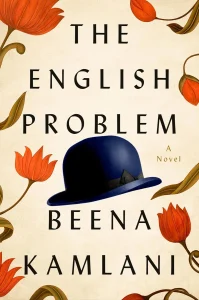
Excerpted with permission from The English Problem by Beena Kamlani published by The Bombay Circle Press 2026.

Beena Kamlani is a Pushcart Prize-winning fiction writer whose work has appeared in Virginia Quarterly Review, Ploughshares, Identity Lessons: Learning to Be American, eds. Gillan (1999), Growing Up Ethnic in America, eds. Gillan (1999), The Lifted Brow (2008), World Literature Today and other publications. She received the Yeovil Fiction Award (Somerset, England), for a novel in progress in 2017. She has been awarded fellowships at Yaddo, MacDowell, Ledig House/Writers Omi, Hawthornden Castle, Jentel Arts, and Hedgebrook. In her years as senior editor at Viking Penguin, she worked closely with literary luminaries like Saul Bellow and Robert Fagles; bestselling writers like Kim Edwards, Terry McMillan, Jacqueline Mitchard, and Natalie Baszile; literary fiction writers like Ruth Ozeki and Paul Beatty; biographers like Diane Middlebrook and Blanche Wiesen Cook; and translations of works by Jiang Rong, Mo Yan, and Reinaldo Arenas. She taught book editing at New York University for nearly two decades and earned an award for teaching excellence. Her first novel, The English Problem, was published in January 2025.