
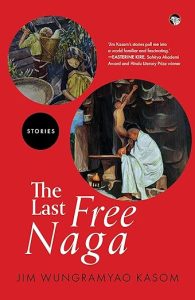
Review: The Last Free Naga
Kasom's collection centers Nagaland's periphery, revealing how local narratives expose universal human…
Read more →Cold gun barrels meet fiery anger amidst Imphal's cheap lives. Naga villagers deem hard work sacred, their lives textured by tireless labor.
Incidents like these were not uncommon. In this far-flung village, the skill of survival was paramount. Animal heads were like trophies: the bigger the game, the bigger the trophy. This was perhaps the only plausible way of leaving a tangible legacy because it subscribed to some form of risk and danger that is absent in the safe and mundane life of farming. Memory stones were erected for great hunters with headcounts of animals they had hunted inscribed on them and stories of their achievements were talked about in the neighbouring villages. (Story: The Mountain Man; Page No. 33)
I realized that I could have ended up as the grainy picture in the newspaper. Yesterday, I had an AK-47 barrel pointed at my neck. Surprisingly, the barrel was icy cold, while my brain had fried up. My mind was clogged with fear then, but now the incident provoked no other emotion but anger. I could have died for nothing. Life in Imphal is as cheap as the goods that comes from Moreh, the Indo-Myanmar border town. It’s as if all lives being manufactured here come with a finite warranty. (Story: Salt; Page No. 57)
At night, a profound melancholy permeated as the house stood still, lit by two lamps. Most of the windows had no glasses. In the rain and storm, they had to fix them up temporarily with cheap, transparent and coloured plastic covers that fluttered with the wind. The upper room occupied by Raihao was a single hall with no partition. At night, it was as cold as an open space. Darkness sipped at every little glow from the tiny lamp and prevented any light from reaching the walls. Morning came early in the room through an open window facing the east. (Story: Malice as Old as the Land; Page No. 75)
The mother would have returned to the village the same day if she could. The Tangkhul Naga living in the villages were industrious people. They treated laziness like a sin. It didn’t matter if they succeeded in life. If they worked hard and tormented themselves enough, they felt fulfilled. More than unsuccessful people, they ridiculed lazy people. It was as if they were born and destined to live arduous lives and thereby allowed it to seep into the fabric of their understanding of life. (Story: Good Samaritan on a Rainy Day; Page No. 108)
Excerpted with permission The Last Free Naga by Jim Wungramyao Kasom published by Speaking Tiger Books 2025

Jim Wungramyao Kasom is a talented writer, photographer, and storyteller from Ukhrul, Manipur. He has authored three books: Homecoming and Other Stories, Cradling Memories of My Land, and The Last Free Naga. His poetry, "Philosophy of a Mountain Man," was featured in the Yearbook of Indian Poetry in English 2023. Kasom holds an MA in Mass Communication from AJK MCRC, Jamia, and works as a development communication specialist. He is known for his vivid imagery and deep connection to the Tangkhul Naga community and their culture.