
From ULR
Issue 14 – WITNESS
Sindhu Rajasekaran on ‘Forbidden Desire: How the British Stole India’s Queer Pasts and Queer Futures’ in conversation with Kabir Deb
Rajasekaran traces how British imperial archives simultaneously documented and criminalized non-heteronormative expressions in colonial India, arguing that Brahmanical and Victorian puritanisms converged to construct enduring stereotypes that continue shaping South Asian political and cultural discourse around gender and sexuality.

Sindhu Rajasekaran
Sindhu Rajasekaran is a transgressor of genres. Her debut novel Kaleidoscopic Reflections was nominated for the Crossword Book Award. She has published a collection of short stories, So I Let It Be, and a critically acclaimed book of non-fiction, Smashing the Patriarchy. Her poetry has appeared in reputed literary magazines and anthologies. Sindhu has a PhD in Creative Writing from the University of Strathclyde, where she was a recipient of the Dean's Global Research Award. She is Curatrix at The Subjective Space.
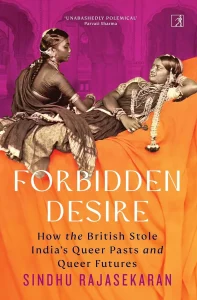
KD: Hello Sindhu! It’s a pleasure to have you with us. First, congratulations on this remarkable book. Reading it has been deeply enriching. From your perspective, how and why is everything personal inherently political? Why did you choose the colonial era as the central framework for understanding censorship? And how does the legacy of colonial politics and anthropology continue to shape our present?
SR: Thank you for your thoughtful questions, Kabir.
I’m a poststructural anti-disciplinarian deconstructionist thinker. So, I’m deeply suspicious of all kinds of self-righteous objectivities. I think one’s subjectivity is quintessential to understanding one’s politics. This is how I read the phrase: “the personal is political.”
When I started researching the colonial archives, I hadn’t set out to write a book about it. As part of my creative writing PhD programme at the University of Strathclyde, I was working on a historical novel about imaginary queer Tamil foremothers. I’d picked the mid-19th century – as the time period interested me (I’m a confirmed history buff). I was looking for traces of queerness in the archives, and for colonial factoids/fictions through which I could construct my storyworld. Lo and behold, I found a deluge of archival material that not only referred to “native” queerness but also records of how the British Empire deliberately criminalized and censured non-heteronormative expressions of gender & sexuality. I was astounded. Then I started reading more critical and historical work on the archives written by stellar decolonial academics like Durba Mitra, Churnjeet Mahn, Anjali Arondekar & Lata Mani. Soon, my PhD took me on a different path, and I became somewhat obsessed with the colonial archives.
The legacy of colonial politics and anthropology continue to inform South Asian culture. The stereotypes and myths about “natives” that the British Empire generated in the Colonial Era still inform South Asian political discourses.
KD: Manusmriti has transformed masculinity into patriarchy and freedom into confinement, particularly for Indian women. Its emphasis on purity is a social construct designed to create rigid binaries within society. You refer to the colonial state as a “Neo-Manu.” What connections do you see between the figure of Manu and the colonizers? In your introduction, you note that the British were interested only in “liberating” Indian women who fit a conventionally hyperfeminine and oppressed stereotype, while simultaneously resisting gender fluidity. Could you elaborate on the distinct forms of oppression at play here?
SR: “Neo-Manu” is a phrase I borrow from Parimala V. Rao’s paper titled: ‘Colonial State as “New Manu”?’ In it, she looks at the how the British Empire reified elite Brahmanical & Islamic prejudices through its educational policies – once again marginalizing the subaltern(ized). Caste, class, ability, gender, and race – were axis along which “natives” were plotted for purposes of reform and civilising in the mid 19th century. One must never forget that the British were/are very feudal in their thinking. Puritanical Brahmanical pundits who helped the colonial State form its administrative laws often drew their spiel from fundamentalist texts like Manusmriti because it fit into the Empire’s Victorian feudal framework – it’s properly patriarchal, casteist, gender essentialist, ascribes masculinity to males and (hyper)feminine subservience to females, it offers severe punishments for transgressions of all sorts.
On the matter of “liberating” Indian womxn – I have spent years wondering how and when this project began. I’ve been working on a book with Aleph Book Company looking into forgotten feminisms from the Indian past. And history shows that troves of womxn from across the socio-economic spectrum participated in the 1857 Rebellion/Mutiny/First War of Independence. This included queens, (fe)male warriors, courtesans, performers, wives, widows, farm workers, labourers, etc. These womxn weren’t appendages to their male counterparts. These were solid, independent, commandeering womxn. How could it be that suddenly by the turn of the 20th century, the British had to come to the rescue of Indian womxn? When did the zeitgeist shift?
As I point out in the book, the British Empire went to elaborate lengths to neutralize “native” womxn’s masculinity and gender fluidity. Which they considered obscene, primitive, wild, and uncivilized. They shamed Indian mxn for not being masculine enough, pushing them into a “crisis of masculinity.” This reflects in the (proto)nationalist/nationalist reform movements where womxn’s “respectability” was often tied to heteronormative marriage. The project of “liberating” Indian womxn was also a project of feminising, domesticating, and (re)forming them to fit into neo-patriarchal frameworks. Reformist Hindu, Islamic, and British paternalism combined forces to (re)imagine how a womxn ought to be, thereby erasing womxn’s agency.
KD: Since its earliest days, India has embraced fluid expressions of sex and gender. Contemporary scholars often point to the Kamasutra as the sole example of this openness. You, however, argue that the text is classist, casteist, and sexually prejudiced. How did you arrive at this interpretation? Why do you believe India’s folkloric traditions treat gender fluidity with greater sensitivity?
SR: I critique the Kama Sutra as it often instrumentalizes the body of subaltern(ized) womxn for the benefit of cis-het male pleasure. The bulk of the book deals with how privileged mxn could get the most out of sex and relationships (within and outside marriage). Vatsyayana was mainly writing for an urbane male audience (the alpha bros of his time), even though he drew his knowledge about sex and pleasure from courtesan literatures/practices. Reading the text in this day and age, it appears sexist and casteist. It hasn’t aged well, let’s say. On the other hand, in neo-conservative India, where womxn’s sexual agency and notions of pleasure are taboo subjects, the text offers a view into how ancient Indian society didn’t exactly shy away from discussing such things.
In fact, erotic/esoteric literature written by courtesans must’ve looked at sex, pleasure, and sexuality from a female point-of-view. We don’t have access to such texts because they were erased in coloniality and postcoloniality (not to mention previous erasures by “native” patriarchs). Muddupalani’s Radhika Santawanam (written in the 18th century) was banned by male reformers for obscenity in the 20th century. If only we could excavate more such texts from the ancient and medieval past, we’d be able to reconstruct a whole different history of desire.
India’s folkloric texts are fascinating, because they are often spontaneous oral texts. These literatures also have particular forms and metres, but they are more about experimenting, pushing the boundaries, free thinking. Plus, it must be pointed out that gender fluidity was more accepted by subaltern(ized) communities given their antiquated pasts and memories that reach far back, to a time before time, when humanity wasn’t so dissociated from nature. Folksongs formulated in fields and mountains, forests and riverbeds, record queer temporalities and fleeting desires in capacious ways unbound by the strictures of elite textual formalism.
KD: Why do you think society continues to interpret Hindu mythology through strictly binary lenses? Today, Vishnu is largely viewed as a masculine deity, yet your book highlights the feminine aspects inherent in his nature—and the same applies to Shiva. When do you believe this shift toward rigid masculinity occurred? What do you see as the primary threat perceived by proponents of Hinduism when addressing same-sex relationships?
SR: I think the Puranic Age is when this shift first occurred. If the Upanishads were all about transcending the body and communing with the soul’s genderless essence, the Puranas often did the opposite. They were gender essentialist, casteist, classist, and ableist. But there are exceptions, like the Markandeya Purana, where a verse called ‘Madalasa’ has queer potential – in it that it questions one’s place in the world. Hypermasculinizing Vishnu and Shiva were political projects to boost the confidence of Puranic patriarchs, I think. Much like today, they needed to (re)imagine their Gods/Icons as figures with six-packs for enthusing their troops.
Fundamentalist Hindu texts have thick patriarchal plotlines. In their scheme of things, men have to be (virile) hypermasculine men and women have to be (fertile) hyperfeminine women to beget prosperous progeny and perpetuate patriarchal bloodlines. The idea of ritual purity is deeply tied to these expectations. So, for the puritanical lot, same-sex relationships were/are at best: useless, and at worst: a visceral threat to the “proper” functioning of the patriarchal order.
KD: You argue that Tantra is “kinky,” and kink is inherently queer—thus making Tantra a queer philosophy. Since the Tantric tradition includes concepts like Ardhanarishvara and sexual liberation, what connections do you draw between kink and what is often called esoteric sexuality? How does this differ from Western understandings of kink, and how might it help individuals discover their sexual identities? Additionally, what are your thoughts on celibacy and its counterpart, polyamory?
SR: Wow, this a topic that will require pages of explanations. I will just say that in subcontinental lore, the erotic and the esoteric are deeply entwined. Sexual liberation can take the form of Tantric sexual union, but it can also be achieved through extreme asceticism – merging the opposite principles within oneself. Kink in this context has several possibilities. Celibates can also be polyamorous, can’t they? Because polyamory isn’t always sexually amorous. Indian mythology and lore contain several references to such possibilities of desire that go way beyond contemporary understandings of kink.
KD: Years ago, a friend told me that when someone calls her a “slut” for embracing her desires, she accepts the label with pride. Apsaras in Hindu mythology have long embodied seduction, yet women who express similar autonomy today are branded as “prostitutes.” Do you think this reflects a colonial hangover? Why are Dalit women more easily targeted with such labels than Savarna women? How do caste and class remain decisive tools for policing a woman’s character, even though such accusations fall under illegal activity according to the IPC?
SR: In the chapter, ‘Who is a “Prostitute”?’ I go deep into colonial codes of female respectability, which I think continue to affect contemporary Indian womxn. In fact, in the beginning, after the Contagious Diseases Act was enacted in British colonies, “native” womxn from across the socio-economic spectrum were typecast as “prostitutes” by authorities. This included Brahmin widows, religious renunciants, “high-caste” courtesans, Muslim polygamous wives, independent polyamorous womxn, performers, traditional practitioners of medicine, labourers, farmers, coolies, female guards – the list was long. In today’s parlance, this means “prostitutes” came from all sections of Indian society according to the British – including Savarna, Bahujan, and Dalit communities.
More often than not, puritanical Brahmin pundits and Islamic maulvis helped the British formulate these codes themselves – deciding which “native” womxn was respectable (and which one was not). As you can imagine, their casteist, racist, classist, and misogynist prejudices must’ve informed these codifications. It is important to point out that they were just as invested in ostracising and punishing sexually agentive womxn who defied the heteropatriarchy.
So, it comes as no surprise that elite “native” patriarchs codified female respectability onto the bodies of womxn from their communities, and marginalized subaltern(ized) womxn by labelling them as prone to sexual transgression. In Bengal, the bhadralok forbid their womxn from interacting intimately with womxn of “lower” castes. There are records of how in early modernity, womxn held all-womxn cultural/religious gatherings where female performers would be invited into their households. These were instances of intercaste/interclass intermingling. But the bhadralok stopped this in the late 19th century, calling it obscene. I wonder what went on in there.
Womxn from subaltern(ized) caste positionalities were often not bound by the strict norms of Brahmanical heteronormativity – which I think is because they have consistently defied the powers that be. I come from an intercaste family and have Dalit ancestry myself. I’ve spent a lot of time researching my Dalit Paraiyan foremother’s pasts. They were a long line of matriarchal Tamil womxn who fought against all odds to survive and thrive. In stories I hear of my great-grandmother’s village, Dalit womxn feature as prominent members of their community. The patriarchs in their lives could not control them. They were exemplars of protofeminist agency.
Dial back to the Colonial Era and think about how this must’ve appeared to the Victorians – obsessed as they were with puritanical notions of gender propriety that forbid womxn from embodying any form of sexual or political agency. Puritanical Brahmin pundits added fuel to the fire by conveniently painting (what we now call) Savarna womxn as respectable and forbidding subaltern(ized) womxn from accessing such respectability. It is no surprise that these colonial ascriptions have stuck on in the Indian imaginary – which for the most part continues to remain casteist, sexist, and classist.
KD: How can a woman’s body function simultaneously as a site of oppression and liberation? In modern India, abortion is heavily criminalized and is treated as a sin by religious conservatives across both East and West. In this context, what role does a woman’s body play when her choice to terminate a pregnancy is deemed criminal? Could you share some raw, unapologetic arguments that challenge the criminalization of abortion?
SR: I’d like to draw from my answer to your previous question for this one too. Once respectability was coded onto the body of the perpetually childbearing heteronormative wife, all womxn who sought to end their pregnancies were labelled as immoral “prostitutes.” In fact, Brahmin widows were typecast as “prostitutes” by the British for this very reason – because they tried to get abortions. When this became public knowledge, Brahmanical patriarchs doubled down on their widowed womxn, marginalizing them further as embodiments of inauspiciousness.
The criminalization of traditional female practitioners of medicine in the Colonial Era was when this calamity broke out full-scale in India
The criminalization of traditional female practitioners of medicine in the Colonial Era was when this calamity broke out full-scale in India, I think. There is ample evidence to show that the Victorians were scandalized by how “native” womxn got abortions left, right, and centre.
It seems to me that even as restrictive religious norms forbid abortion in theory, “native” womxn ended their pregnancies for diverse reasons. The British Empire not only forbid abortion in theory, but also in practise. They legislated against it. Liberating Indian womxn, what a joke.
KD: Marquis de Sade was imprisoned for writing openly about same-sex relations, kink, sodomy, and eroticism—yet his work continued to circulate widely. Many regard him as a catalyst for rape culture in both the West and the subcontinent due to his explicit depictions of sex. What continues to prevent the West from fully embracing gender fluidity? Why does such a clear divide persist between the LGBTQ+ community and the rest of society? And what are your thoughts on reclaiming the word “slut” as a tool of liberation from patriarchy?
SR: Oscar Wilde also went to prison.
Social morality is a constantly changing phenomenon. So, there is hope.
The West is in freefall at the moment. We will have to wait and see what happens.
Reclaiming words as tools of liberation are subjective matters I think, and I’m all for it. I think I’ve done that throughout the length of Forbidden Desire.
KD: Could you recommend some of your favourite books—both fiction and non-fiction—that have shaped your literary journey?
SR: This list could be a book, so I’ll confine myself to suggesting six.
Fiction/Poetry
Virginia Woolf’s Orlando
Fyodor Dostoevsky’s Crime and Punishment
Meena Alexander’s Poetics of Dislocation
Non-Fiction
Alain de Botton’s How Proust Can Change Your Life: Not a Novel
Romila Thapar’s Time as a Metaphor of History: Early India
Madhavi Menon’s Infinite Variety: A History of Desire in India
KD: Lastly, what are your thoughts on our feminist magazine, The Usawa Literary Review?
SR: I am very happy to be included in it. There is much need for spaces where folks can think deeply, question isms, and construct new discourses. The Usawa Literary Review provides such a space. I wish it the very best and hope it continues to grow.

Kabir Deb
Kabir Deb is an author/ poet based in Karimganj, Assam. He works in Punjab National Bank and has completed his Masters in Life Sciences from Assam University and is presently pursuing his MCW from Oxford University, London. He is the recipient of Social Journalism Award, 2017; Reuel International Award for Best Upcoming poet, 2019; and Nissim International Award, 2021 for Excellence in Literature for his book ‘Irrfan: His Life, Philosophy And Shades’. He runs a mental health library named ‘The Pandora’s box to a Society called Happiness’ in Barak Valley. He reviews books, many of which have been published in magazines like Outlook, Usawa Literary Review, The Financial Express, Cafe Dissensus, Sahitya Akademi etc