
KINDNESS four commandments and a caution
Live as a deep-rooted tree, an open meadow, an armored body, always…
Read more →This article interprets László Krasznahorkai's work as a profound maelstrom, challenging the reader's intellectual and primal faculties. It argues his narratives uniquely expose the complex, often beastly "humanimality" of existence, achieved through distinct linguistic precision.
Why do I love the work of László Krasznahorkai?
Discover the books that shape our times
Because he challenges every part of my readerly writerly creaturely brain
Because I am dragged into a maelstrom I know is real—all too real
Because once I’m in—the only way out is through
In that sense, Krasznahorkai’s novels are like life
Without the slightest whiff of the dreary faithfulness of social realism, they fill my head with people and places crises and conflicts that I have always encountered, that I have never encountered, in that particular slant of light
He reminds me that language is the thing that does the work—without working language to death
That sense of ease I owe to the labour of his magnificent translators—George Szirtes, Ottilie Mulzet, John Bakti—who brought him into English, as if only for me
Sustained by a terrific tension, his texts bring to the front and centre of my consciousness our commonhumanimality
We are beasts. Carnivorous apathetic frightened comedic avaricious manipulative proselytising fanatical fearful sycophantic antagonistic parochial bipeds eking out a life so wrenched, so robbed of agency the only thing we do is give in.
We are angels. Idealistic dreamers with notions so removed from the earthly, they can only be seen as manic or delusional or even downright imbecilic. The idiot child of our times is often the only one with a moral compass that twirls so hard it breaks—as if by the sheer force of the immoral magnetic field within which it finds itself.
We are monomaniacal. Our obsessions cannot be explained away by the calm voice of a therapist’s echo chamber. Be it existential (the world as we know it is on the brink of extinction) or epistolary (letters must be written to the German Chancellor, the only person in the world who can fix it); be it intensely personal (the twelve-tone scale of the Werckmeister Harmonies are ‘false to the core’) or exquisitely universal (ice must melt back into the water that it was) the monomaniacs seem to be the only ones unwilling to fall for the comfort of living like marionettes. An idée fixe to save a precious manuscript or see, for instance, the Schaffhausen Falls is all it takes to be a Krasznahorkian hero.
We are escapists. We will make a break for it. Even if it means another forever entrapment, a terrible looping awareness of futility, we will make a break for it.
We are fools. “We think we’re breaking free,” says Irimiás to Petrina in Sátántangó, “but all we’re doing is readjusting the locks. We’re trapped, end of story.”
We are bigots. Small or big, we are entrenched in ways of thinking that we bludgeon others with. When the bludgeon is in the biggest bigot’s hands, we are in danger of being bludgeoned. We save ourselves by gathering under the shadow of the biggest bigot of all, the god in whose image we remake ourselves. Each hates the other as much as the other hates each. Within the airlessness of our own tribe we suffocate to death, thinking we are alive.
We are dancers. We dance in the turgid light of a café at the end of nowhere. There is a drunken din inside us. In endless circles we dance, clinging to the nearest thing we can cling to. High on the prospect of a spectacular violence to come, the night is never too young.
We are hoodlums. Perpetually on the verge of conflagration, all we need is a spark. In our world that spark can be malice or malevolence. In Herscht 07769 it is hatred—racial hatred—the old unmentionable blood disgrace that sets the wolves on fire, as they howl at the big yellow moon that hangs low over a livid land.
We are spectators. We pay to spectate. Be it a massive dead leviathan that passes through a town at the dead of night in an ominous presaging of doom, or a guest lecturer detained in the basement who must deliver his lecture on melancholy, the hall must be packed, the public must pay.
And yes, they do.
*
László Krasznahorkai has quietly resisted the label of the political allegorist or social commentator, even as he has affirmed the power of art as a means of resistance.
Writing for him is a “totally private act”.
In a Paris Review interview, he said: “I’m ashamed to speak about my literature—it’s the same as if you were to ask me about my most private secrets.”
In a world where the writer is increasingly a publicly performing animal, this embarrassment may seem absurd, even disingenuous.
To me, it is the essence of.
A distillate of just how important writing may be.
To talk is to assume a listener. A roomful of listeners is just another kind of noise.
By keeping that room empty, what is written grows into the real conversation: between reader and writer, mind and mind.
Krasznahorkai privileges the contact that needs no mediation but for the translator who will carry his Hungarian into the world.
And in the world, between that writer and this reader, experience gallops like the four horsemen of the apocalypse. We sense:
The force of evil is greater than the forces of good.
Where there is a mob, there is no I.
Where there is no I, there is no seeing.
Blind fury moves through the air like a virus.
Familiar?
As I revisit Sátántangó (1985), The Melancholy of Resistance (1989), War & War (1999), Seiobo There Below (2008), Animalinside (2010), The World Goes On (2013) and Herscht 07769 (2021), I am almost unnerved by how current they feel, how local to when and where I read from.
*
I learn that Krasznahorkai’s original family name was Korin.
Korin is the name he gives to his protagonist in War & War.
Korin has discovered a manuscript in a ‘far-off archive in distant Hungary’ that must be saved. Korin believes it must be taken to New York. He takes it there, ‘to the terrifying core of the city that was the centre of all their hopes’. And in the course of putting this ‘Glorious Work’ on the world wide web—the only place where it might achieve the eternity it deserves—Korin has an epiphany which he shares with the interpreter.
The order in the sentences—almost celestial, one imagines—is belied by the crazy collapse where ‘language simply rebels and refuses to serve, will not do what it was created to do, for once a sentence begins it doesn’t want to stop, not because … of incompetence, … but because it is driven by some crazy form of rigor, as if its antithesis—the short sentence—led straight to hell’.
It is in this ‘complete catalogue of the capabilities of language’ that Korin believes those sentences achieve the importance of life and death, building towards a terrific complication.
Isn’t it just that terrific complication that Krasznahorkai addresses through the life-and-death urgencies his people bring to their tiny existence? If, as Valuska reminds us, darkness is not all, and all we have to do is step into boundlessness to find beauty and quietude, why does it not happen more often?
I realise that against the dirty messy business of life that unfolds in all its banality, cruelty and crudity in Krasznahorkai’s books, more than one character is fascinated by the cosmological, even if—or maybe because—it is an imagined cosmos, a ‘heavenly mechanism driven by some hidden motor of enchantment and innocence’. There is, you see, on the periphery of our peripheral vision—eternity.
*
While the themes of apocalypse and totalitarianism have always been apparent, what struck me vividly on my return to Krasznahorkai is the unlikely theme of ‘friendship’.
Eszter the musicologist in The Melancholy of Resistance loves Valuska, the carrier of his daily meal, the trustiest of dabbawalas! While Eszter acknowledges that he loves him the way a ‘lonely lepidopterist might love a rare butterfly’, Valuska cannot believe one so respected and learned should consider him a friend.
In similar vein, Florian Herscht cannot believe there’s anyone kinder than his Boss, who cuffs him constantly as if he were a disobedient brat instead of a faithful follower, amenable to every command. His gratitude is beyond measure, for without the Boss where would he be? This Boss—not only of a graffiti-cleaning outfit but of a neo-Nazi vigilante gang that commits arson and murder—is to be valiantly guarded from the slightest hint of infamy, such is the extent of Florian’s devotion.
If the Boss is the falsest of friends, the most sinister of masters—visibilised in a way the mysterious Prince in Sátántangó was not—Herr Köhler the weatherman is the kindest of mentors. Florian fluctuates between the two of them like a feverish child, frantic over the disappearance of one and gutted by the deception of the other. The truth about his beloved Boss tears apart the fabric of his blindly loving soul. The animal inside emerges, the hunted turns hunter, and a feral justice is done.
*
In Animalinside (a collaboration with the artist Max Neumann), Krasznahorkai lays out what we sense in every work of his: the enemy is inside, and it is invisible.
In section VI, you will encounter a voice that you recognise down to the chill in your bones, the gooseflesh on your arms:
‘in vain do you prepare against me… I will strike down upon you, and you will not be able to do anything against me, because I am inexplicable… be terrified …’
The animal who must be fed, who calls the one who feeds him ‘my little master’, ingratiates and wheedles, rants and bullies, threatens and grovels. Together, when they have destroyed everything, leaving not even ‘a dog-eared page from a copy of the penal code’, there will be only one question: which of the two shall be king.

I learn that Andreas Werckmeister—who lends his name to the title of Béla Tarr’s film based on Krasznahorkai’s Melancholy of Resistance—was the 17th century organist who gave Western classical music its equable temperament with a series of mathematical rearrangements that boggle my mind just looking.
I learn these well-tempered tonalities so despised for their unnaturalness by fictional Eszter were much loved by historical Bach.
I remember that in Seibo There Below, a 64-year-old architect speaks of his private passion: music, the ‘faultless eloquent melody’ of the Baroque, its sublime essence embodied by—Bach.
What does it mean that Bach is the presiding deity of Florian Herscht’s Boss? The Boss’s evangelising with a vengeance has no effect on poor Florian. He cannot love Bach by listening to amateurs grinding it out. It is only when he seeks Bach out on his own that he begins to hear him. This gentle Luddite giant receives music like a sacrament through the bewildering, unaffordable gizmos of his age. As he lopes through the Thuringian countryside, looking to avenge the loss of faith—in the man he thought was god—Florian has internalised Bach to the point where he hears him like a perpetual soundtrack in his head. Tricked by the Boss he revered, shocked by the facts that he had refused to admit, Florian disengages from it all—society, technology, solidarity.
In a world riven by hate, what price, solidarity?
I think of Mihály Vig’s hypnotic score, the unforgettable opening scene in Werckmeister Harmonies.
I learn that Krasznahorkai was a musical prodigy.
For him, and Tarr, the music of the spheres could well be danced, could well be the silence contained in a single drop of water, each drop a perfect sphere.
The world goes on.
I look at ‘The Swan of Istanbul’, written in memory of Konstantinos Kavafis: seventy-nine [invisible] paragraphs on blank numbered pages, anchored by meticulous footnotes that tell the story of the writing that isn’t there—and I know, afresh, just why I love the work of László Krasznahorkai.
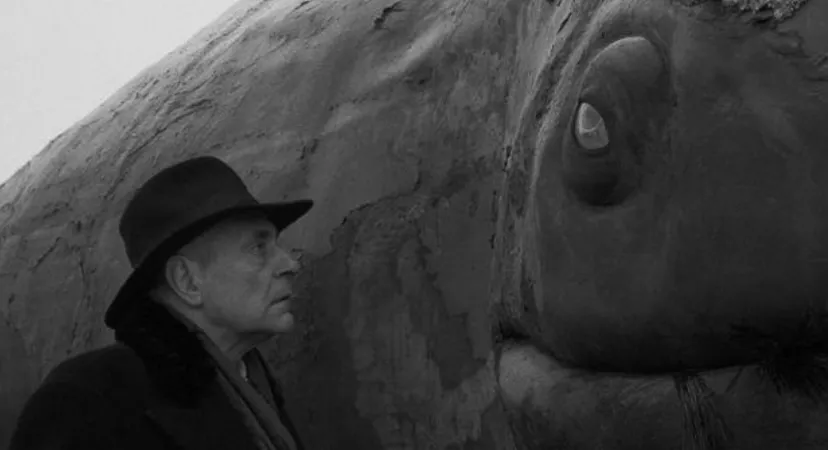
On 6 January 2026, Béla Tarr passed away.
The man who said he learned filmmaking more from painters and musicians than from other filmmakers taught me a new way of reading and seeing. Rest in peace and long takes…. and the question

Sampurna Chattarji is a writer, editor, translator and teacher with twenty-one publications to her credit. These include Space Gulliver: Chronicles of an Alien (HarperCollins 2015, 2020), which she wrote while on residency at the University of Kent, Canterbury; Dirty Love (Penguin 2013), which is her short story collection about Bombay/Mumbai; and Wordygurdyboom! (Puffin Classics 2008), which is her translation of Sukumar Ray’s poetry and prose. Her translation of Joy Goswami’s prose poems After Death Comes Water (Harper Perennial, 2021) has been lauded as a recreation of the Bangla originals in ‘a living voice, as inventive and vivid as the English of Joyce’. Sampurna’s work as an editor includes Future Library (Red Hen Press 2022) an anthology of contemporary Indian writing released in the US. The most recent of her eleven poetry titles is Unmappable Moves, just out from Mumbai-based indie-press Poetrywala. She can be found on Instagram as @ShampooChats.