
Review: That’s a Fire Ant Right There
Khadeer Babu's work delineates a transitioning Indian small town's complex social realities,…
Read more →This morning, a neighbor's spade evokes mother's garden, fragrance as home. Potatoes, black cats, dreams shared with sisters bloom on the tongue.
This morning,
when I heard my neighbour’s spade
rub against the earth outside my house,
I thought of my mother’s garden.
The grounding perfume,
and the wild weed’s breath,
made me think of her warmth.
Sometimes home is a fragrance,
warm and dear.
***
This morning,
I woke up
and lingered in a quiet pause,
thinking of boiling potatoes
with herbs from my mother’s garden.
Oh, they would taste wonderful
with smoked meat curry from last night.
I woke up,
eager to greet
the sweet adventures
of daylight.
***
This morning,
I woke up
next to my cat,
a gorgeous black cat.
How she slept in stillness,
unbothered by the murmurs of the world.
I envied her,
and thought to myself
that I could be a black cat someday,
unaware of weary thoughts
and the weight of the mundane,
just be fed and pampered.
***
This morning,
I called my sister,
to tell her
about the beautiful dream
I had of her last night.
Beautiful dreams should be told
in the morning.
The day will bloom brighter,
and the heart, happier.
A good dream makes you
survive a long prosaic day.
***
My father loves watermelons
but he calls them cucumbers.
He just wouldn’t agree
that watermelons are not cucumbers
and cucumbers are not watermelons.
It is April,
and watermelons are in abundance.
My father brings them home
each time he goes to the market.
This afternoon too,
he bought watermelons
from the farmer’s market
and said, Let’s have some cucumbers.
Father, they are watermelons, I said.
But we don’t have a word for watermelon
in my mother tongue.
We call them cucumber
in my mother tongue,
my father replied.
***
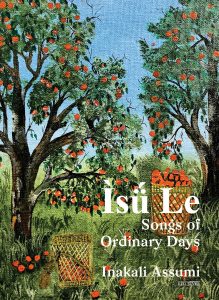
My family had an orange farm when I was little.
December days were always filled with
cheerful fragrance of oranges.
Our orange trees
bent to the fruits they bore,
and the part of the fertile mountain it grew in
was painted with colours of greenish yellow and peach.
December
meant harvesting truckload of oranges.
Orange peeling
and orangey yellow hands
marked our childhood years.
How we loved those bright-sunny
and fragrant winter days.
Father would take us down the hills,
and our tiny hands would each pick an orange
to fill the bamboo baskets one at a time.
When I was very little,
I remember my father being young
and my mother, so radiantly youthful.
There were no wrinkles on their skin then.
Their youth resembled the oranges we picked —
plump and luscious.
I have always had a deep liking for oranges.
Not ever did I wonder
why I have always affectionately loved them,
until this afternoon
when I stumbled upon this part of my childhood,
while walking by the alley of unvisited memory lane.
***
Excerpted with permission from Ìsǘ Le Songs of Ordinary Days by Inakali Assumi published by Red River 2025

Inakali Assumi is an author, researcher, and an educator. She has a PhD in English literature. She is actively involved in research related to revival and preservation of vulnerable cultural heritage, particularly folk songs, and has been awarded the Samvaad Fellowship enabled by Tata Steel Foundation in 2022. Her short story, ‘The Yellow Dress’ has been included in the post-graduate course of the Department of English at St Joseph University, Nagaland. Some of her books are Voices from the Forgotten Village, a novel; The Yellow Dress, a collection of short stories; and a Sümi drama, titled Niphu lo Athi Kütsüghü Potigha Ighi (The Arrival of Rice Mill in Our Village: A Three Act Drama in Sümi), which is the first drama written in Sümi dialect. Her works have been a subject of research by young scholars for their cultural relevance. She has directed and produced a documentary film, A Documentation of Vanishing Sümi Folksongs, which showcases a number of ancestral Sümi folk songs almost on the verge of extinction with no folk singers to carry them forth.