
Review: That’s a Fire Ant Right There
Khadeer Babu's work delineates a transitioning Indian small town's complex social realities,…
Read more →Arunachal Pradesh breathes in verse. Oral histories echo: lost scripts devoured, hunts under moonlight, and Mopin's rhythms. Memory's river flows, ancestors sing.
The story of lost words
still haunts us.
We are accused
of lacking history and authenticity.
Our oralities dismissed as hearsay.
And so,
we suffer an excess of absence
in all tongues
born of a scribal world.
In the beginning, our gods gifted
symbols, signs and scrolls,
etched on leather, bark and leaf.
But struck by a tragi-comedy,
they were munched in hunger
by goats, lambs or dogs
or drowned
in raging flood and river.
Even
Tani, in hunger,
resorted to the leather fragments
symbols, signs and scrolls.
All lost!
In memory, we survived
our stories to narrate; we aspired
in shaman’s magic chants,
grandmothers grey with memories,
indulging eager ears and drowsy eyes
urging us to recollect
words faster than thought —
all flowed like a swollen river
lapped by the dry pen
marked and signed by modern voices.
So sang our stories —
our parchment gone
but the mind is a game
and
to win is to remember.
Stories are enough
to fill the void of empty skies.
My modern mind is
drawn to ancestors
whose songs we still sing today.
Almost every tribe in Arunachal Pradesh does not have a written script. Surprisingly, each has a story of how they lost their script. In Galo tribe, the written word is called as Boi Bola. The story goes that our ancestor Abo Tani (Father Tani) was given the knowledge of script written on a dried skin of an animal by a benevolent Uii (Spirit). Due to hunger or by mistake, Tani ate the dried skin and the knowledge of Boi Bola was lost to us forever.
***
Who are we? What is our place?
Questions assail as eyes turn grey
while nations walk a thousand miles
to draw lines across familiar terrains
and mark territories for every faith.
Are we ancient forest beings
or a race beyond tall mountains
or born from mighty rivers
or from across valleys up north
or of misty clouds, we rained?
Fathers tell tales of lore
Of Golo Yorbo, a mountain range
and long days and long trains
of sleepless nights and hungry tides
of shallow breath and abated thoughts.
Mothers tell tales of hope,
with prayers and lullabies,
under gleaming stars that open paths,
toward hidden places, where years await
with songs and warm beds.
Nyibo’s machetes echo rhythms
ancient hums in dark wombs
across unseen realms, guiding souls,
where shadows dance, he wades,
shedding the weight of wandering years.
***
Every full moon
our ancestors gathered
by the river’s edge
with gleaning machetes
and arrows of bamboo,
to enter
the prelapsarian forest,
standing grim and
silent as a shroud.
The forest is witness
to the birth of sons and the death of fathers.
Tribes live by the rule
that every man is a child of the forest.
Generations fathered this way,
old blood in young bodies
body and jungle
of the same seed.
So, in the glowing moon,
men cast shadows without a care.
The cool light of the night
discloses shadows perched
on tall, black branches.
Creatures of the dark
sing primaeval songs
of the hunter and the hunted
in a maddening dance of
hide and seek.
***
Mopin drizzles are the softest;
the April showers, in brief respite,
reveal revelling sounds of the clan,
and a heady rush of earth and grass
enraptures us in their soft embrace.
A sea of white, radiant
the altar in bamboo tassels,
laden igin, with itte and poka
the nyibo dances in rain and sun,
the ponu, in tandem, rush to his call.
The Mopin feasts warm by fire,
pobar-poka flows for days;
ancestors recalled with oblations
each igin, on women’s backs,
laden with blessings and Ai-Agam.
***
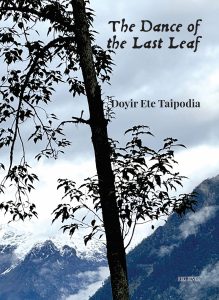
Excerpted with permission from The Dance of the Last Leaf by Doyir Ete Taipodia published by Red River 2026
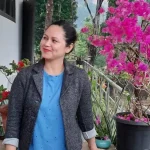
Doyir Ete Taipodia is an Associate Professor in the Department of English at Rajiv Gandhi University in Arunachal Pradesh. Her research interests include oral narratives, memory, and cultural studies, particularly concerning tribal communities. Several of her poems have been published in Prayaas, a literary magazine of the Arunachal Pradesh Literary Society (APLS), and in Matrix Anthology, published by the North East Writers Forum (NEWF). She has also co-edited Matrix Anthology, Vol I, and Vol II in 2022 and 2025. Additionally, she regularly contributes literary reviews to The Arunachal Times, a daily publication from the state of Arunachal Pradesh.