
Review: That’s a Fire Ant Right There
Khadeer Babu's work delineates a transitioning Indian small town's complex social realities,…
Read more →A city sings—rickshaw leather, crow cries, rain-soaked streets. This collection maps forgotten corners, its sharp voice a cartographer’s, charting histories textbooks omit.
a lemon sapling in between the cracks of the sidewalk, an old man in a milkmaid costume, the tousling krishnachuras, a wilting leaf in the blue faux-leather seat of the rickshaw waiting for the passenger: the tattering edges, the holes, the tears
here, in this city, raindrops roar like women squatting down in the middle of rice-fields to push out rickety babies from their insides
the irrepressible stammer of a begging bowl, the shriek of the lorry tyres on rain-soaked streets, the irritable blare of agitated fingers on car horns, the broken voice of the six-year-old boy hawking mangoes — amid these chimes of obsequious diligence, a woman with coarse palms, turmeric and ink-stains on finger-tips, bends her hips to touch the broken leather between her toes
a quiet moment that arrives accompanied by a bell-banging orchestra, yet this is that crucial juncture when her feet fail to own the city’s bone-marked history
betwixt the shark-toothed comb in a man’s pocket and the crowded grime of a local train is an oft-forgotten lesson: never ignore to learn to read the cartographers’ whims
***
a tessellation of accidents, a broken quest: the moment
when the city becomes the shared thesaurus
of all we have been wanting to write
taut line-breaks, belaboured end-rhymes, a list,
a suppurating moth wing: a tumescent lychee
birds mistaking the streetlights as sun
what if the secret historiographies of our homes
were written in the crowded porches
across oceans? what if every folktale
that we’ve tattooed on the floor of our terrace is a cry — a cry
without words, a cry beyond words
a waterfront too inhibited to wipe off
the fingerprints of sailors, cartographers and clerks
a belated memorial for those who were made to leave
a dying river unable to respond in metaphors
across the once-famous cafe, a mythic
carpenter: busy chiselling banyan trees out of old
bookshelves, cupboards and dressing tables
this is how a table is sutured
the sound of the needle tying the threads
reverberates through every home in the city: this sound
of memories walking out
of the termite-infested pages of an album
***
the morphology of this language arrives before me — a shrunken
skeleton from a long-forgotten museum
the syntax of the aforementioned tongue
appears in this citation though as a remembrance of prohibition
an unnecessary training ground
whereby, constraints are not carved into cartilages,
embargoes do not mutate into excavations,
obstructions do not transmogrify into ossuaries
in this unknitting of the yarn, what is not delivered is a shriek —
the imagination of a howl
the imagination of a war cry
the imagination of something between the two
revamps into a harmless contract
***
the morning siren loves to break all pronouns into chipped earthen cups
a limestone chapel in the middle of coconut trees
the church-bells ringing, the untuned cymbals of an evening sankirtan, the azaan, the rare raven next to the bough of an autumn-depleted palash : the city
is an exercise in incongruence
unmaking of the photocopy of what came before
of elsewhere
re-mythologisation, paralysed
to say that blood has seeped
into everything we touch,
taste, linger upon
is a cliché
yet, you do not renounce
that oft-repeated brittleness
for the opulence of a new blue-seamed shirt
you know, crumpled arrest warrants
are countries in their own right
***
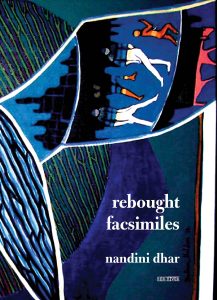
Excerpted with permission from Rebought Facsimiles by Nandini Dhar published by Red River 2024
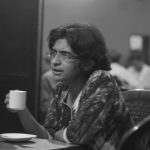
Nandini Dhar is a bilingual poet who writes in English and her native language Bangla. She is the author of the book Historians of Redundant Moments (Agape Editions, 2017) and the chapbook Occupying the Tongue (Aainanagar Prakashani, 2017). She has also written four full-length collections of poems in Bangla. She is an educator by profession, edits the bilingual journal Aainanagar, and divides her time between Delhi, the national capital of India and her hometown of Kolkata.