
Review: The Struggle
*The Struggle* dissects how patriarchal village economies and nationalist movements rendered peasant…
Read more →Scandal's weight confines Phulmoti. Whispers and averted eyes sting. To clear her name, should she embrace the accusations, a dark joke played
Phulmoti didn’t like to step out of home nowadays. Whoever she ran into looked at her very strangely. She had gone to speak to Golbanu one day, but she turned her face and walked away without saying a word. Motijaan’s Ma was an old day. She even berated her, ‘Chee! How did you become so reckless, Phulmoti?’
The matter plagued her thoughts all the time. How could she be relieved of the scandal that was being cooked up? Should she go from house to house and tell people that whatever Sabratu was saying was all false? Would anyone believe her? Would she be free of blame if she asked Qutubali to leave, and he did go away? Once a woman’s name was sullied, did she stain ever get removed? What, then, was she to do?
Should she do whatever they wanted? Go one morning to the landlord’s house, and once there tell the landlord’s son, Majibar: ‘I’ve come to you, do whatever you want.’
Or should she grab the Munshi’s hand, on his way home from the mosque after concluding the Isha prayer at night? And say to him, ‘Come, you wretch, come to the mosque, and marry me there.’
As for Sabratu, she could move into his house at any time. Maybe she’d go and wake him up right in the middle of the night, and say, ‘Here you are, young man, take me into your household. Call your woman, I have no objections to becoming her maidservant.’
Despite her apprehensions, she felt like laughing as she imagined herself doing so. There’d be an uproar if she actually went through with any of those ideas. Which wife would tolerate a loose woman snatching away her husband like this? It would be bad enough if she went to the landlord’s house, or to Sabratu’s, but if she went and held the Munshi’s hand, all hell would break loose.
[Page No. 115]
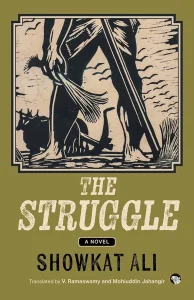
Excerpted with permission from The Struggle by Showkat Ali translated Mohiuddin Jahangir and V. Ramaswamy published by Speaking Tiger Books 2025.
Showkat Ali (1936–2018) was a renowned Bangladeshi novelist, short story writer and journalist whose work explored history, class and identity in Bengali society. Born in Raiganj, he began his career as a journalist and teacher, later gaining recognition for his fiction, which often wove together folklore and the struggles of ordinary people. His most celebrated novel, Prodoshe Prakritojon (1984), is considered a landmark in Bangladeshi literature for its vivid portrayal of marginalized communities in the Sena Empire. He received multiple literary awards, including the Bangla Academy Literary Award and the Ekushey Padak, one of the highest civilian honours in Bangladesh.

Mohiuddin Jahangir was born in Manikganj Sadar Upazila, Bangladesh, and obtained his PhD in Bengali from the University of Dhaka. He has had a longstanding engagement in field research on the Liberation War in Manikganj district. He is currently Assistant Professor in Khabashpur Adarsa University College. His articles on literature, history and heritage have been published in scholarly journals, and he is the author of seven books.V. Ramaswamy took up literary translation from Bangla after two decades of social activism in favour of the labouring poor of Kolkata. The writers he has translated include Subimal Misra, Manoranjan Byapari, Adhir Biswas, Shahidul Zahir, Mashiul Alam, Swati Guha, Shahaduz Zaman and Ismail Darbesh. He was awarded the Translation Fellowship by the New India Foundation, and the English PEN Presents award in 2022.